

Radio Control: Pylon Racing
Bill Hager 4 Holly Springs Dr. Conroe, TX 77302
As I'm writing this, 102 competitors are headed for Madera, California, just outside of Fresno, for the first annual RC Unlimited Air Races. Pilots will be racing for over $25,000 in cash and prizes. It should be very exciting! More on this race as I get it.
New Twists
Here are some quick notes on some new things, or some old things with new twists:
- Jennings Products, P.O. Box 1121, Hendersonville, TN 37077-1121, offers a handy-looking model aircraft carrier and storage rack. Write for more information.
- Gary Walker Custom Building, 309 Pine Ave., Cocoa, FL 32922. If it flies, Gary will build it. Gary has produced a great many good Q-500s.
- For those looking for more strength with very little weight gain, try Bradley Model Products, 1337 Pine Sap Ct., Orlando, FL 32825, and Composite Structures Technology (CST), P.O. Box 4615, Lancaster, CA 93539. Both companies supply carbon fiber, Kevlar, and fiberglass products useful for strengthening pylon racers.
- For those who have attended the AMA Nationals the last couple of years and marveled at how quickly and precisely race results were posted, the man behind it all is Paul Page. Paul has been working pylon races for many years and has developed a very good program for pylon racing. For more information, contact Paul at 46 Debra Lane, Bristol, CT 06010-2725.
Running the Webra Q-500 Engine with a Dynamax Carb
(from the PROPS Newsletter — Pete Bergstrom)
The new Quickie 500 engine from WEBRA is fantastic — it turns great rpm and has been making heads turn on the Q-500 circuits over the past year. There have been some problems running this engine with the Dynamax (Slide Bar) Carb that a few people have encountered. I'm hopeful that what I present here may solve some of those problems.
Muffler Pressure:
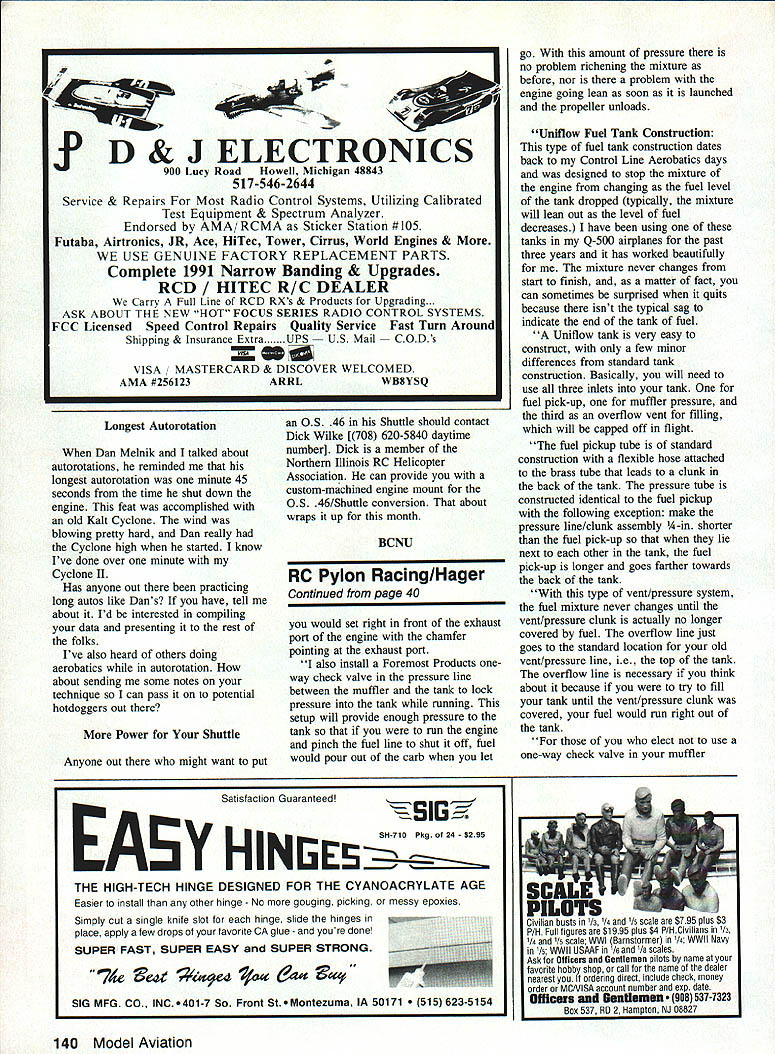
- The Dynamax Carb needs lots of muffler pressure. This carb was originally designed for Pattern competition to be used with a tuned pipe, which provides a tremendous amount of pressure.
- The muffler provided with this engine in previous versions does a less-than-adequate job of providing pressure to the tank in the typical pressure-tank installation.
- You can solve this problem by installing a slightly modified brass piece from a DuBro fuel can cap fitting as a one-way check valve in the pressure line between the muffler and the tank. This locks pressure into the tank while running.
- With this setup there is enough pressure to the tank that if you run the engine and pinch the fuel line to shut it off, fuel will pour out of the carb when you let go. With this amount of pressure there is no problem richening the mixture as before, nor is there a problem with the engine going lean as soon as it is launched and the propeller unloads.
Uniflow Fuel Tank Construction
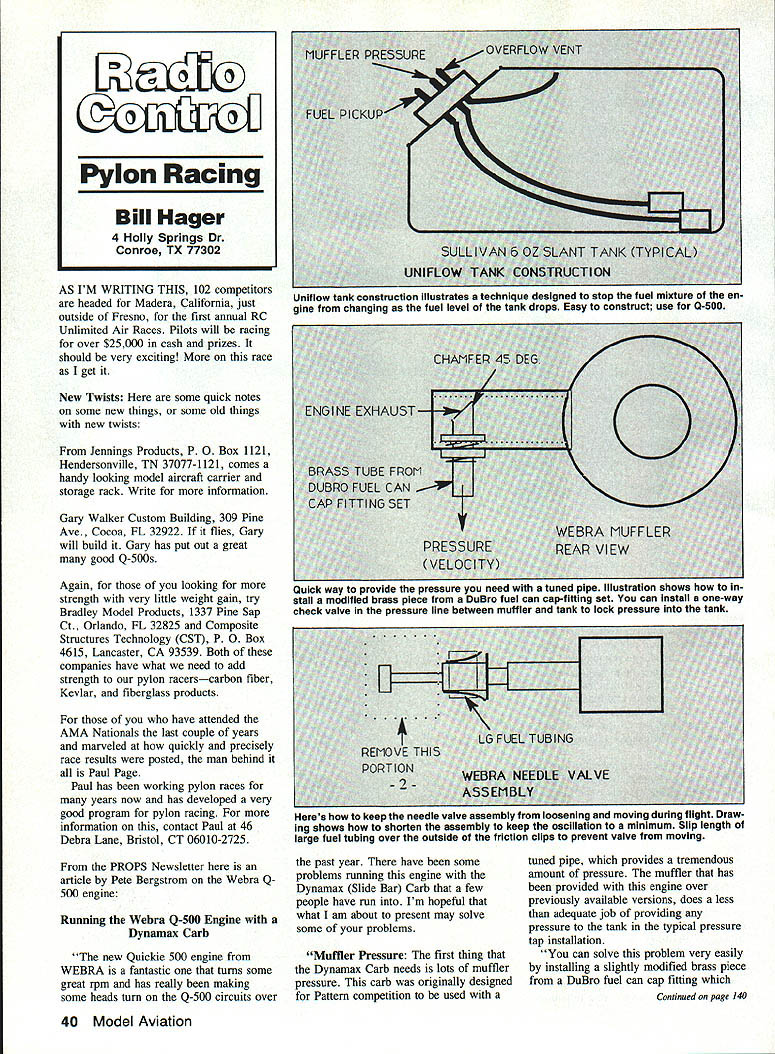
This type of fuel tank construction dates back to my Control Line Aerobatics days and was designed to stop the engine mixture from changing as the fuel level in the tank dropped (typically, the mixture will lean out as the fuel level decreases). I have been using one of these tanks in my Q-500 airplanes for the past three years and it has worked beautifully for me. The mixture never changes from start to finish; as a matter of fact, you can sometimes be surprised when it quits because there isn't the typical sag to indicate the end of the tank of fuel.
A Uniflow tank is very easy to construct, with only a few minor differences from standard tank construction. Basically, you will need to use all three inlets into your tank: one for fuel pick-up, one for muffler pressure, and the third as an overflow vent for filling, which will be capped off in flight.
- The fuel pickup tube is of standard construction with a flexible hose attached to the brass tube that leads to a clunk in the back of the tank.
- The pressure tube is constructed identically to the fuel pickup with the following exception: make the pressure line/clunk assembly 1/4 in. shorter than the fuel pick-up so that when they lie next to each other in the tank, the fuel pick-up is longer and goes farther toward the back of the tank.
- With this type of vent/pressure system, the fuel mixture never changes until the vent/pressure clunk is actually no longer covered by fuel. The overflow line goes to the standard location for your vent/pressure line, i.e., the top of the tank.
- The overflow line is necessary because if you were to try to fill your tank until the vent/pressure clunk was covered, your fuel would run right out of the tank. When refueling, you will have to clamp the muffler pressure line to prevent the fuel from siphoning and running out of your muffler.
Needle Valve Assembly:
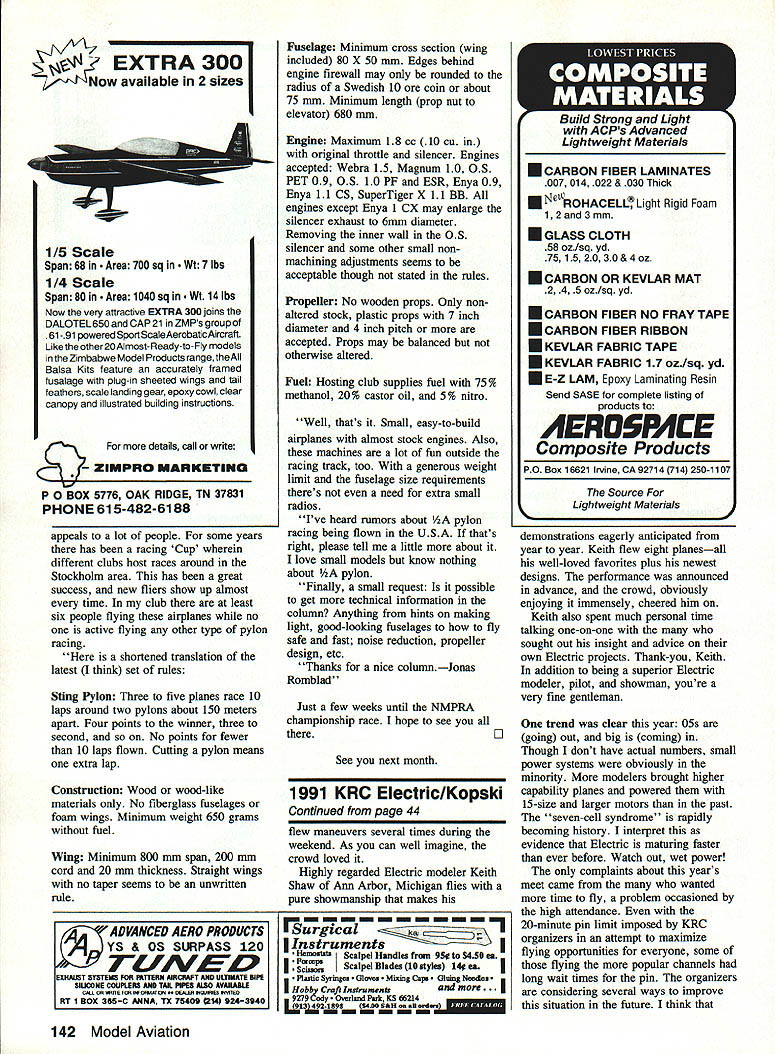
- Another criticism of this engine is that the needle valve assembly loosens and moves in flight. Because of the length of this assembly, it has a tendency to vibrate and oscillate back and forth at high rpm — especially if the propeller is not perfectly balanced.
- A simple and reliable fix: shorten the needle assembly as shown in the accompanying drawings, then slip a short length of large fuel tubing over the outside of the friction clips installed on the needle valve assembly. This will increase the friction and prevent the needle from moving.
A quick evening's work doing these three things to your tank and engine will result in an engine/tank combination that is reliable, not twitchy on the needle, and that will provide a tremendous amount of pressure. Of course, all of these ideas will work as well on the TN-Carb-equipped Webra Q-500 motors, but I seem to be able to get a couple hundred more rpm out of the Dynamax carb. I really hope this helps some people out. — Pete Bergstrom
Thanks, Pete. That advice sounds great! Now for some input from Jonas Romblad in Stockholm, Sweden.
Letter from Jonas Romblad (Stockholm, Sweden)
"I recently read in your Pylon column in Model Aviation (September 1991) that there are no good classes for beginners to try pylon racing in the United States. In Sweden the interest for F1 racing is rather small, and that also goes for most other types of pylon racing. This is probably because of the cost and complexity of the material as well as the fact that very few clubs have paved runways. Also, noise has been quite a problem over here for a long time.
One class that appeals to a lot of people. For some years there has been a racing 'Cup' wherein different clubs host races around the Stockholm area. This has been a great success, and new fliers show up almost every time. In my club there are at least six people flying these airplanes while no one is active flying any other type of pylon racing.
Here is a shortened translation of the latest (I think) set of rules:
- Sting Pylon: Three to five planes race 10 laps around two pylons about 150 meters apart. Four points to the winner, three to second, and so on. No points for fewer than 10 laps flown. Cutting a pylon means one extra lap.
- Construction: Wood or wood-like materials only. No fiberglass fuselages or foam wings. Minimum weight 650 grams without fuel.
- Wing: Minimum 800 mm span, 200 mm chord, and 20 mm thickness. Straight wings with no taper seem to be an unwritten rule.
- Fuselage: Minimum cross section (wing included) 80 x 50 mm. Edges behind engine firewall may only be rounded to the radius of a Swedish 10-öre coin (about 7.5 mm). Minimum length (prop nut to elevator) 680 mm.
- Engine: Maximum 1.8 cc (.10 cu. in.) with original throttle and silencer. Engines accepted: Webra 1.5, Magnum 1.0, O.S. PET 0.9, O.S. 1.0 PF and ESR, Enya 0.9, Enya 1.1 CS, SuperTiger X 1.1 BB. All engines except Enya 1 CX may enlarge the silencer exhaust to 6 mm diameter. Removing the inner wall in the O.S. silencer and some other small non-machining adjustments seems to be acceptable though not stated in the rules.
- Propeller: No wooden props. Only non-altered stock plastic props with 7 in. diameter and 4 in. pitch or more are accepted. Props may be balanced but not otherwise altered.
- Fuel: Hosting club supplies fuel with 75% methanol, 20% castor oil, and 5% nitro.
"Well, that's it. Small, easy-to-build airplanes with almost stock engines. Also, these machines are a lot of fun outside the racing track, too. With a generous weight limit and the fuselage size requirement there's not even a need for extra small radios.
"I've heard rumors about 1/2A pylon racing being flown in the U.S.A. If that's right, please tell me a little more about it. I love small models but know nothing about 1/2A pylon.
"Finally, a small request: Is it possible to get more technical information in the column? Anything from hints on making light, good-looking fuselages to how to fly safe and fast, noise reduction, propeller design, etc.
"Thanks for a nice column. — Jonas Romblad"
Just a few weeks until the NMPRA championship race. I hope to see you all there.
See you next month.
Bill Hager 4 Holly Springs Dr. Conroe, TX 77302
Transcribed from original scans by AI. Minor OCR errors may remain.

