
Radio Control: Pylon Racing
Bill Hager 4 Holly Springs Dr. Conroe, TX 77302
THIS MONTH'S column features the final section of the series on finishing your Pylon Racer.
Before finishing up, a correction: the last time I listed kit manufacturers I left someone out. Paul's Flying Stuff has been in business for a long time. Sorry, Paul!
Items sold by Paul's Flying Stuff include:
- Cosmic Wind — Formula I Racer
- Denight Special — Formula I Racer
- Thunder Quickie II
- Bar Stock Motor Mounts
- X40, K&B, O.S. .40, VRP
- Quickie 500
For more information, write: 1281 Rincon Rd., Escondido, CA 92025; Tel. 619/743-5458.
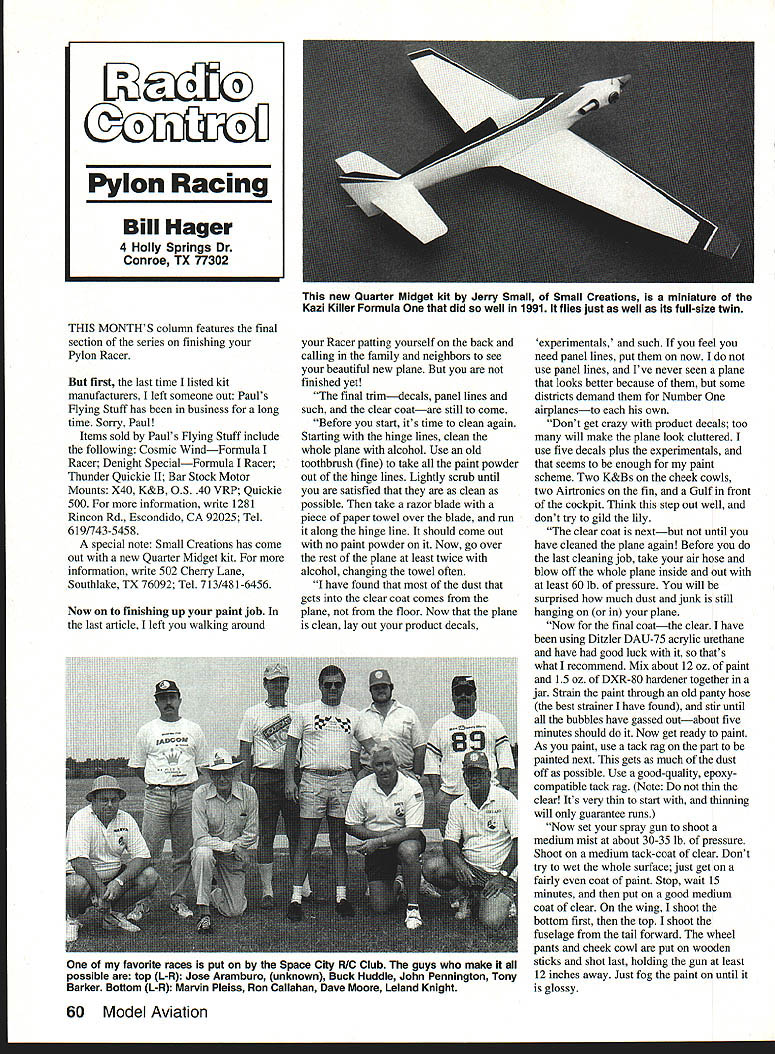
A special note: Small Creations has come out with a new Quarter Midget kit. For more information, write: 502 Cherry Lane, Southlake, TX 76092; Tel. 713/481-6456.
Finishing the Paint Job
In the last article I left you walking around your Racer patting yourself on the back and calling in the family and neighbors to see your beautiful new plane. But you are not finished yet! The final trim—decals, panel lines and such, and the clear coat—are still to come.
Before you start, clean again. Beginning with the hinge lines, clean the whole plane with alcohol. Use an old toothbrush (fine) to take all the paint powder out of the hinge lines. Lightly scrub until satisfied they are as clean as possible. Then take a razor blade with a piece of paper towel over the blade and run it along the hinge line. It should come out with no paint powder on it.
Now go over the rest of the plane at least twice with alcohol, changing the towel often. I have found that most of the dust that gets into the clear coat comes from the plane, not from the floor.
Lay out your product decals, "experimentals" and such. If you feel you need panel lines, put them on now. I do not use panel lines, and I have never seen a plane that looks better because of them, but some districts demand them for Number One airplanes—to each his own.
Don't get crazy with product decals; too many will make the plane look cluttered. I use five decals plus experimentals; that seems to be enough. For example:
- Two K&Bs on the cheek cowls
- Two Airtronics on the fin
- A Gulf in front of the cockpit
Think this step out well, and don't try to gild the lily.
Preparing for the Clear Coat
Before the final cleaning, take an air hose and blow off the whole plane, inside and out, with at least 60 lb. pressure. You will be surprised how much dust and junk is still hanging on (or in) your plane.
I have been using Ditzler DAU-75 acrylic urethane for clear coat and have had good luck with it. Mix about 12 oz. of paint with 1.5 oz. of DXR-80 hardener in a jar. Strain the paint through an old pantyhose (the best strainer I have found), and stir until all the bubbles have gassed out—about five minutes should do it.
As you paint, use a tack rag on the part to be painted next. Use a good-quality, epoxy-compatible tack rag. Note: do not thin the clear! It is very thin to start with, and thinning will only guarantee runs.
Set your spray gun to shoot a medium mist at about 30–35 lb. of pressure. Shoot a medium tack-coat of clear. Don't try to wet the whole surface; just get on a fairly even coat. Stop, wait 15 minutes, and then put on a good medium coat of clear.
On the wing, shoot the bottom first, then the top. Shoot the fuselage from the tail forward. Put the wheel pants and cheek cowl on wooden sticks and shoot them last, holding the gun at least 12 inches away. Just fog the paint on until it is glossy.
The hardest part of shooting clear coat is knowing when to stop. You will find yourself squinting, looking for dry places to give the last squirts. You usually have enough paint; too much will cause runs. Now put the gun down and walk away from the plane for at least half an hour. Have a cup of coffee or a cold drink and get away.
After a break, come back, clean the gun and look at the plane. The paint will be dry to dust in about half an hour. Don't touch it for at least 12 hours; 24 hours would be better. In that half hour the paint will flow out and film over what you see, and it will look completely dry. Check for runs or large pieces of dust trapped in the clear coat. If unacceptable areas remain, wait about 36 hours after shooting the clear coat to block sand them. Use old #600 paper and machine polish (good polish like Mothers) with a 6-inch lambs wool wheel attached to an electric drill.
Secrets for a Good Clear Coat
- Preparation — clean the plane thoroughly; strain the paint. Have a well-built, well-painted plane to start.
- Knowing when to stop — too much clear turns a good job into a sagging mess.
When to Paint
I have found that sunrise or early morning is probably the best time to paint clear; the air is clean and just a little damp, and there is usually no wind. Also, the plane has the whole day to dry before you come back to fondle it.
After drying for a day, the clear coat is just about bulletproof. Go ahead and install your radio and engine, put silicone on the wing saddle, and fly the plane.
Color-Fading Techniques
Fading is probably the easiest way to do a striking paint job—but it can also create a total mess. Many painters try to fade colors that are too far apart on the spectrum, and the planes look like someone forgot a piece of masking tape. If you are going to try fading colors, use shades that are close to one another.
Tips:
- Use dark/light shades of the same color or colors next to each other on the color wheel.
- Shoot the colors together with as little drying time between them as possible.
- Always fade the lightest color over the dark.
- Hold the airbrush so the overspray goes back into the color you are spraying.
- The biggest secret to fading is knowing when to quit.
I hope this series of articles has given you some points on spraying that you did not know before. My method is not the only way to paint, but it has been successful for me.
This article was made possible by someone who took the time to pass on information helpful to other fliers. If you have anything you think someone would be interested in, please don't hesitate to send it in. Let's share some of those trade secrets.
See you next month.
Transcribed from original scans by AI. Minor OCR errors may remain.

