
Radio Control: Pylon Racing
By Bill Hager, 4 Holly Springs Dr., Conroe, TX 77302
Our Formula I racers have not seen much change over the years, so when something new comes out, it is worth writing about. What follows is a story about a great new Formula I pylon racer written for us by Jerry Small.
The "Kaze Killer" (by Jerry Small)
"There isn't a full-size Formula One called a 'Kaze Killer'!
"The Formula I rules state: 'Models must be a replica of the 190-cu. in. class of full-size Formula I racing aircraft.'
"Listen, my children, and do wither, 'cause I'm going to tell you about the 'real' Kaze Killer. With tongue firmly planted in my cheek, let me tell you how this outrageous name Kaze Killer came about.
"During the February 1989 race in Phoenix, longtime F-1 flier and friend Keith Davidson said, 'Hey, Jerry, what you need to do is make a kit of Robby Grove's new all-composite full-size Formula I.'
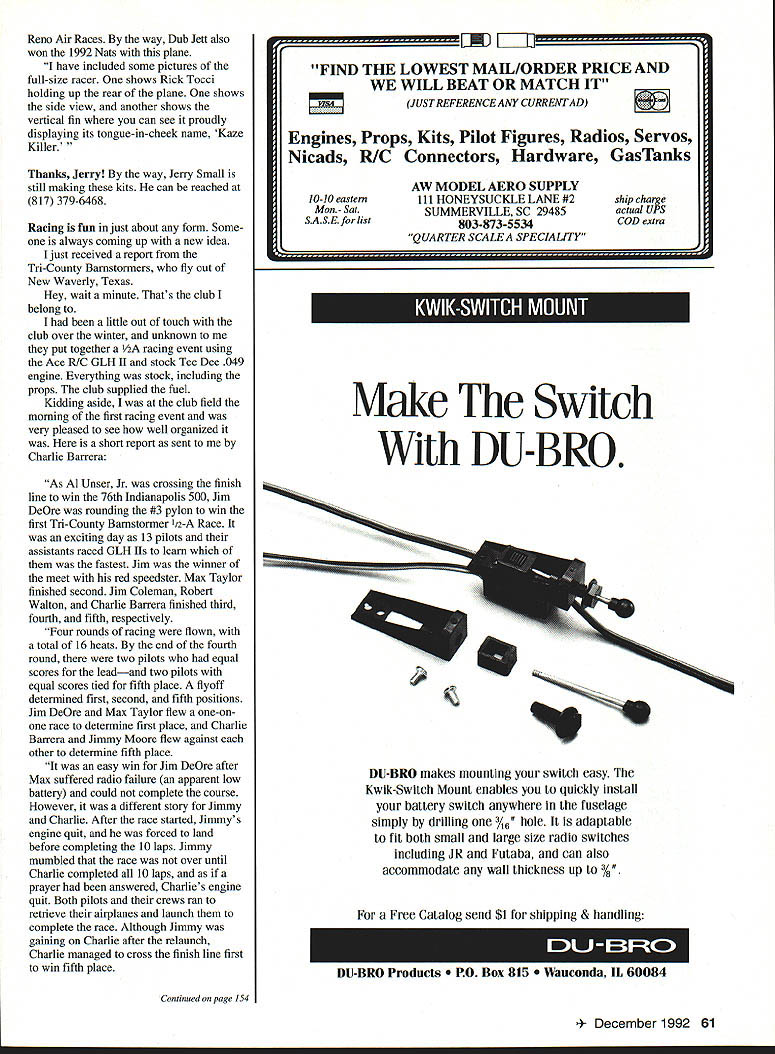
"'Is it a low wing?' I asked. "'Yeah!' Keith replied. "'Does it have long wings?' "'Yeah!' "'What is it called?' "'Kaze Killer!' "'Get serious! Your friend Robby Grove surely did not build a full-size racer and call it a 'Kaze Killer'!' "'Well, no . . . not quite exactly,' Keith said, 'but his plane already had a bunch of names like Bummers' Bullet (named after the pilot), Plastic Fantastic, Glass Tiger, and, of course, its formula name, GR-7.'
"Another one would not hurt, and it could be great fun."
For those racers who do not know what a "Kaze" is, shame on you. Dave Shadel, Gary Hover, and Richard Verano have been flying a "Kaze" for years and have won everything in sight. They've set more fast times than can be counted. Gary Hover designed and built the original and furnished kits to his friends before he started kitting it for everyone else.
Wait a minute, you say, there's no full-size airplane called Kaze, either. Yeah, but Jim Shinohara's group is called the Samurai Racing Team, and since Gary's airplane resembles a Cosmic Wind (a real racer), Gary took a little Japanese artistic license and called it Kaze. My apologies to Gary if what I've said isn't totally the way it happened.
Back to 1989: Keith Davidson was true to his word and sent three-views of the airplane. He even sent a set of drawings for a .40-size racer that Keith and Robby had worked out.
It was love at first sight. I had never seen a sleeker, meaner, or more graceful airplane in my life. It looked fast just sitting there.
I wanted to carve a new plug right away, but just could not squeeze out the time. So I cheated. I dusted off my Estrellita mold, did a little fudging in the canopy area, laid up a fuselage, and started ad-libbing the wings and tail feathers. It was finished in time to go to the Fort Worth F-I contest in May of 1989.
A better Hollywood script could not have been written for its debut. Phil Bussell furnished an engine, and we went racing. I won the first two heats with mediocre times of 1:17. The third heat had me up against Bryan Richmond, who had just turned a then-record time of 1:05 the day before. Bruce Hobbs, who had just turned 1:11 (fast time for Texas), was also in the heat. To make things worse, I had to take off third.
Well, I came back from the scatter pylon first and was never pressed. I turned a 1:10 in that heat! I turned another 1:10 against Dub Jett—and finished the day with an easy 1:13 to win the contest. Kaze Killer worked!
I sold a few kits to friends. But really, very few people had heard of the Kaze Killer until Rich Tocci built one and artistically created a showstopper. Then he bravely took it to a contest in California in 1990. Can you imagine having the guts to sit an airplane down on Kaze turf and tell everyone its name is Kaze Killer? What gall, what sacrilege! Dare I say, hey, I didn't name it; I just built it . . . blame Robby Grove and Keith Davidson. Anyway, Rich was not tarred and feathered, and I think everyone took the idea in good nature. By the way, Rich won Best of Show and continued to win Best of Show with the same airplane for a long time.
Both the model and the full-size racer have had some good successes since 1989:
- Dub Jett and Johnny Shannon won the World Champs in Australia while setting a world record of 1:06.
- Norm Johnson won the 1991 NMPRA Champs.
- The full-size GR-7 set fast times at recent events.
- Dub Jett also won the 1992 Nats with this plane.
You can take your pick. Anyway, it's a slick speed machine.
I have included some pictures of the full-size racer. One shows Rich Tocci holding up the rear of the plane. One shows the side view, and another shows the vertical fin where you can see it proudly displaying its tongue-in-cheek name, "Kaze Killer."
Thanks, Jerry! By the way, Jerry Small is still making these kits. He can be reached at (817) 379-6468.
Racing is fun in just about any form. Someone is always coming up with a new idea.
Tri-County Barnstormers 1/2A Racing (report by Charlie Barrera)
I just received a report from the Tri-County Barnstormers, who fly out of New Waverly, Texas. Hey, wait a minute—that's the club I belong to.
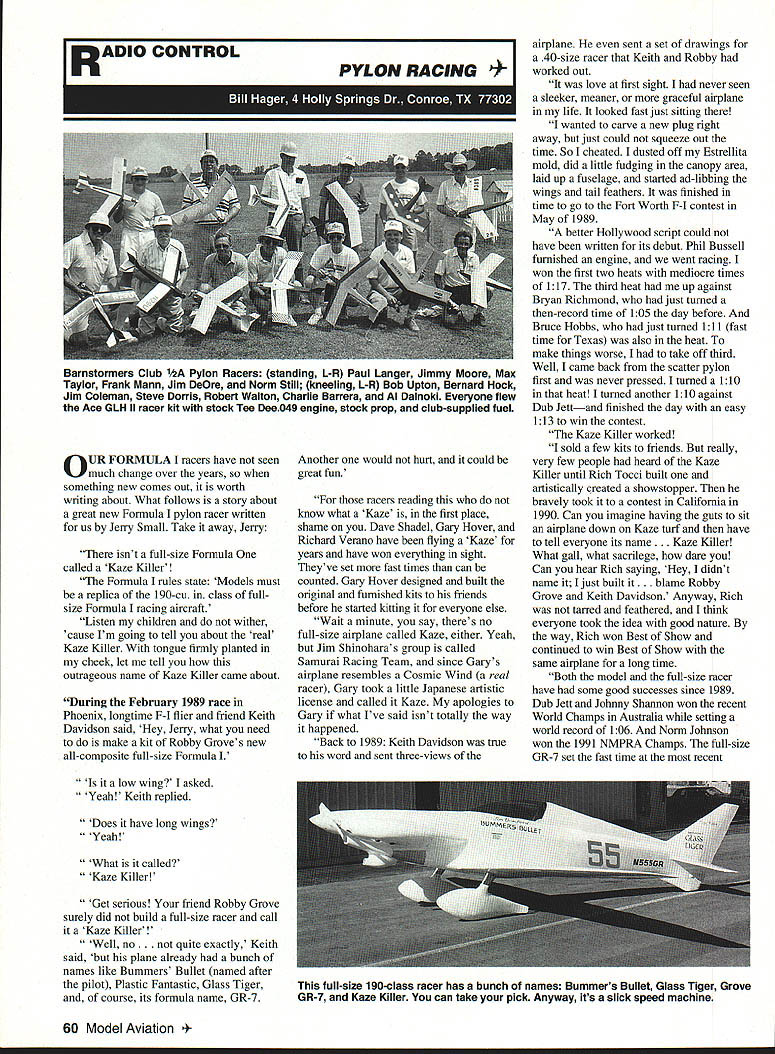
I had been a little out of touch with the club over the winter, and unknown to me they put together a 1/2A racing event using the Ace R/C GLH II and stock Tee Dee .049 engine. Everything was stock, including the props. The club supplied the fuel.
I was at the club field the morning of the first racing event and was very pleased to see how well organized it was. Here is a short report as sent to me by Charlie Barrera:
"As Al Unser, Jr. was crossing the finish line to win the 76th Indianapolis 500, Jim DeOre was rounding the #3 pylon to win the first Tri-County Barnstormer 1/2-A Race. It was an exciting day as 13 pilots and their assistants raced GLH IIs to learn which of them was the fastest. Jim was the winner of the meet with his red speedster. Max Taylor finished second. Jim Coleman, Robert Walton, and Charlie Barrera finished third, fourth, and fifth, respectively.
"Four rounds of racing were flown, with a total of 16 heats. By the end of the fourth round, there were two pilots who had equal scores for the lead — and two pilots with equal scores tied for fifth place. A flyoff determined first, second, and fifth positions. Jim DeOre and Max Taylor flew a one-on-one race to determine first place, and Charlie Barrera and Jimmy Moore flew against each other to determine fifth place.
"It was an easy win for Jim DeOre after Max suffered radio failure (an apparent low battery) and could not complete the course. However, it was a different story for Jimmy and Charlie. After the race started, Jimmy's engine quit, and he was forced to land before completing the 10 laps. Jimmy mumbled that the race was not over until Charlie completed all 10 laps, and as if a prayer had been answered, Charlie's engine quit. Both pilots and their crews ran to retrieve their airplanes and launch them to complete the race. Although Jimmy was gaining on Charlie after the relaunch, Charlie managed to cross the finish line first to win fifth place.
"It was a wonderful day, and everyone had a great time. The event proved to be quite popular, and now there is discussion about having these races on a regular basis.
"I would like to thank everyone who participated, especially those who did not fly. These people put forth the extra effort needed as flagmen, pylon judges, and callers. These dedicated individuals are the backbone of the club. Without them the races could not have been a success."
Thanks, Charlie, for the report.
By the way, it is about time to be getting ready for this year's NMPRA Championship Race. It should be a great one. This year's race will be held at Crow's Landing in Modesto, CA. See you next month.
Transcribed from original scans by AI. Minor OCR errors may remain.

