
Radio Control: Pylon Racing
Bill Hager, 4 Holly Springs Dr., Conroe, TX 77302
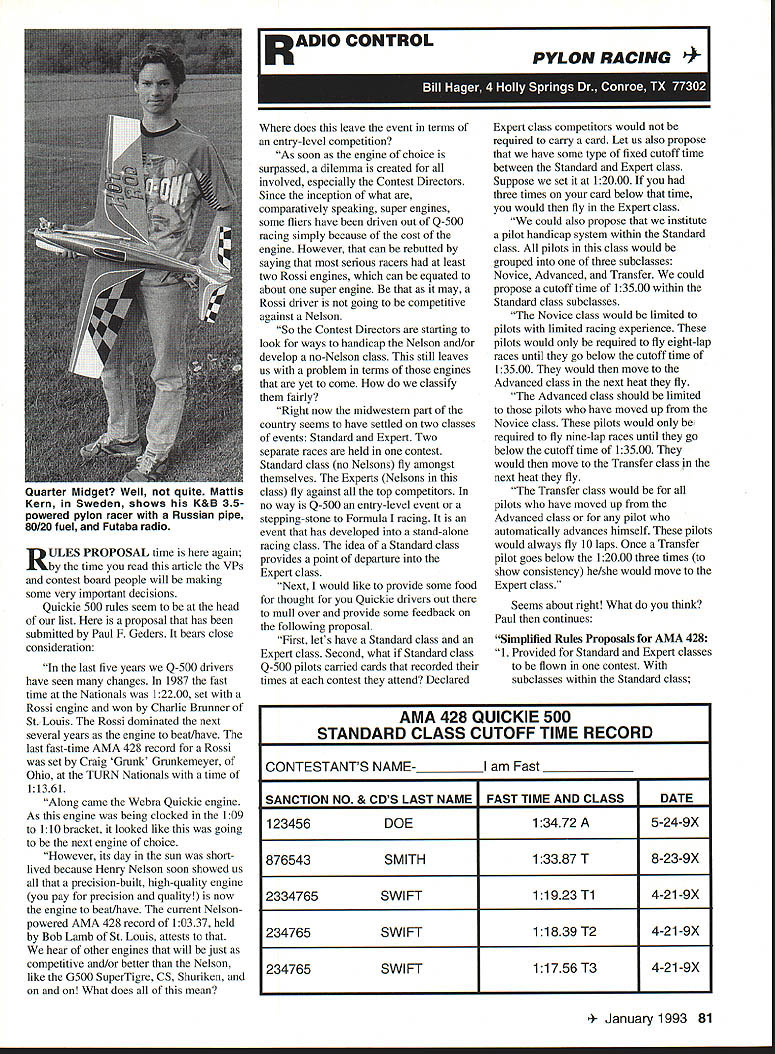
Rules-proposal time is here again; by the time you read this article the VPs and contest board people will be making some very important decisions. Quickie 500 rules seem to be at the head of our list. Here is a proposal that has been submitted by Paul F. Geders. It bears close consideration.
In the last five years we Q-500 drivers have seen many changes. In 1987 the fast time at the Nationals was 1:22.00, set with a Rossi engine and won by Charlie Brunner of St. Louis. The Rossi dominated the next several years as the engine to have. The last fast-time AMA 428 record for a Rossi was set by Craig "Grunk" Grunkemeyer, of Ohio, at the Nationals with a time of 1:13.61.
Along came the Webra Quickie engine. As this engine was being clocked in the 1:09 to 1:10 bracket, it looked like this was going to be the next engine of choice.
However, its day in the sun was short-lived because Henry Nelson soon showed us all that a precision-built, high-quality engine pays off; it is now the engine to have. The current Nelson-powered AMA 428 record of 1:03.37, held by Bob Lamb of St. Louis, attests to that. We hear of other engines that will be just as competitive and/or better than the Nelson, like the G500 SuperTigre, CS, Shuriken, and on and on! What does all of this mean?
Where does this leave the event in terms of an entry-level competition?
As soon as the engine of choice is surpassed, a dilemma is created for all involved, especially the Contest Directors. Since the inception of, what are, comparatively speaking, super engines, some fliers have been driven out of Q-500 racing simply because of the cost of the engine. However, that can be rebutted by saying that most serious racers had at least two Rossi engines, which can be equated to about one super engine. Be that as it may, a Rossi driver is not going to be competitive against a Nelson.
So the Contest Directors are starting to look for ways to handicap the Nelson and/or develop a no-Nelson class. This still leaves us with a problem in terms of those engines that are yet to come. How do we classify them fairly?
Right now the midwestern part of the country seems to have settled on two classes of events: Standard and Expert. Two separate races are held in one contest. Standard class (no Nelsons) fly amongst themselves. The Experts (Nelsons in this class) fly against all the top competitors. In no way is Q-500 an entry-level event or a stepping-stone to Formula 1 racing. It is an event that has developed into a stand-alone racing class. The idea of a Standard class provides a point of departure into the Expert class.
Next, I would like to provide some food for thought for your Quickie drivers out there to mull over and provide some feedback on the following proposal.
First, let's have a Standard class and an Expert class. Second, what if Standard class Q-500 pilots carried cards that recorded their fast times at each contest they attend? Declared Expert class competitors would not be required to carry a card. Let us also propose that we have some type of fixed cutoff time between the Standard and Expert class. Suppose we set it at 1:20.00. If you had three times on your card below that time, you would then fly in the Expert class.
We could also propose that we institute a pilot handicap system within the Standard class. All pilots in this class would be grouped into one of three subclasses: Novice, Advanced, and Transfer. We could propose a cutoff time of 1:35.00 within the Standard class subclasses.
- The Novice subclass would be limited to pilots with limited racing experience. These pilots would only be required to fly eight-lap races until they go below the cutoff time of 1:35.00. They would then move to the Advanced subclass in the next heat they fly.
- The Advanced subclass should be limited to those pilots who have moved up from the Novice subclass. These pilots would only be required to fly nine-lap races until they go below the cutoff time of 1:35.00. They would then move to the Transfer subclass in the next heat they fly.
- The Transfer subclass would be for all pilots who have moved up from the Advanced subclass or for any pilot who automatically advances himself. These pilots would always fly 10 laps. Once a Transfer pilot goes below the 1:20.00 cutoff time three times (to show consistency) he/she would move to the Expert class.
Seems about right! What do you think? Paul then continues:
Simplified Rules Proposals for AMA 428
- Provide for Standard and Expert classes to be flown in one contest. Expert subclasses within the Standard class.
- Provide cutoff time between Standard and Expert classes: 1:20.00.
- Provide cutoff time within Standard class: 1:35.00.
- Must go below cutoff time 1:20.00 three times to show consistency before advancing to Expert class.
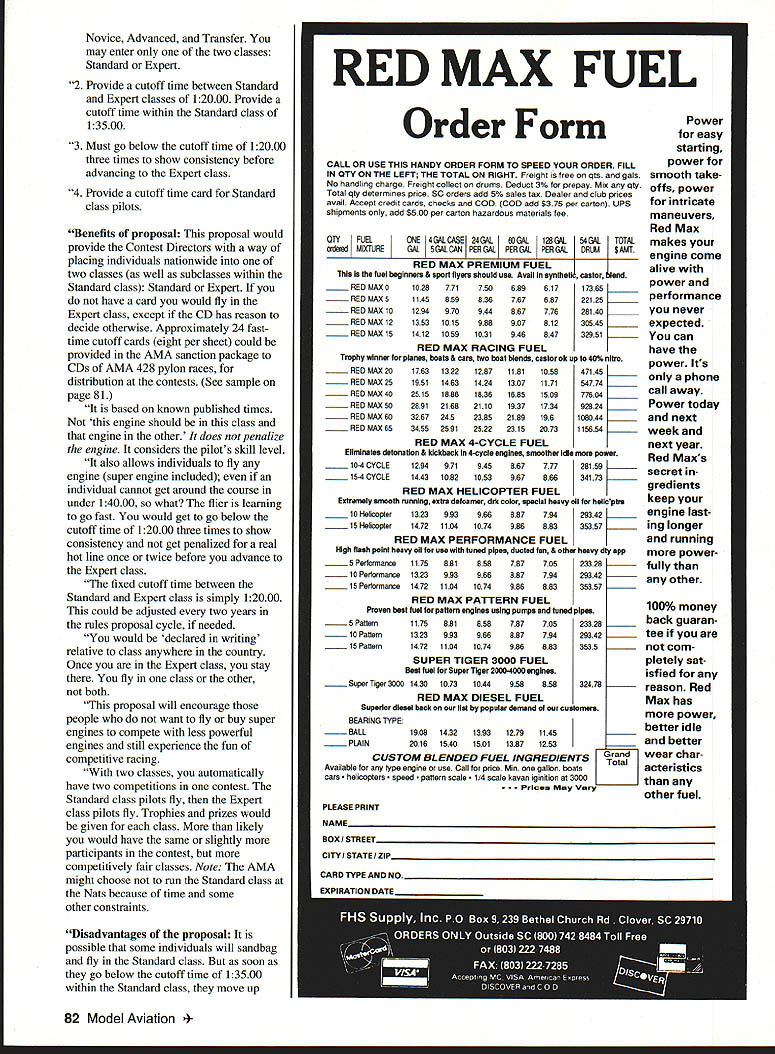
AMA 428 Quickie 500 — Standard Class Cutoff Time Record (sample)
CONTESTANT'S NAME - ____________________ I am Fast ______________
SANCTION NO. & CD'S LAST NAME FAST TIME AND CLASS DATE
- 123456 DOE 1:34.72 A 5-24-9X
- 876543 SMITH 1:33.87 T 8-23-9X
- 2334765 SWIFT 1:19.23 T1 4-21-9X
- 234765 SWIFT 1:18.39 T2 4-21-9X
- 234765 SWIFT 1:17.56 T3 4-21-9X
Novice, Advanced, and Transfer. You may enter only one of the two classes: Standard or Expert.
- Provide a cutoff time between Standard and Expert classes of 1:20.00. Provide a cutoff time within the Standard class of 1:35.00.
- Must go below the cutoff time of 1:20.00 three times to show consistency before advancing to the Expert class.
- Provide a cutoff time card for Standard class pilots.
Benefits of the proposal
- This proposal would provide the Contest Directors with a way of placing individuals nationwide into one of two classes (as well as subclasses within the Standard class): Standard or Expert. If you do not have a card you would fly in the Expert class, except if the CD has reason to decide otherwise.
- Approximately 24 fast-time cutoff cards (eight per sheet) could be provided in the AMA sanction package to CDs of AMA 428 pylon races, for distribution at the contests. (See sample on page 81.)
- It is based on known published times. Not "this engine should be in this class and that engine in the other." It does not penalize the engine. It considers the pilot’s skill level.
- It also allows individuals to fly any engine (super engine included): even if an individual cannot get around the course in under 1:40.00, so what? The flier is learning to go fast. You would need to go below the cutoff time of 1:20.00 three times to show consistency and not get penalized for a real hot line once or twice before you advance to the Expert class.
- The fixed cutoff time between the Standard and Expert class is simply 1:20.00. This could be adjusted every two years in the rules proposal cycle, if needed.
- You would be "declared" in writing, relative to class anywhere in the country. Once you are in the Expert class, you stay there. You fly in one class or the other, not both.
- This proposal will encourage those people who do not want to fly or buy super engines to compete with less powerful engines and still experience the fun of competitive racing.
- With two classes, you automatically have two competitions in one contest. The Standard class pilots fly, then the Expert class pilots fly. Trophies and prizes would be given for each class. More than likely you would have the same or slightly more participants in the contest, but more competitively fair classes.
- Note: The AMA might choose not to run the Standard class at the Nats because of time and some other constraints.
Disadvantages of the proposal
- It is possible that some individuals will sandbag and fly in the Standard class. But as soon as they go below the cutoff time of 1:35.00 within the Standard class, they move up within the class (Novice to Advanced to Transfer), or when they go below the cutoff time of 1:20.00 (three times) they automatically move to the Expert class.
- The proposal creates additional work for the CDs because they would fill out the Standard class fast-time cards. However, this would only be done for those competitors who go below the cutoff times.
Rules as they would appear in the rule book
Page 91 of the 1992 and 1993 Competition Regulations under "Quickie 500" for event 428, add the following after "1. Purpose."
1.1. Classes. You may enter only one of the two competition classes (if both are offered at a contest), either Standard or Expert. Each class would be matrixed separately within one contest. Standard class competitors would carry a "fast-time cutoff" card that records all times below the cutoff times. The fast-time cutoff card would only show the date and time you advanced from one subclass to the next. All pilots in the Standard class would be grouped into one of the three subclasses: Novice to Advanced (A) to Transfer (T). The A and T abbreviations would be used in the "Fast Time" and "Class" column on the fast-time cutoff card — i.e., 1:34.23 A, 1:33.51 T, 1:19.89 T1, 1:17.72 T2, and one more time below 1:20.00 to show advancement from the Novice to the Advanced to the Transfer (T1, T2, and then Expert).
1.1.1. The Novice subclass is limited to pilots with limited racing experience. These pilots are required to fly only eight-lap races until they go below the cutoff of 1:35.00. They then move to the Advanced subclass.
1.1.2. The Advanced subclass is limited to those pilots who have moved up from the Novice subclass. These pilots are required to fly only nine-lap races until they go below the cutoff time of 1:35.00. They then move to the Transfer subclass.
1.1.3. The Transfer subclass is for all pilots who have moved up from the Advanced subclass or any pilot who automatically advances himself. These pilots always fly 10-lap races. Once a Transfer pilot goes below 1:20.00 three times (to show consistency) he/she would move to the Expert class.
1.1.4. The Expert class is for all pilots who have moved up through the Standard class, or any pilot who automatically advances himself to this class. Expert class pilots do not carry cards.
1.1.5. Once a pilot has moved up he cannot go back to the lower class. Pilots can move up subclasses in the Standard class within the same contest. Once the cutoff time has been achieved, a pilot will automatically advance to the next higher subclass in the very next heat he flies, except between the Standard and Expert class. If you show signs of consistency in a contest with three consecutive flights under 1:20.00, you would move to the Expert class in the next contest entered.
1.1.6. To avoid confusion for the lap counters, the lap counting boards would be adjusted to show laps completed for each pilot before the start of each heat. For example, the lap board would show two laps completed for a Novice pilot and one lap completed for an Advanced pilot before the heat is started.
1.1.7. If you do not have a card and you declare yourself as a Standard class contestant, a card will be issued to you at the contest. If you forget your card you will be placed in the Expert class, except if the CD has reason to decide otherwise. CDs or assistants need to ask if contestants have been issued a card at registration.
1.1.8. Example of a filled out "standard class cut-off time record" card. [See example elsewhere in article.]
1.1.8.1. The first entry above shows that an individual has moved from the Novice subclass by breaking through the 1:35.00 cutoff time for eight-lap trials and has moved to the Advanced subclass on 5-24-9X. The second line shows he flew nine laps and went below the cutoff time of 1:35.00 and moved to the Transfer subclass on 8-23-9X. The third through fifth entries show that at the same contest held on 4-21-9X he went below the 1:20.00 cutoff time three times (T1, T2, T3), which means he moves into the Expert class in the next contest he enters. He now can keep his card for posterity or throw it away.
Paul has some very good points here. But hey, this is your event. If you agree or disagree, now is the time to let people know how you feel. Do not let just one or two people make your rules for you.
See you next month.
Transcribed from original scans by AI. Minor OCR errors may remain.

