
Radio Control: Pylon Racing
Bill Hager, 4 Holly Springs Dr., Conroe, TX 77302
Time really flies when you're having fun! I can't believe we're already at the end of another summer of great racing.
Upcoming events
- Q-500 (Quickie 500) Championships — Houston, Texas (Editor's note: Quickie 500)
- Formula One Championships — Crows Landing, California
Look for full reports on these meets in future issues. Also, there will be a new Quickie 500 engine for 1993; I will report on this in the near future.
This past year (1992) we had a race that paid cash to the top finishers. Here is a report from Don Nix on the first annual Hollywood Nationals at Sepulveda Basin.
Hollywood Nationals — report (Don Nix)
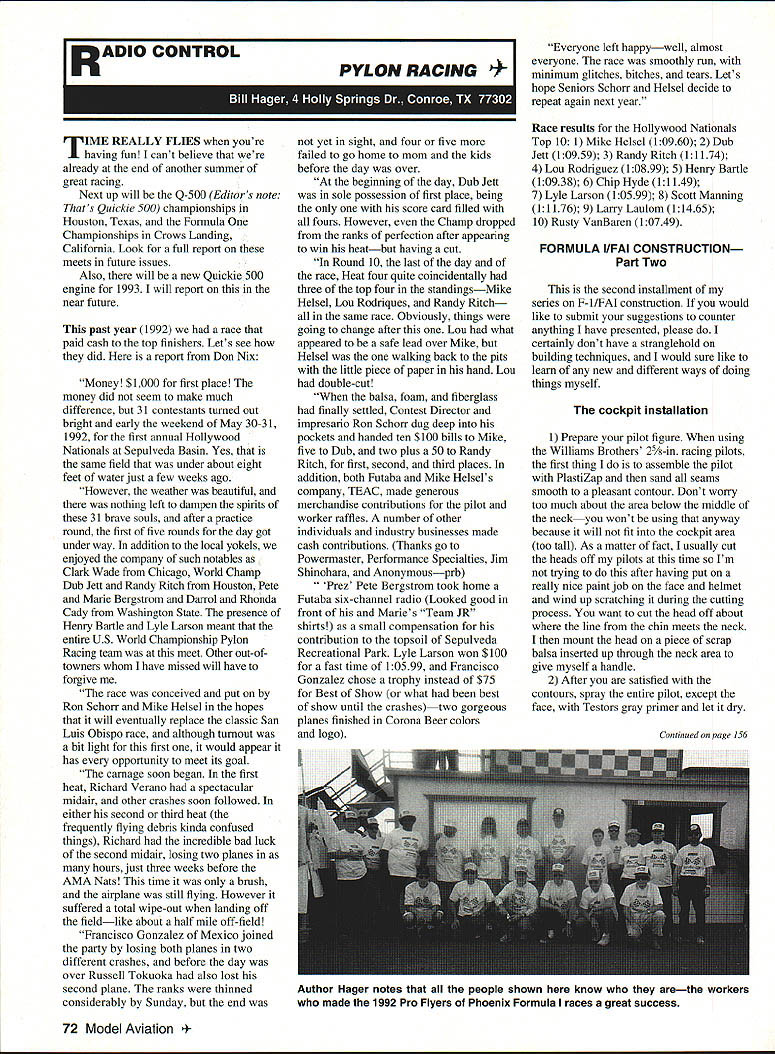
Money! $1,000 for first place! The money did not seem to make much difference, but 31 contestants turned out bright and early the weekend of May 30–31, 1992, for the first annual Hollywood Nationals at Sepulveda Basin. Yes, that is the same field that was under about eight feet of water just a few weeks earlier.
The weather was beautiful, and nothing dampened the spirits of these 31 brave souls. After a practice round, the first of five rounds for the day got under way. In addition to the locals, we enjoyed the company of such notables as Clark Wade from Chicago, World Champ Dub Jett and Randy Ritch from Houston, Pete and Marie Bergstrom and Darrol and Rhonda Cady from Washington State. The presence of Henry Bartle and Lyle Larson meant that the entire U.S. World Championship Pylon Racing team was at this meet.
The race was conceived and put on by Ron Schorr and Mike Helsel in the hopes that it will eventually replace the classic San Luis Obispo race. Although turnout was a bit light for this first running, it appears the event has every opportunity to meet its goal.
The carnage began early. In the first heat, Richard Verano had a spectacular midair, and other crashes soon followed. In either his second or third heat (frequently flying debris made things confusing), Richard had the incredible bad luck of a second midair, losing two planes in as many hours — just three weeks before the AMA Nats! At first the airplane was only bruised and still flying, but it suffered a total wipe-out when it landed off the field — about a half mile away.
Francisco Gonzalez of Mexico joined the party by losing both planes in two different crashes, and before the day was over Russell Tokuoka had also lost his second plane. The ranks were thinned considerably by Sunday, and four or five more pilots had their days end early.
At the beginning of the day, Dub Jett held sole possession of first place, being the only one with his score card filled with all fours. However, even the champ dropped from perfection after appearing to win a heat but getting a cut.
In Round 10, the last of the day, Heat 4 quite coincidentally had three of the top four in the standings — Mike Helsel, Lou Rodriguez, and Randy Ritch — all in the same race. Lou appeared to have a safe lead over Mike, but Helsel was walking back to the pits holding the little piece of paper in his hand: Lou had double-cut balsa, foam, and fiberglass.
When the balsa, foam, and fiberglass finally settled, Contest Director Ron Schorr dug deep into his pockets and paid out the cash prizes: ten $100 bills to Mike Helsel for first, five $100 bills to Dub Jett for second, and two $100 bills plus a $50 bill to Randy Ritch for third. In addition, Futaba and Mike Helsel's company TEAC made generous merchandise contributions for the pilot and worker raffles. A number of other individuals and industry businesses made cash contributions; thanks go to Powermaster, Performance Specialties, Jim Shinohara, and anonymous donors.
"Prez" Pete Bergstrom took home a Futaba six-channel radio (looked good in front of his and Marie's "Team JR" shirts!) as a small compensation for his contribution to the topsoil of Sepulveda Recreational Park. Lyle Larson won $100 for a fast time of 1:05.99. Francisco Gonzalez chose a trophy instead of $75 for Best of Show (or what had been Best of Show until the crashes) — two gorgeous planes finished in Corona Beer colors and logo.
Everyone left happy — well, almost everyone. The race was smoothly run, with minimum glitches, complaints, and tears. Let's hope Schorr and Helsel decide to repeat again next year.
Race results — Hollywood Nationals (Top 10)
- Mike Helsel — 1:09.60
- Dub Jett — 1:09.59
- Randy Ritch — 1:11.74
- Lou Rodriguez — 1:08.99
- Henry Bartle — 1:09.38
- Chip Hyde — 1:11.49
- Lyle Larson — 1:05.99
- Scott Manning — 1:11.06
- Larry Laulom — 1:14.65
- Rusty VanBaren — 1:07.49
RC Pylon / Hager
Continued from page 72
Painting pilots and dyeing canopies (steps 3–5)
3) Match pilot helmet to airplane color scheme.
- There has been a trend for static judges to look for pilots whose paint scheme complements the airplane, so try to have some idea how you want to paint your airplane before you paint the pilot's helmet.
- If you have no idea, use neutral colors or paint the helmet at least the base color of your airplane. This is only a suggestion, not a rule.
I use Testors plastic model paints for my pilots. The paints come in a variety of colors, and their gloss is excellent. Some builders may paint pilots with the same paint used on the airplane — that's fine. I prefer Testors because there is no mixing.
4) Paint the helmet first.
- Painting the helmet first allows you to mask over the face without worrying about pulling off face paint and details when you remove the masking tape.
When I paint the face, I usually put a base coat of flesh color on and then have Marie apply the details with a combination of paint and makeup. Be careful with makeup — it may fade over time — but I haven't had pilots last long enough for that to be a real problem. A spouse or partner is often the best person to apply face makeup.
When you are satisfied with the face, a coat of Testors semigloss clear will seal the makeup and remove any unwanted shine. Put your pilot aside for now.
5) Dyeing the canopy.
- Some people like to dye the canopy a color that closely matches or complements their color scheme. I used to dye canopies but stopped because if you are not extremely careful you can make the canopy too dark and obscure the cockpit detail added for judging.
- Remember, these airplanes are judged from a distance of 5 to 10 feet, so make your cockpit detail large enough to be seen from that distance. If the canopy is too dark to see through, you may not get the score you deserve for cockpit detailing.
If you decide to dye the canopy, get Rit Fabric Dye in powdered form in the color you wish to use. Rit is available in supermarkets, drug stores, or hardware stores.
If you want your canopy to turn out gray, do not buy black and merely adjust the density by immersion time; black dye often behaves differently than expected.
Transcribed from original scans by AI. Minor OCR errors may remain.

