
RADIO CONTROL: PYLON RACING
Bill Hager, 4 Holly Springs Dr., Conroe, TX 77302
A Bit of Bad News
I have just learned of the passing of a fellow pylon racer—Number 58, Joe Streem. Joe and his family were very active in R/C and he was one of the pioneers of pylon racing. Although he had not been racing much in the last few years, he helped many of us by making very good Formula I props. We will miss Joe.
Corrections to NMPRA Formula I Championships
My report on the NMPRA Formula I Championships included a few mistakes that should be corrected:
- The national points standings showed Brad Young in ninth place. Scott Winslow actually finished ninth; Brad finished 39th. Congratulations, Scott — it takes a lot of work to finish in the top 20.
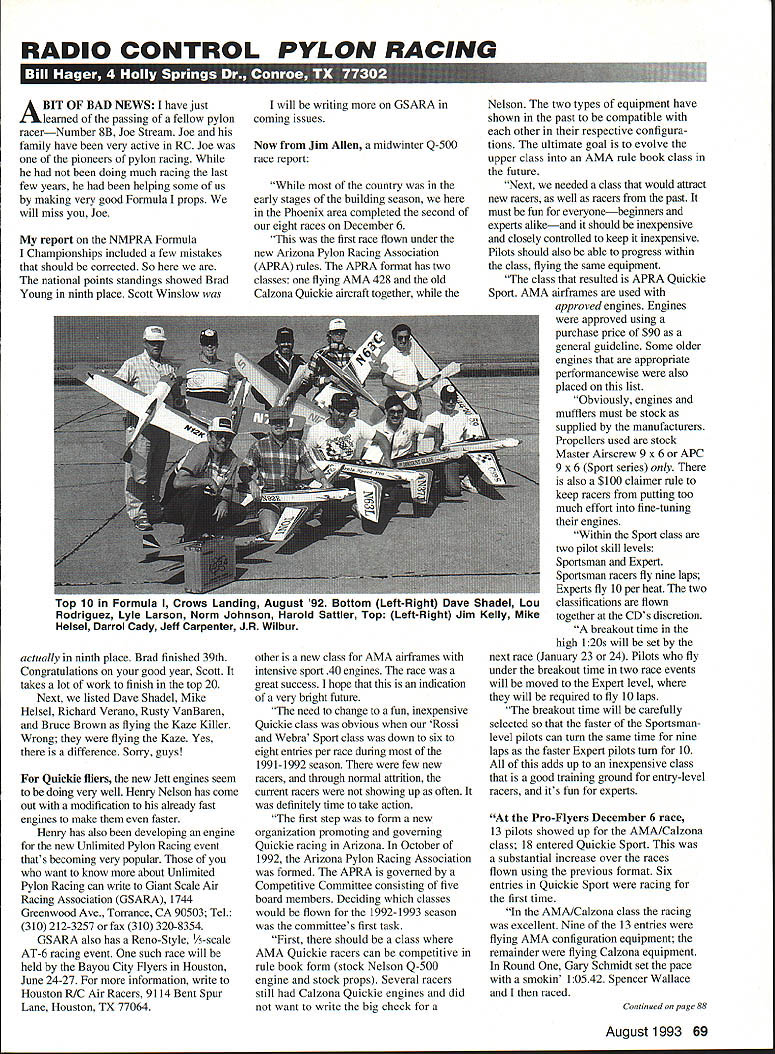
- We listed Dave Shadel, Mike Helsel, Richard Verano, Rusty VanBaren, and Bruce Brown as flying the Kaze Killer. They were flying the Kaze. Yes, there is a difference. Sorry, guys!
Quickie Fliers and GSARA
- The new Jett engines seem to be doing very well for Quickie fliers. Henry Nelson has introduced a modification to his already fast engines to make them even faster.
- Henry has also been developing an engine for the new Unlimited Pylon Racing event, which is becoming very popular.
For more information on Unlimited Pylon Racing, write:
- Giant Scale Air Racing Association (GSARA), 1744 Greenwood Ave., Torrance, CA 90503; Tel. (310) 212-3257; Fax (310) 320-8354.
GSARA also sanctions a Reno-style 1/5-scale AT-6 racing event. One such race will be held by the Bayou City Flyers in Houston, June 24–27. For more information, write:
- Houston R/C Air Racers, 9114 Bent Spur Lane, Houston, TX 77064.
I will be writing more on GSARA in coming issues.
APRA and the New Quickie Sport Class
In midwinter, Jim Allen submitted the following Q-500 race report from Phoenix and a description of the new Arizona Pylon Racing Association (APRA) format.
Background and Formation
While much of the country was in the early stages of the building season, the Phoenix area completed the second of eight races on December 6. This was the first race flown under the new APRA rules.
- APRA was formed in October 1992 to promote and govern Quickie racing in Arizona.
- It is governed by a Competitive Committee consisting of five board members.
- The committee’s first task was to decide which classes would be flown for the 1992–1993 season.
Class Structure
The APRA format has two main classes:
- A class where AMA Quickie racers can be competitive under rule-book form (stock Nelson Q-500 engine and stock props). This accommodates racers who still have Calzona Quickie engines and do not want to invest in a Nelson; historically, the two equipment types have been compatible in their respective configurations. The ultimate goal is to evolve an upper class into a full AMA rule-book class in the future.
- APRA Quickie Sport — a new class designed to attract new and returning racers. Key features:
- AMA airframes with approved engines.
- Engine approvals used a purchase-price guideline of $90; some older, appropriately performing engines were also approved.
- Engines and mufflers must be stock as supplied by the manufacturers.
- Propellers allowed: stock Master Airscrew 9×6 or APC 9×6 (Sport series) only.
- A $100 claimer rule is in effect to keep costs down and discourage expensive fine-tuning.
Within the Sport class there are two pilot skill levels:
- Sportsman — fly nine laps per heat.
- Expert — fly 10 laps per heat.
The two classifications may be flown together at the Contest Director’s discretion. A breakout time (in the high 1:20s) will be set by the next race (January 23 or 24). Pilots who fly under the breakout time in two race events will be moved to the Expert level and required to fly 10 laps. The breakout will be selected so that faster Sportsman pilots can turn the same time for nine laps as faster Expert pilots turn for 10. The goal is an inexpensive, fun, entry-level class that also serves as a training ground for newcomers while still being enjoyable for experts.
Midwinter Q-500 Race Report (Jim Allen)
The December 6 race was a great success and an encouraging sign for the new format.
- Entries: 13 pilots in the AMA/Calzona class and 18 in Quickie Sport — a substantial increase over the previous format. Six Quickie Sport entries were racing for the first time.
- AMA/Calzona racing: Nine of the 13 entries flew AMA configuration equipment; the remainder flew Calzona equipment. In Round One, Gary Schmidt set a pace of 1:05.42. The racing featured many lead changes and close contests. In Round Two, Tom Hart from Las Vegas recorded a 1:04.07, which held up as fast time for the contest.
- Notable mentions: Mike Delponte flew a Calzona-legal, piped, rear-exhaust Nelson but suffered damage after flying low; the Las Vegas group (Larry Drury, Dave Ficcaelli, Tom Hart) returned and were competitive; Drew Telford returned but had engine problems; Mark Holmstrand from Anchorage traveled the farthest to attend.
- Quickie Sport racing: Very close — the 10 fastest planes were separated by only 10 seconds (1:28.38 to 1:38.43). A four-way flyoff among Sportsman-level pilots for second through fifth place was a highlight.
- Randy Schoenemann, Tom Wetherill, and Scott Sibson battled down to the wire. Bob Smith stayed clean and finished fourth overall when Tom cut.
- Scott Sibson and Tom Wetherill were impressive considering this was only their third Quickie race.
- The three Expert pilots had fast times in the middle of the top 10 overall. Tom Wetherill’s 1:28.38 was fast time of the day for Quickie Sport.
- Popular engines in Quickie Sport: ASP .40, FSR ABC, and SuperTiger GS .40 Ring. In the air they were virtually indistinguishable, which made for great racing. The only prop used was the APC 9×6.
- Typical prop speeds: Competitive engines were turning the prop around 16,500 to 16,800 rpm with no major issues. One incident: Tom Wetherill shortened his prop by about a half inch with a near nose-over on takeoff during the flyoff; he finished with a cut but no other problems.
Overall, attendees considered the event a great success. The AMA/Calzona class had good racing all day, and Quickie Sport looked to have a very bright future in Arizona. The APRA Quickie Sport format combines several proven ideas into what the competition committee believes will be the most successful and fun Quickie class in the region.
Race Results
Quickie Sport class:
- Bill Schoenemann — 1:34.38
- Randy Schoenemann — 1:30.83
- Scott Sibson — 1:35.85
- Bob Smith — 1:34.06
- Tom Wetherill — 1:28.38
- Ron Saum — 1:34.81
- Robert Moore — 1:33.48
- Bud Mellor — 1:38.05
- Joe Prizina — 1:49.14
- Bob Mellor — 1:38.05
AMA/Calzona class:
- Jim Allen — 1:06.46
- Tom Hart — 1:04.07
- Larry Drury — 1:10.41
- Gary Schmidt — 1:05.17
- Spencer Wallace — 1:06.77
Transcribed from original scans by AI. Minor OCR errors may remain.

