
RADIO CONTROL PYLON RACING
Bill Hager 4 Holly Springs Drive, Conroe, TX 77302
We have several months' building tips and have missed some contest reports, so we're going back to pick up a couple.
Supplier note — Master Tach
Add the Master Tach made by Allen Booth to the list of pylon-racing suppliers printed last month. This is the tach I use. It is very accurate and has an auto-shutoff feature so you won't drain the batteries by leaving it on.
To order: Allen Booth, 1836 Alabama Ave., Fort Wayne, IN 46805. Phone: (219) 424-7441.
---
Crow's Landing '92 — Formula I (report by Lou Rodriguez)
August 22–23 were the dates for Crow's Landing '92 and the chance for Formula I fliers to tune up for the NMPRA Championship Race scheduled here for October. Thirty entries from six states and Canada competed.
Round One (Saturday morning)
- Round One was underway by 10 a.m.
- Four of the eight leaders at the end of the first round posted times under 1:10, indicating good racing conditions and a competitive field.
Round Two
- Mike Helsel flew 1:08.0 in Round Two.
- Dave Shadel followed in the next heat with a 1:05.8 to establish the fast time for the contest.
- Lyle Larson maintained his position on the leaderboard, winning over Richard Verano and Jeff Carpenter while flying his second consecutive 1:07 time.
Round Three (after lunch)
- A tremendous race between Dave Shadel, Mike Helsel, and Lyle Larson; the first five laps were virtually wingtip-to-wingtip. Lyle then got some bad air around Pylon One and crashed.
- Dave managed a small lead over Mike to take the checkered flag.
- Gary Hover beat Harold Sattler.
- Rusty Van Baren stayed perfect through three rounds, narrowly edging out Bruce Brown.
- Todd West, making his first Formula I appearance, gave Bob Greer a race to remember—Greer won by a spinner's length.
Round Four
- Wind strengthened significantly, increasing race times.
- Lou Rodriguez fought off attacks from Dave English, winning with a 1:10.4 and staying in the hunt, one point behind the lead.
- Jeff Carpenter took advantage of a lean run. Rusty Van Baren suffered a broken rod. Jim Kelly finished second and continued to gather points.
- Henry Bartle had a wing failure around Pylon One. By 2:30 p.m. the wind was steady at 22–25 mph. Racing would resume Sunday hoping for better conditions.
Sunday
- Dawn brought an eerie haze from wildfires in northern California and an early morning breeze.
- Gary Hover convincingly beat Henry Bartle, J.R. Wilbur, and Mike Helsel; he pushed for fast time and posted 1:06.2.
- Mike Helsel pushed as well but suffered a piston failure.
- Darrol Cady narrowly beat Dave English by about half a second.
- Jeff Carpenter, Lyle Larson, Lou Rodriguez, Harold Sattler, Dave Shadel, and Scott Manning won respective heats.
End of contest
- Round Five completed by 9:30 a.m.; wind picked up to 22–23 mph.
- Pilots voted to end the contest; the Contest Director concurred.
Volunteers and helpers
Special recognition to:
- Larry and Diane Bickers
- Ward Hendricks
- Jim Bambacigno
- Dave English
- Participating members of EBRC, MCRC, and RCFU
Sponsors
Thanks to the generous support of:
- Bambacigno Steel (Ralph and Jim Bambacigno)
- California Corvettes (Henry Bartle)
- Communications Specialists (Peter Priest)
- Custom Ornamental Iron (Jim Bowman)
- Futaba
- Kruse-Lucas Imports (Terry Lucas)
- Modesto Hobby and Craft
- Pec's Hobbies
- Performance Specialties (Dave Shadel)
- PIC Products
- Powermaster Fuel (Don Nix)
- Sheldon's Hobbies
- Jim Shinohara
- Ace R/C
- Sig Manufacturing
Finally, thanks to all the contestants. Without pilots and airplanes there would only be a pylon course standing sadly idle.
Thanks to Lou Rodriguez for the report.
---
RC Interference Flight Testing
RF power outputs used in the tests ranged from 200 to 500 mW.
Instrumentation
- Decoded servo output signals from the receiver-under-test were fed to two on-board recorders and to a telemeter transmitter.
- One on-board recorder monitored servo position jitter due to interference. The Servo Jitter Counter (SJC) recorded the number of times the decoded servo position pulse width deviated from the encoded pulse (encoded = 1.5 ms). Deviations exceeding ±50 microseconds were counted.
- The other recorder counted the absence of servo position information. The Frame Rate Counter (FRC) registered a count if the servo information was not refreshed at the encoded frame rate of 20 ms.
- SJC and FRC counts were stored in two separate binary-sequenced LED displays. Counters were reset prior to each flight and the data documented after each flight.
- The telemeter system was a modified Ace R/C, Inc. Thermic Sniffer operating on 49.845 MHz under FCC Part 15 rules. The variometer air-flow sensor signal was disconnected and the on-board counter signals were substituted as the modulation source.
- Note: The SJC and FRC could not operate simultaneously. The telemeter chirp indicated that either one or the other counter was counting; it was not possible to distinguish between them from the telemetered signal.
RC interference flight test procedure
Five people were required to run the tests:
- Mobile transmitter operator at the remote site.
- Airplane pilot at the flying site.
- Mechanic/helper for the aircraft.
- Person operating the transmitter sending signals to the receiver-under-test to simulate an RC pilot.
- Test conductor at the flying site.
- The test conductor coordinated the interfering signal via VHF radio as required by the test sequence and recorded the test sequence, the telemetered data, and the post-flight on-board recorder data on a pocket voice recorder. The telemeter record was a voice description of observations and later transcribed.
Typical flight pattern used for interference testing
- The test used an abbreviated version of a typical fun flight: takeoff, climb to about 400 feet, then fly toward the mobile station.
- The mobile transmitter was turned on as the model came over the outbound path and data recording began.
- The model was flown to an estimated one-quarter-mile point, turned 180°, and flown back to the airport. Earlier flights used a ground spotter at the quarter-mile point to calibrate distance estimation.
- When the model was overhead on the return path, the mobile transmitter was turned off. The model then landed and airborne counters were recorded and reset.
- Typical flight duration for the tests was about two minutes.
---
Final Standings — Crow's Landing '92
- Dave Shadel — 20 pts — 1:05.8*
- Lou Rodriguez — 19 pts — 1:10.4
- Lyle Larson — 18 pts — 1:07.0
- Norm Johnson — 17 pts — 1:03.8
- Harold Sattler — 16 pts — 1:15.4
- Jim Kelly — 15 pts — 1:33.7
- Mike Helsel — 14 pts — 1:08.0
- Darrol Cady — 13 pts — 1:14.3
- Jeff Carpenter — 12 pts — 1:17.2
- J.R. Wilbur — 11 pts — 1:25.2
* Fast Time ** Best of Show (Kazi Killer)
---
East Coast — Florida State Sport Pylon Championship (Lucien Miller)
"The 8th Annual Florida State Sport Pylon Championship Race got underway at exactly 10 a.m. on December 6, 1992. There were a total of 31 fliers — 18 in Standard class and 13 in the Expert class.
A total of 39 aircraft were processed during registration. The computer was up..." (report continues)
---
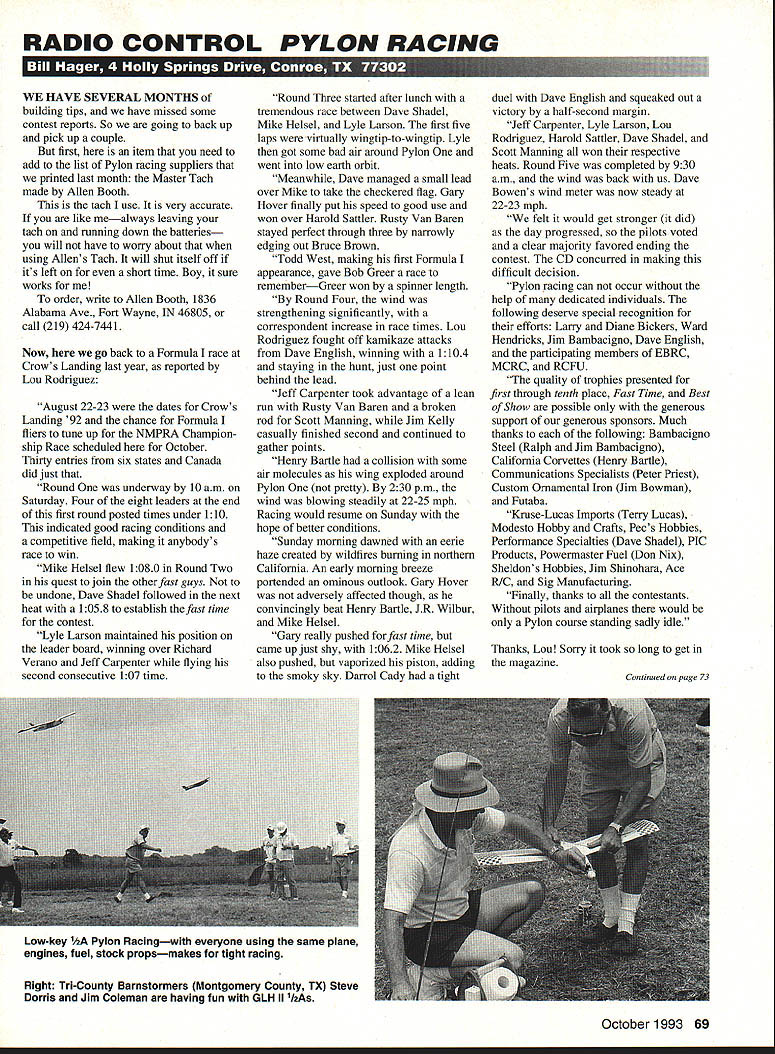
Low-key Pylon Racing (Brandon field report)
Tom Pownall, Jimmy Bartels, and Todd Miller in lanes 1, 2, and 3.
"When the checkered flag dropped, Jim and Tom took off together—and were at about 30 feet later. Tom's plane came down on top of Jimmy's. Tom's prop hit right in the middle of Jimmy's plane. When the contact was over, Jimmy's plane looked like it had been attacked by 'Jaws.' The chunk that was missing out of his plane was about 12 inches wide at the trailing edge and extended about four inches forward. The entire aileron was gone, but the plane kept on flying."
- Despite the heavy damage, Jimmy still managed a 1:49.22, earning two points and falling into a three-way tie for third with 18 points.
- In Standard class there was a three-way tie for second between Gary Kurzawa, Mario Travieso, and Bob Silwanicz, to be settled with a flyoff. Mario led most of the way, but on lap seven he pulled tight on pylon two and was called for a cut. That opened the door for Gary Kurzawa to win the heat, Bob Silwanicz finished second, and Mario third — making Gary second overall in Standard and Bob third.
- In Expert class there was a three-way tie for third; pilots decided to use fast time to determine the winner, which put Jimmy Bartels in third.
Engine teardown and disqualifications
Back in the pits, Tom Bogut, Steve Kovach, and Charlie Poulton tore down engines of the top three and fast-time pilots in each class. It was discovered that Jimmy Bartels and Bob Silwanicz had engines that had been reworked. After discussion about what constitutes cleaning versus reworking an engine, Jimmy and Bob were disqualified.
- The Brandon field organizers made it clear: cheating will not be tolerated. Tear-down will be a part of every race from now on.
Final results — Expert class
- William Roe
- Charlie Poulton
- Steve Kovach
Fast time: Charlie Poulton — 1:14.35
Top ten in order of finish: William Roe, Charles Poulton, Steve Kovach, Mark Brown, Tom Bogut, Carl Simms, Tom Pownall, David Zisman, Gene Steinbrook, John Dunham.
Final results — Standard class
- David Donaldson
- Gary Kurzawa
- Mario Travieso
Fast time: David Donaldson — 1:23.99
Top ten in order of finish: David Donaldson, Gary Kurzawa, Mario Travieso, Mike Roberts, Kevin Born, Jack Milburn, Steve Bowman, Kevin Clark, Jeff Grounds, Bud Roane.
---
Next month: More tips on flying, and a letter from Lucien Miller on cleaning versus reworking a motor.
See ya!
Transcribed from original scans by AI. Minor OCR errors may remain.

