
RADIO CONTROL PYLON RACING
Bill Hager 4 Holly Springs Drive, Conroe, TX 77302
We sure have a lot of Q-500 racing this year. It is hard to keep up with what is going on, but I'll try.
The latest news flash is that Gail "Jake" Jacobson set a new Q-500 record of 1:00.13. Jake was using a Nelson engine—so close to that one-minute mark! (I am not sure what the Quarter Midget record is. Someone help me out on this one, please.)
Our Formula I record still stands at 1:03, by Rich Verano. For those who do not know, Q-500 is flown on the short Quarter Midget course; Formula I is flown on the long course.
Q-500 report (Orv Steinmetz)
The Rock Valley Flyers started the '93 race season on May 2nd. A week of rain, with more rain and gusty winds forecast for race day, was not a good way to start the season.
Although 23 fliers started the contest, five of their planes never made it back home. In heat one of Round One, after rounding Pylon Three, Mike McGlothen, who had driven all the way from Muscatine, Iowa, hit soggy earth hard enough to total his only airplane.
One heat later, Clark Wade, while leading the pack, wiped out his new plane, and three heats later, airplanes belonging to Jerry Aarestad and Ron Walker tried to congratulate each other in the air after the heat was over. Two more new planes went to the scrap barrel.
After six rounds of good sportsmanship and friendly competition, we called it quits. Danny Kane Jr. took the fast time for the day, a 1:06.
The top ten, in order of finish, were:
- Glen Wierschke
- LeRoy Webb
- Orv Steinmetz
- Dan Kane
- Wayne Messner
- Bob Petrinic
- Charlie Cappis
- Ron Walker
- Dennis Bielik
- Steve Winner
Phoenix Pro-Flyers (Formula I)
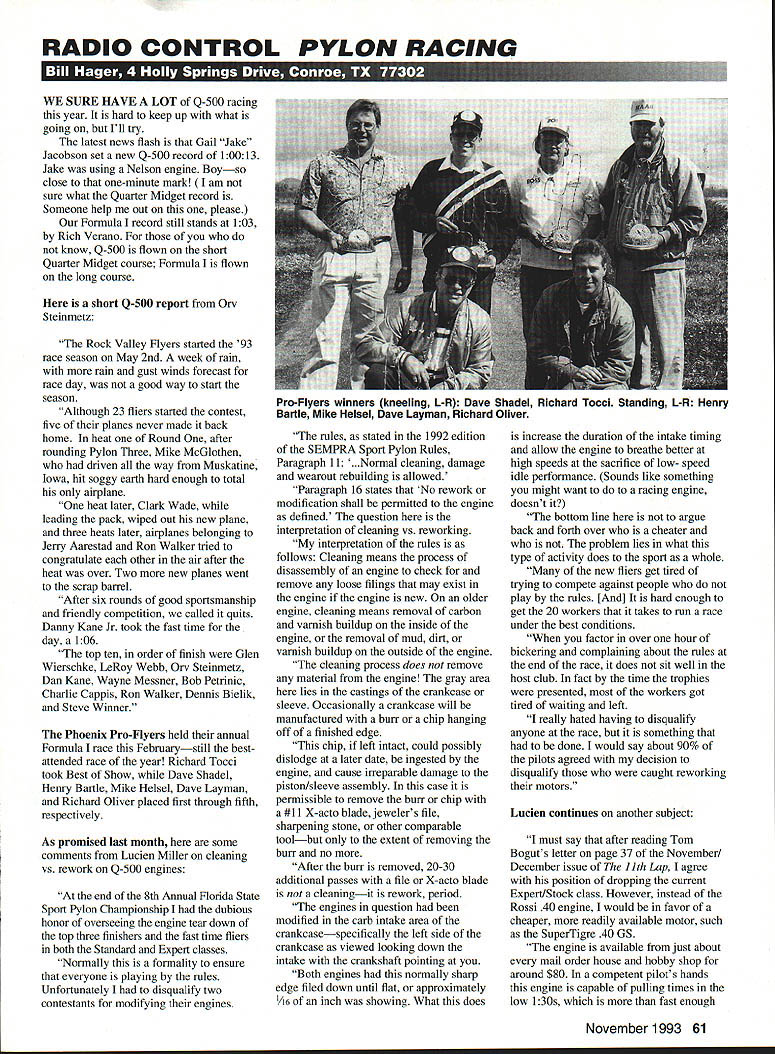
The Phoenix Pro-Flyers held their annual Formula I race this February—still the best-attended race of the year. Richard Tocci took Best of Show, while the top five finishers were:
- 1st: Dave Shadel
- 2nd: Henry Bartle
- 3rd: Mike Helsel
- 4th: Dave Layman
- 5th: Richard Oliver
Cleaning vs. Rework (Lucien Miller)
At the 8th Annual Florida State Sport Pylon Championship I had the dubious honor of overseeing the engine teardown of the top three finishers and the fast-time fliers in both the Standard and Expert classes.
Normally this is a formality to ensure that everyone is playing by the rules. Unfortunately, I had to disqualify two contestants for modifying their engines.
The rules, as stated in the 1992 edition of the SEMPRA Sport Pylon Rules, Paragraph 11: "...Normal cleaning, damage and wearout rebuilding is allowed."
Paragraph 16 states that "No rework or modification shall be permitted to the engine as defined." The question here is the interpretation of cleaning vs. reworking.
My interpretation of the rules is as follows: Cleaning means the process of disassembly of an engine to check for and remove any loose filings that may exist in the engine if the engine is new. On an older engine, cleaning means removal of carbon and varnish buildup on the inside of the engine, or the removal of mud, dirt, or varnish buildup on the outside of the engine.
The cleaning process does not remove any material from the engine. The gray area here lies in the castings of the crankcase or sleeve. Occasionally a crankcase will be manufactured with a burr or a chip hanging off a finished edge. If left intact, it could possibly dislodge at a later date and be ingested by the piston/sleeve assembly causing irreparable damage to the engine. It is permissible to remove the burr or chip with a #11 X-acto blade, jeweler's file, sharpening stone, or other comparable tool—but only to the extent of removing the burr and no more.
After the burr is removed, 20–30 additional passes with a file or X-acto blade is not a cleaning... it is rework, period.
The engines in question had been modified in the carb intake area of the crankcase—specifically the left side of the crankcase as viewed looking down the intake with the crankshaft pointing at you. Both engines had this normally sharp edge filed down until flat, about 1/16 of an inch was removed. What this does is increase the duration of the intake timing and allow the engine to breathe better at high speeds at the sacrifice of low-speed idle performance. Sounds like something you might want to do to racing engines, doesn't it?
The bottom line here is not to argue back and forth about who is a cheater and who is not. The problem lies in what this type of activity does to the sport as a whole. Many of the new fliers get tired of trying to compete against people who do not play by the rules. It is hard enough to get the 20 workers that it takes to run a race under the best conditions.
When you factor in over an hour of bickering and complaining about the rules at the end of the race, it does not sit well in the host club. In fact, by the time the trophies were presented, most of the workers got tired of waiting and left.
I really hated having to disqualify anyone at the race, but it is something that had to be done. I would say about 90% of the pilots agreed with my decision to disqualify those who were caught reworking their motors.
Lucien continues on another subject:
I must say that after reading Tom Bogut's letter on page 37 of the November/December issue of The 11th Lap, I agree with his position of dropping the current Expert/Stock class. However, instead of the Rossi .40 engine, I would favor a cheaper, more readily available motor, such as the Super Tigre .40 GS. The engine is available from just about every mail-order house and hobby shop for around $80. In a competent pilot's hands this engine is capable of pulling times in the low 1:30s, which is more than fast enough for any Standard class flier.
A new flier could purchase two Scat Cat kits, two engines, plus all of the MonoKote, glue, and hardware needed to complete them for about $275. This would allow just about anyone to fly a "Stock" class competitively, while allowing those with money to burn, or an incurable need for speed, to fight it out in the Modified class.
Why join NMPRA?
I am a very strong supporter of the racing organization that has gotten us to where we are racing today: the National Miniature Pylon Racing Association (NMPRA).
Why should you join NMPRA? Well, as with any organization, 90% of the work is done by about 5% of the people. This 5% requires the support and a small amount of input from the rest in order to adequately represent them.
NMPRA is the official advisory group to the AMA for Pylon Racing. The leverage we can apply depends on numbers. If we were a group of only five or so, the AMA would never recognize us.
If you like to race model aircraft, you need NMPRA's voice concerning:
- noise limitations
- insurance
- flying sites
- speed records
- team selection
- national coverage in magazines
- racing rules
- qualifications of contest directors
All of these apply to your special interest and your ability to find places to enjoy the sport.
Without your support, those that actively work for the betterment of pylon racing are severely handicapped. Let your voice be heard!
Good leaders usually have ideas of their own. It is imperative, however, to temper those ideas with the thoughts, needs, and desires of the fliers they are supposed to represent. To do this, your voice as a member must be heard. To give credence to your voice, you must show your interest by at least being a supporting member.
Information and national recognition—the newsletters and the hard work of the scorekeepers keep you abreast of the latest technical developments, contests, national products, and keep you posted on how well you are doing in relation to your peers.
NMPRA has developed a unique scoring system, designed to lessen the gap between those regions of the country with large turnouts and those with small turnouts. During the last year, two individuals from the Northeast ranked in the top 20 nationally in Formula I races and received national recognition. The average turnout of their Formula I races was under 20.
Finally, NMPRA does need funds to operate and be an effective voice. Fundraisers, dues, and gifts are the source. There are no paid helpers in NMPRA; the volunteers' time and travel expenses are donated. Your support can do a little for your sport. Join NMPRA—and bring a friend, too!
For more information write to: David Doyle 133 Shannon Dr. Warwick, RI 02889
See ya next month!
Transcribed from original scans by AI. Minor OCR errors may remain.

