
RADIO CONTROL PYLON RACING
Bill Hager, 4 Holly Springs Drive, Conroe, TX 77302
New Formula I engine from Dub Jett
FLASH—FLASH—FLASH: For you Formula I fliers, we have another engine to use. This engine is being built by Dub Jett.
For those of you just getting started who do not know who Dub Jett is: he is our current FAI (Formula I) World Champion and winner of the last two AMA Nationals.
This engine is available and legal now, as I write this column. With Dub's extensive engine-building experience I am sure this will be a very good engine. I already have one in my plane.
The latest Jett engine is $250 (engine only). With Dub's special remote needle valve the price is $275. This puts the price back to what used to be charged for a custom Prather Tiger. Wow — what a deal!
Houston AT-6 Races (report by Mike Wise)
In August I attended Houston's first AT-6 Races. This event seems to be getting very popular. I was very impressed; this group put on a great contest. Mike Wise has this report:
The Houston R/C Air Races Group, chaired by Formula I pilot Wiley Brown, organized and ran the first Giant Scale R/C Air Races in Texas for AT-6s/SNJs June 24–27, 1993. Houston became the second site on the Giant Scale Air Racing Association's (GSARA) circuit for 1993 races.
The host club, Bayou City Flyers, with the assistance of several other area clubs, hobby shops, manufacturers, and sponsors, provided the machinery and support necessary to run the event successfully the first time out. Welcome guidance and support were provided by David Birdi, president of GSARA, and Lesley Burnett, Madera Unlimited Races, both of whom attended this year's race.
Although the race site, Dick Scobee Memorial Field, suffered from lingering effects of tropical storm Arlene, some 2,500 spectators turned out between the rain showers to watch the racing action, which was fast-paced, competitive, and fun.
Teams from Texas, Kansas, Indiana, and California competed in eight rounds and 24 heats Saturday and Sunday, earning points toward final class standings. Each heat race consisted of six laps around the 3/4-mile course, which was laid out with 40-foot-high pylons topped with Texas flags. An excellent turn caller, light system, and gate system made for fast laps and few cuts.
Registration and qualification began on Wednesday the 23rd and continued until Saturday. Ron Nelson of Houston was the last to qualify, after spending a week of late nights finishing his Saxton AT-6. He qualified with the gear down due to retract problems, but ended up winning first-place Bronze after faster planes dropped out due to crashes and other problems.
The experience of Charles Winter from Merced, California, with Race #60 showed as he set the pace for three laps as fast qualifier with a time of 1:16, winning the $1,000 prize. Chuck and his team also won the AT-6 Gold at this year's RUMARA races (Reno Unlimited Model Air Race Association). Many of us saw his yellow and black AT-6 strike the pylon in the '92 Madera videotape, and we know how tight a course he flies.
As luck would have it, although he was running away from the pack in Houston with points, Chuck lost his model in a crash on Sunday, thus finishing third in Gold. Hopefully his winnings of prize money and new Robart landing gear will find him back in the air soon.
Minor and major crashes also claimed a few other competitors. One which caught the crowd's attention was that of Houstonian John Murphy's AT-6, which was piloted by John Dent. The model was almost lost the day before due to a loose motor mount, but was repaired. During its next attempt to qualify, control was lost due to either radio or battery problems. Its ensuing crash was watched by both the pilot and crowd as it orbited left in shallow, full-throttle turns until it impacted with a mighty splash, which brought a moan from the crowd.
Another loss, although repairable, was Randy Ritch's SNJ from Houston, which spiraled after running out of gas and stalling at the end of a heat race on Saturday.
The two most skillful pilots were Charles Winter and Tom Street of Houston, flying Wiley Brown's Byron AT-6. These pilots demonstrated such concentration and smoothness that their flying can only be compared to flying the course on rails.
From the flying start behind the pace plane in which the planes gained altitude before rounding pylon number two, through the diving, low-level pass at the start/finish line, to the tight, high-G turns at the pylons, these pilots set the standard for AT-6 race flying.
The format of stock 1/5-scale planes with 101-inch wingspans, stock Zenoah G-62 engines, sponsor-supplied props and fuel (Zinger 22 x 10s and Ritch's Brew) proved again that pilot skill is the deciding factor.
All of the heat races were competitive. One of the closest and most exciting was on Saturday during Round Two, Heat 8, in which Richard Oliver from Houston, Loren Tregellas of Wichita, Kansas, and Jim Goad Jr. from Carmel, Indiana, raced virtually wingtip-to-wingtip. Oliver, flying Wiley Brown's Byron AT-6, crossed the finish line first with a time of 3:11.03, followed by Tregellas at 3:16.03, and Jim Goad Jr.'s Ziroli AT-6 finishing third at 3:19.07. This was typical of some of the closer races throughout the weekend, and it really brought the crowd to its feet.
Unfortunately, at the end of the race, a landing accident (in which Oliver's beautiful red model was stopped by a pilot safety net) had Loren Tregellas slip and fall on top of the plane as he was trying to get out of the way. The resulting damage eliminated Richard's model from further racing.
Jim Goad Jr.'s ISC International Zenoah-sponsored fluorescent pink model was one of the crowd favorites, due to its highly visible paint scheme and competitive racing speed. Jim is an up-and-coming pilot and should prove a circuit threat with more practice.
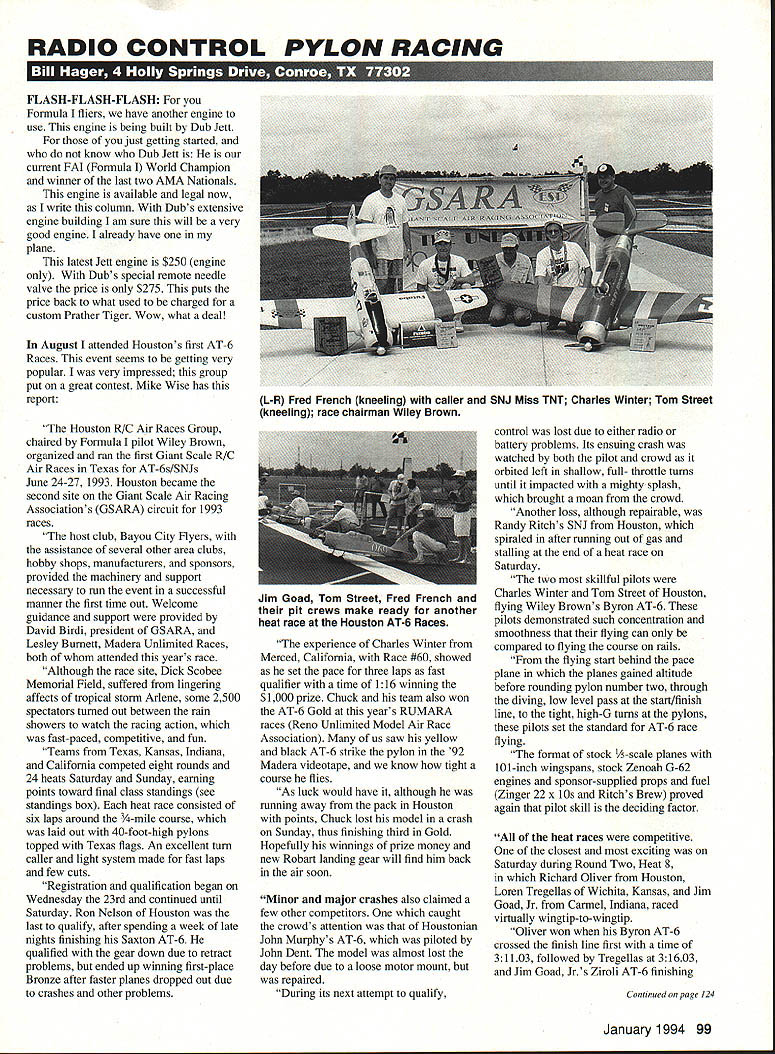
The scale SNJ types brought to the race, such as Phil Vance from Alvin, Texas, were also among the crowd favorites. Fred French, from Round Rock, Texas, won the Pilots' Choice Award as well as second place Gold. Fred's victory rolls at the end of his heats sure got the crowd's attention.
In between the weekend racing were giant scale flight demonstrations. Two of the fliers were B.B. Weber's B-17 bomber runs, and Tom Street's beautiful Ziroli Beech-18, which executed one of the most picture-perfect wheels-up landings ever seen.
Some special events included the Pilot and Team Pool Party/Social on Friday night, and the Texas-style barbecue on Saturday. The barbecue was donated by Tommy Jackominy of Houston's Hofbrau House, and was cooked on a pit trailer so big it looked like a steam locomotive — yeah, it's Texas!
Manufacturer products and display booths included local hobby shops and Tommy Walker's engine setup (Robart's Mr. Radial). Seeing this radial beauty run was indeed impressive.
Manufacturer sponsorship included a complete, ready-to-fly Lancer RC giant scale Stinger, donated by Bubba Spivey, which helped promote the event locally and was a key to the event's bottom line. Other sponsors included ISC International, Futaba, Tru-Turn, and Saxton Glass, as well as a surprise cash donation by the RUMARA organization.
The public interest generated in RC (and the sport of Giant Scale racing) by this event was overwhelming. It was not only proof that sponsorship from the hobby's major companies is a smart investment in the future, but ensured that next year's races in Texas will be unlimited!
Plans for 1994 are already underway, and include major sponsors, an airport race site, and much more. The Houston R/C Air Races Group has renamed itself the Texas Unlimited Air Racers Group (TUARG).
Contact information:
- Texas Unlimited Air Racers Group (TUARG): 141 Bent Spur Lane, Houston, Texas 77064; Tel./FAX: (713) 469-6460.
- Giant Scale Air Racing Association (GSARA): 1744 Greenwood Ave., Torrance, CA 90503; Tel.: (310) 212-3257; Fax: (310) 320-8354.
Contact TUARG if you would like more information or a videotape of the 1993 AT-6 races. If you would like further information about Giant Scale air racing, contact GSARA.
Thanks, Mike! Next month I will let you know how the new Jett Formula I engine did at its first contest.
See you at the races.
Transcribed from original scans by AI. Minor OCR errors may remain.

