
Radio Control: Pylon Racing
Dave Lane
BY THE TIME you read this article, you should have one or two races under your belt for the 1977 season and you should be aware of the fact that Ron Shorr is president of the NMPRA for one more year.
Whit Stockwell is the new secretary and has asked me to encourage you pylon racers to support the NMPRA in 1977. The $10.00 for membership includes the monthly newsletter, membership card, patch and decals. Considering the price of patches and decals these days, $10.00 is a bargain. If the NMPRA is to survive and be the spokesman for all pylon fliers to the AMA, we need to support the organization 100 percent.
I know that there have been some unhappy people in the past, but I think 1976 proved that the Quarter-Midget and Formula-One factions can work together on a national level. So, get on the bandwagon and get your racing groups to sign up! Time's awastin'. Send your dues to NMPRA, 4000 Hayvenhurst Ave., Encino, CA 91436, c/o Whit Stockwell.
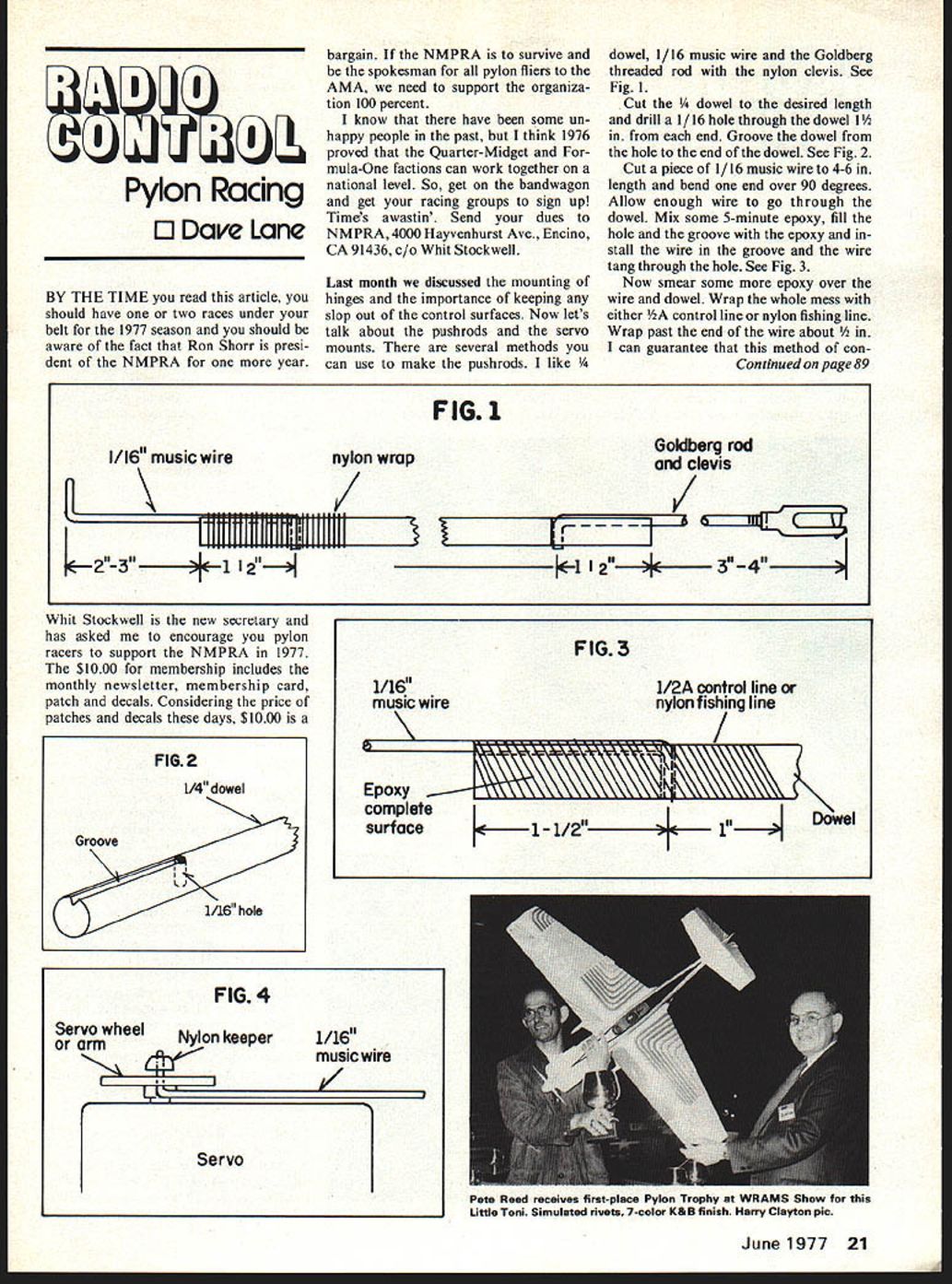
Last month we discussed the mounting of hinges and the importance of keeping any slop out of the control surfaces. Now let's talk about the pushrods and the servo mounts. There are several methods you can use to make the pushrods. I like 1/4" dowel, 1/16" music wire and the Goldberg threaded rod with the nylon clevis. See Fig. 1.
Cut the 1/4" dowel to the desired length and drill a 1/16" hole through the dowel 1-1/2 in. from each end. Groove the dowel from the hole to the end of the dowel. See Fig. 2.
Cut a piece of 1/16" music wire to 4-6 in. length and bend one end over 90 degrees. Allow enough wire to go through the dowel. Mix some 5-minute epoxy, fill the hole and the groove with the epoxy and install the wire in the groove and the wire tang through the hole. See Fig. 3.
Now smear some more epoxy over the wire and dowel. Wrap the whole mess with either 1/2A control line or nylon fishing line. Wrap past the end of the wire about 1/2 in. I can guarantee that this method of constructing a pushrod will never fail in flight.
Now let's hook up the pushrod, servo wheel arm and control surface. The clevis should be a snug fit onto the control horn. Keep slop minimum and also make sure there are no binds in the hookup. The clevis must move freely on the horn. On the other end of the pushrod, bend the wire 90 degrees about 5/16 in. and insert it through the hole in the servo arm wheel. See Fig. 4. Install a nylon keeper over the wire on the top of the servo arm as insurance against the pushrod vibrating out of the servo. Set up the servo linkages properly. The servo body will also keep the pushrod from dropping out. The servo arm wire should push fit the servo arm. Keep the slop minimum.
I hope this has helped speedsters who may have some problems with sloppy control systems and flutter.
I've heard some disturbing news concerning Quickie-500 racing. It seems engine restrictions are going to be lifted; already in the Southern California area .500s are competing with Formula events. I thought Q-500 guys wanted to get into pylon racing without having to fight the super-engine syndrome. Sounds like it will go that way — racing the fastest possible engines. The cost and hang-ups suppose we will see two classes: Q-500 just as a Quarter-Midget formula, something like that.
In the interest of bringing new people into pylon racing, I would like to see a class set up for novices — beginner, whatever you want to label it — where an individual who wants to learn to fly and compete in pylon would have his needs satisfied. Maybe we need class racing based on categories similar to pattern classes. Once an individual has mastered the art of going straight and turning left with stock equipment, have him graduate to more sophisticated engines and aircraft. To draw the line, I would say an individual able to consistently fly the standard Formula-One course under 150 with stock equipment is ready for the advanced class.
I would like to hear from people thinking of getting into pylon who don't because they see super-fast engines tearing up the course. I know we need another racing class like this; I believe it will entice new blood into the sport. Don't set up a basic class that the newcomer can't use. The CPC Chicago area has come up with a plan to help out races and will pay $1,000 per day for full days wor to the more sophisticated engines and aircraft. How do you draw the line? I would say when an individual is able to consistently fly the standard Formula-One course under 1:50 with stock equipment, he is ready for the more advanced class.
I would like to hear from you people that are thinking of getting into pylon, but don't because all you see are the super-fast engines tearing up the course.
I know we need another racing class like we need a hole in the head, but I believe we will not entice new blood into the sport if we don't set up a basic class for the newcomer.
The CPC in the Chicago area has come up with a plan to get more help out to the races. They will pay $10.00 per day for a full day's work for a pit crew member. They also carried a motion to allow any airplane being kitted for the 500 class to be allowed as long as it is built to kit specifications. Front rotor 40's may be used, but no pumps, mufflers, or exhaust extensions! Sounds as if you guys in the Chicago area are trying to do what I have been harping on. How do you get away with no mufflers?
I'm sure everybody knows by now that pylon at the Nationals will be in the afternoon each day. You can plan on some wind and probably a lot of smog. Visibility will be limited, so plan some bright color schemes.
Dave Lane, 4477 136th, Hawthorne, CA 90250.
Transcribed from original scans by AI. Minor OCR errors may remain.

