
RADIO CONTROL PYLON RACING
Bill Hager 4 Holly Springs Drive, Conroe, TX 77302
We voted in some new rules this year. The Quarter Midget event was totally changed from the way we had been flying since Quarter Midget began. I have talked to a lot of people who did not agree with what was done: those people are QM fliers.
How did this happen? I am not sure; possibly those who are supposed to represent the fliers voted on what they wanted rather than what the fliers wanted. I am not saying that this happened, but if the shoe fits, wear it!
How do we prevent this from happening again? Contest board members are appointed by your district VP. If you do not think that you are being represented, put pressure on the VP to appoint someone else. It is that simple.
A reminder to you elected and appointed representatives: your job is to represent us. Your personal feelings should be put aside.
It is a shame that an event that drew 40 entries to the 1993 Nats was wiped out by the stroke of a pen and replaced with an event that has never been flown. Something is very wrong here! Again, if the shoe fits, wear it. I am open for comments on this.
Pylon Racing — South of the Border (Lyle Larson)
Luis Garcia Blake was my host when I attended a race at the R.C. Pegaso Club in Toluca, Mexico. Toluca is located outside of Mexico City at an elevation of approximately 7,200 feet. The club itself is absolutely beautiful. The facility offers runways in four directions, each 700 to 800 feet in length. The runways are surrounded by manicured green grass and are fully fenced, with an on-site guard twenty-four hours a day.
In addition to the flying facilities, the club boasts two tennis courts, a basketball court, a playground, and an RC car racing track. The clubhouse is equipped with a full kitchen and an entertainment center including stereo, TV, and recording equipment, plus a fireplace and cozy conversation areas. Everything was kept immaculate by a very professional staff.
Each member of the club has his own hangar, approximately 8 x 10 feet, where they can keep models and equipment. The hangars are equipped with electrical outlets and lights.
The race was very well run. Racers and their crew were issued identification cards, and no one was allowed to enter the pit area without one. Each racer was assigned his own area, which included a concrete picnic table located under an awning. The spectator area was roped off and everyone was protected by 20-foot fences surrounding the pit and spectator areas. Radios were checked in at the beginning of the day and kept in glass cases; they were delivered to each racer on the field when it was his turn to race.
I arrived at the field on Friday for test flying. Not expecting to go very fast due to the altitude, I turned my elevator up one number on the transmitter; it seemed to work perfectly. The flying was a lot like I expected, but faster. My fast time for the weekend was 117. The altitude definitely affects your time.
Saturday I attended the pilots' meeting, which was all spoken in Spanish (I later gave a building/flying class in English). The race got started about 10:00 a.m.—after all, we were in Mexico! The trained work crew did a fabulous job. Imagine my surprise when the first race of the day, the fliers all took off into the wind towards pylons two and three. Then they turned around to come back at pylon one.
By the second round, the wind had changed direction and we were taking off correctly. They did not have the capability of moving the pylons; however, Luis Garcia has promised to put the pylons on rollers so this situation can be corrected at the next race.
I was pleasantly surprised at the quality of fliers in Mexico City. All seemed to be of equal talent. But watch out, because they are a very young club now; they are working hard and will definitely be a threat in the near future.
The most memorable race was my race against Luis Garcia. We flew wingtip-to-wingtip for 20 laps, and would still be racing if we had enough fuel!
I cannot say enough about the hospitality offered by these people; from the moment my plane landed in Mexico City, I was provided with a driver and guide. Everyone went out of his way to make sure I was where I was supposed to be on time and that I had everything I needed.
I would like to say a special thank you to Luis Garcia Blake and his family, Ernesto Mendez and his daughter Monica, Felipe Green, and Guillermo Montiel and his wife. These people and many others gave a special touch that made me feel very welcome and at ease in a very foreign country.
I am looking forward to organizing a race in conjunction with Luis Garcia, perhaps next September. He has assured me that every racer who comes down from the United States will be provided with his own sponsor to help him through rough spots, i.e., airports, motels, language, transportation.
I will be talking to most of you over the next few months about this possibility. Please try to put aside some time next September to attend. I have never been so impressed with a race as I was with this one. Words cannot do justice to the facilities or the people; you will not regret making the time to experience the R.C. Pegaso Club.
Remote Needle Valve Fuel System (Formula 1) — Dub Jett
I asked Dub Jett to write about racing, and here is what he has to say about installing and operating the remote needle valve fuel system for Formula 1.
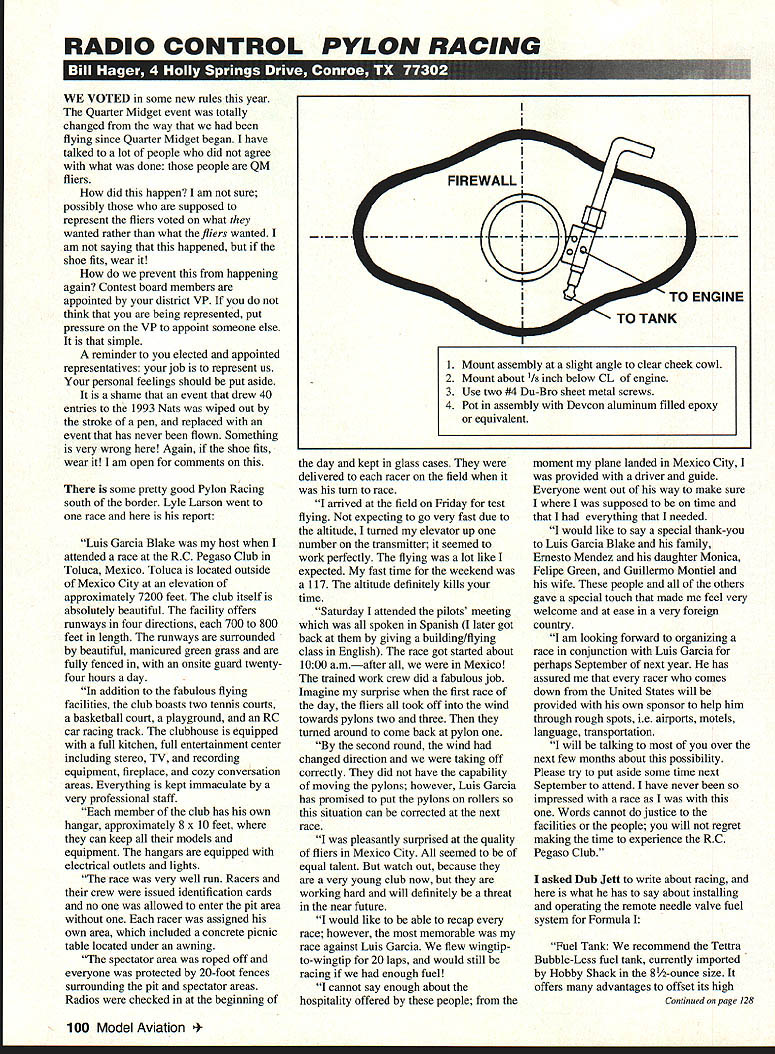
- Mount the assembly at a slight angle to clear the cheek cowl.
- Mount about 1/8 inch below the centerline of the engine.
- Use two #4 Du-Bro sheet metal screws.
- Pot the assembly with Devcon aluminum-filled epoxy or equivalent.
#### Fuel Tank
We recommend the Tettra Bubble-Less fuel tank, currently imported by Hobby Shack in the 8-1/2-ounce size. It offers many advantages to offset its higher price.
- Assemble the tank with only one line inside the bladder, instead of the two shown; you will not need the overflow part, but will use a vacuum fill instead.
- Cut the internal fuel tubing to about half the length of the tank and notch the lid like a crown to make sure the bladder can't plug the fuel inlet.
- Deburr the front edge of the tank where the bladder overlaps.
- This tank needs only a minimum amount of foam padding, if any. Place the tank level with as much of the fuselage surface as possible, making sure that nothing is pinched.
- Use Prather medium tubing inside the fuselage, which is almost impossible to pinch off. Outside the fuselage, convert to a softer tubing for the shutoff—Aero-Tred medium or small is recommended. The shutoff must be leakproof when the radio is off.
#### Remote Needle Valve Assembly
Install the remote needle valve assembly on the firewall inside the left cheek cowl, with the centerline of the assembly about 1/8 inch (3 mm) below the centerline of the airplane. You may need to angle the needle slightly to make room for hookups, but avoid unnecessary sharp turns. A longer loop around the mount may be better.
#### Vacuum Filling
We use the 5-ounce (150 ml) syringe from Sig. Withdraw all the air from the tank with the syringe and purge the air. Connect to the tank and release the syringe, adding more fuel if necessary. Repeat the process until 7-1/2 ounces is added (for Formula 1).
If you are unable to draw a vacuum, either your shutoff or your tank is leaking. Check the bladder for vacuum leaks before installing. You might try to practice the filling before you install the tank.
[Article text truncated]
Transcribed from original scans by AI. Minor OCR errors may remain.

