
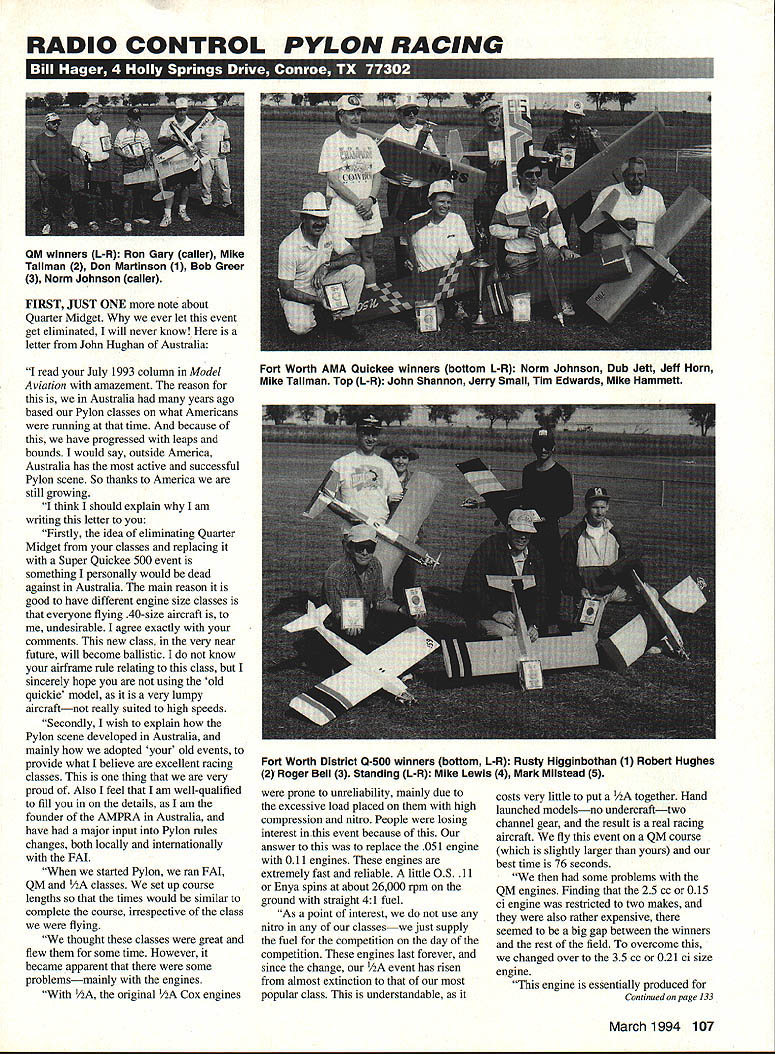
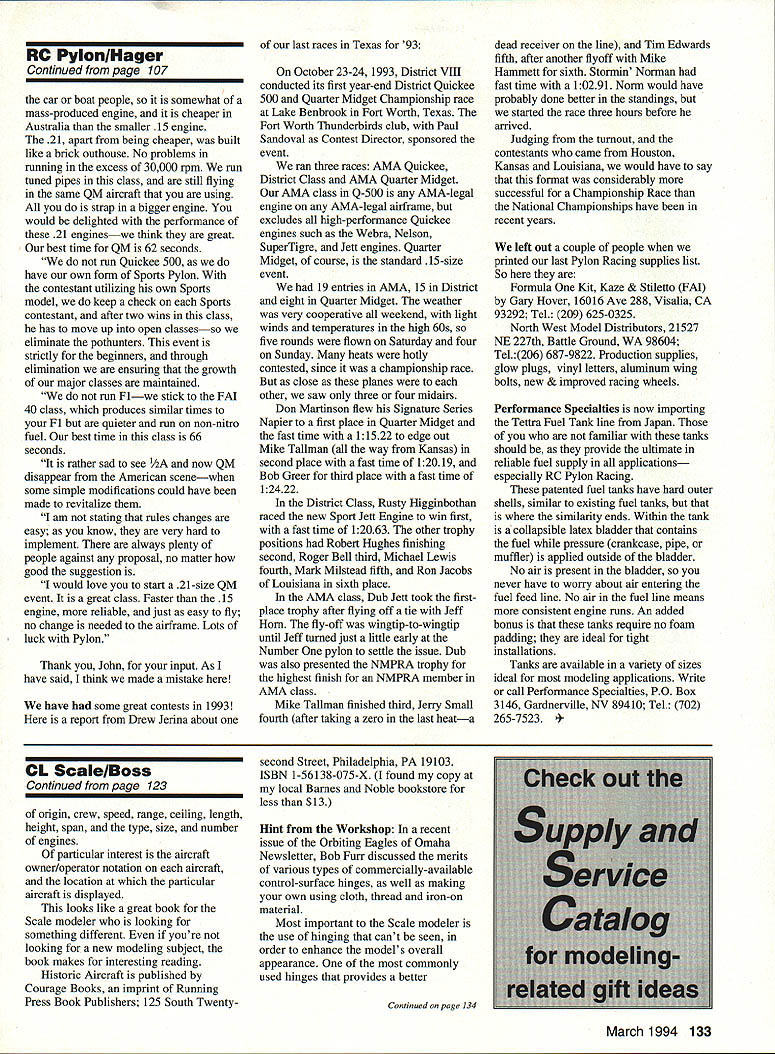
RADIO CONTROL PYLON RACING
Bill Hager, 4 Holly Springs Drive, Conroe, TX 77302
Letter from John Hughan (Australia)
First, just one more note about Quarter Midget. Why we ever let this event get eliminated, I will never know! Here is a letter from John Hughan of Australia:
I read your July 1993 column in Model Aviation with amazement. The reason for this is, we in Australia had many years ago based our Pylon classes on what Americans were running at that time. And because of this, we have progressed with leaps and bounds. I would say, outside America, Australia has the most active and successful Pylon scene. So thanks to America — we are still growing.
I think I should explain why I am writing this letter to you:
Firstly, the idea of eliminating Quarter Midget from your classes and replacing it with a Super Quickee 500 event is something I personally would be dead against in Australia. The main reason is it is good to have different engine size classes so that those flying .40-size aircraft are not excluded. I agree exactly with your comments: this new class, in the very near future, will become ballistic. I do not know your airframe rule relating to this class, but I sincerely hope you are not using the "old Quickie" model, as it is a very lumpy aircraft — not really suited to high speeds.
Secondly, I wish to explain how the Pylon scene developed in Australia, and mainly how we adopted your old events to provide what I believe are excellent racing classes. This is one thing that we are very proud of. Also I feel that I am well qualified to fill you in on the details, as I am the founder of AMPRA in Australia, and have had a major input into Pylon rule changes, both locally and internationally with the FAI.
When we started Pylon, we ran FAI, QM and 1/2A classes. We set up course lengths so that the times would be similar to complete the course, irrespective of the class we were flying.
We thought these classes were great and flew them for some time. However, it became apparent that there were some problems — mainly with the engines.
With 1/2A, the original 1/2A Cox engines were prone to unreliability, mainly due to the excessive load placed on them with high compression and nitro. People were losing interest in this event because of this. Our answer to this was to replace the .051 engine with .11 engines. These engines are extremely fast and reliable. A little O.S. .11 or Enya spins at about 26,000 rpm on the ground with straight 4:1 fuel.
As a point of interest, we do not use any nitro in any of our classes — we just supply the fuel for the competition on the day of the competition. These engines last forever, and since the change, our 1/2A event has risen from almost extinction to our most popular class. This is understandable, as it costs very little to put a 1/2A together: hand-launched models — no undercarriage — two-channel gear — and the result is a real racing aircraft. We fly this event on a QM course (which is slightly larger than yours) and our best time is 76 seconds.
We then had some problems with the QM engines. Finding that the 2.5 cc (0.15 ci) engine was restricted to two makes, and they were also rather expensive, there seemed to be a big gap between the winners and the rest of the field. To overcome this, we changed over to the 3.5 cc (0.21 ci) size engine. This engine is produced by several manufacturers, making it more available and affordable.
Radio Control: Pylon Racing
We have had some great contests in 1993! Here is a report from Drew Jerina about one of our last races in Texas for ’93:
District VIII Quickee 500 and Quarter Midget Championship
Lake Benbrook, Fort Worth, Texas — October 23–24, 1993 Contest Director: Paul Sandoval (Fort Worth Thunderbirds)
District VIII conducted its first year-end District Quickee 500 and Quarter Midget Championship race at Lake Benbrook. We ran three races: AMA Quickee, District Class and AMA Quarter Midget. Our AMA Q-500 class is any AMA-legal engine on any AMA-legal airframe, but excludes all high-performance Quickee engines such as the Webra, Nelson, SuperTigre, and Jet engines. Quarter Midget, of course, is the standard .15-size event.
We had 9 entries in AMA, 15 in District and 8 in Quarter Midget. The weather was very cooperative all weekend, with light winds and temperatures in the high 60s, so five rounds were flown on Saturday and four on Sunday. Many heats were hotly contested, since it was a championship race. But as close as these planes were to each other, we saw only three or four midairs.
Results and highlights:
- Quarter Midget
- 1st: Don Martinson — Signature Series Napier — fast time 1:15.22
- 2nd: Mike Tallman (Kansas) — fast time 1:20.19
- 3rd: Bob Greer — fast time 1:24.22
- District Class
- 1st: Rusty Higginbotham — Sport Jett engine — fast time 1:20.63
- 2nd: Robert Hughes
- 3rd: Roger Bell
- 4th: Michael Lewis
- 5th: Mark Milstead
- 6th: Ron Jacobs (Louisiana)
- AMA Class
- 1st: Dub Jett — won after a fly-off tie with Jeff Horn (the fly-off was wingtip-to-wingtip until Jett turned just a little early at Pylon No. 1)
- Dub Jett was also presented the NMPRA trophy for the highest finish by an NMPRA member in AMA class.
- 3rd: Mike Tallman
- 4th: Jerry Small — took a zero in the last heat due to a dead receiver on the line
- 5th: Tim Edwards — won a flyoff with Mike Hammett for sixth
- Fast time: Stormin' Norman — 1:02.91 (Norman likely would have placed higher, but we started the race three hours before he arrived.)
Judging from the turnout — with contestants from Houston, Kansas and Louisiana — this format was considerably more successful for a Championship Race than the National Championships have been in recent years.
Supplies
We left out a couple of people when we printed our last Pylon Racing supplies list. So here they are:
- Formula One Kit, Kaze & Stiletto (FAI) — Gary Hower
- Address: 16016 Ave 288, Visalia, CA 93292
- Tel.: (209) 625-0325
- North West Model Distributors
- Address: 21527 NE 227th, Battle Ground, WA 98604
- Tel.: (206) 687-9822
- Production supplies, glow plugs, vinyl letters, aluminum wing bolts, new & improved racing wheels
Tetra Fuel Tanks (Performance Specialties)
Performance Specialties is now importing the Tetra Fuel Tank line from Japan. Those of you who are not familiar with these tanks should be, as they provide the best available fuel reserve for use in all applications — especially RC Pylon Racing.
These patented fuel tanks have hard outer shells, similar to existing fuel tanks, but what is inside is where the similarity ends. Within the tank is a collapsible bladder which isolates the fuel and keeps the pressure (crankcase, pipe, or muffler pressure) applied outside of the bladder.
There is no air present in the bladder, so you never have to worry about air entering the fuel line. Add an internal vent tube to the tank and your engine will be even more consistent. The additional bladders and other related items are ideal for tight installations.
Tanks are available in a variety of sizes ideal for most modeling applications.
Performance Specialties P.O. Box 3146, Gardnerville, NV 89410 Tel.: (702) 265-7523
Transcribed from original scans by AI. Minor OCR errors may remain.

