
RADIO CONTROL PYLON RACING
Bill Hager 4 Holly Springs Drive, Conroe, TX 77302
Here we are at the start of another racing season. Last winter, three-time AMA Formula I Nats winner Dub Jett came up with some ideas that might create new interest in Formula I. We are always open to new ideas, so here we go.
I have put together a laundry list for an "alternate" F1. Obviously not all items will be acceptable, but at least you can get the gist of the project.
Proposed engine rules
- Engine rules will be the same except for the following:
- After January 1, 1996, all engines will be front induction (this eliminates rear rotors).
- Mufflers will be required. Dimensions will be determined, but will be similar to Nelson/Jett mufflers (may be slightly smaller, not any longer; fixed outside diameter, length, outlet, etc.).
- Engines must run on muffler pressure.
- No fuel regulators, electronic or electromechanical engine controls, in-flight mixture controls, or anything similar.
- One glow plug utilizing a 1/4-32 thread.
Fuel
- Fifteen-percent fuel will be contest-supplied; the contents will be specified.
- Fuel might be mixed at the site with a couple of witnesses.
- Several policing ideas were discussed; stiff penalties for cheating are preferred.
Model rules
Models will be the same except for the following changes:
- Weight: 4 pounds, 12 ounces.
- Maximum wingspan: 50 inches.
- OK to fly without wheel pants.
- Engine head fins may be exposed without affecting scale points.
- No cockpit detail required.
- Cheek cowls must be within 10% of cross-section on both sides.
- No speed bumps.
- Maximum three-color paint schemes; numbers on canopy — maybe a fourth color. The canopy must be painted on. No metallics, transparents, pearls, or other exotic custom paints.
- Two 2-1/4-inch wheels, at least eight inches apart.
I'm sure there are more good ideas, but I have tried to include the suggestions that address the most troublesome areas.
Implementation plan
- Get the blessing of the District VPs, who in turn get the blessing of the membership. We cannot expect 100% acceptance, but a majority will do nicely.
- Immediately allow these racers to fly at all NMPRA F1 contests and get points.
- Lobby the AMA and Wayne to allow them at the Nats.
- Police the rules informally until we decide whether to make it an official event.
- Recruit at least two pilots from each district to fly the new setup (even though it may be slightly slower — I do not think it will be).
- Jerry Small and I have volunteered to do the necessary R&D. Henry, Dave, Lyle, and anyone else are welcome to join. This is not a commercial operation, but an effort to save an event we all love.
- I will provide one engine to each volunteer; Jerry will provide one kit and the test airframe.
- During April I will conduct a weekend fly-in in Texas to get everyone started.
Two important points:
- Takeoffs must be 1-3-2-4. These models could easily be discriminated against by the scale judges, and we should not continue to eliminate 25%–50% of the competition before the race starts. People must believe they have a chance to win or they won't race.
- Formula I, as it is now, is too much trouble, too noisy, and too costly in time and money. Fifteen-percent fuel will save engines; if you stay away from tuned pipes we will be able to go to a contest with one or two engines that will last all year. The wing change addresses and eliminates the need to build composite wings to compete. New paints and techniques result in safer, lighter models that will land and fly better.
I would like the support of the new Quarter Midget guys — they were the only ones who had the guts to try something to fix our problems.
Background and rationale
We have tried 15% before with disappointing results: models were slow, engine sound was weak, and reliability problems persisted. We burned out motors and plugs, used expensive fuel, and lost competitors because it was too much hassle.
However, Quickie fliers come to our races and enjoy consistently completing flights without burning out equipment. They get to race and concentrate on flying; they have fun. That experience points to the potential of combining 15% fuel with rear-exhaust mufflers (Quickie-style) and mild sleeve timing changes to get reliable, fun, and more accessible F1 racing.
The idea is simple: take current racers, add rear-exhaust Quickie mufflers, alter sleeve timing slightly, and run on 15% contest fuel.
First flight report (Jerry Small)
As Rich Tocci and I drove across Dallas to the Seagoville flying field, we discussed the problems and decline of Formula I. Something had to be done, but what? We both voiced concerns about changing anything — we like the beautiful models and the roar and smell of nitro.
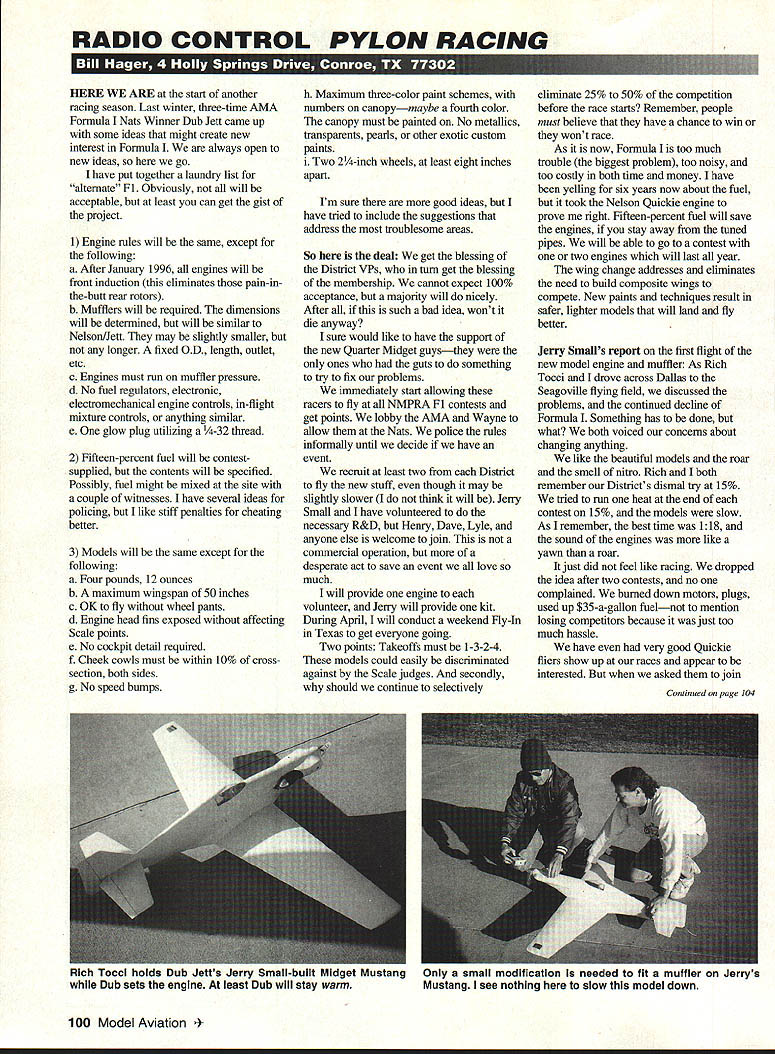
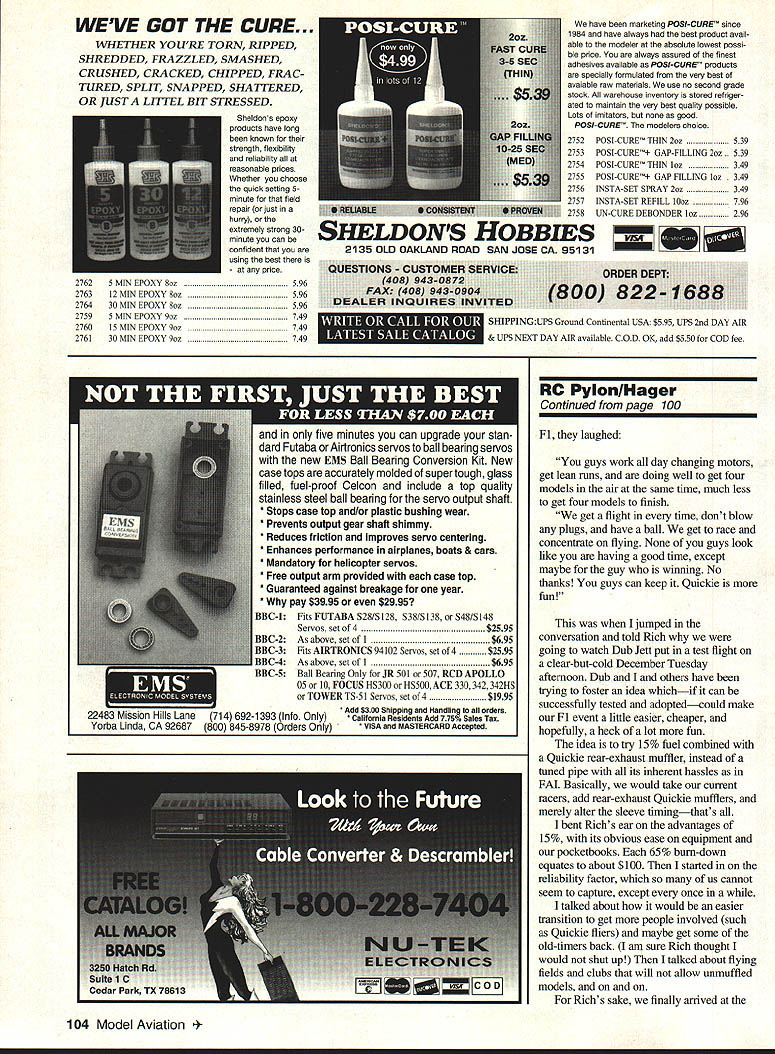
Dub was waiting at the field. He already had the model fueled with five ounces of 15% and was ready to fly. I held the model while Dub started it and set the needle. The prop was a Rev-Up 8-3/4 x 6-1/2 cut to about eight inches and barely cleaned up. The needle had a ton of range, it peaked at about 24,000 rpm, and idled around 23,000 rpm (this was a trim flight).
The model trimmed quickly, but the motor died after about four circuits and Dub had to land. "Must have been too lean" was our first guess. We refueled and checked the plug — still good. We fired it up again; it ran a few laps and died again, leaving a streak of metalized oil down the fuselage.
We discovered the header was loose. Dub tightened it with Loctite and on the third try it went about 15 laps and trimmed out well. On the fourth flight, on the course, it turned a very impressive 1:11. This was a 1:11 on a clipped, unworked prop with very little research on raised timing or the muffler.
The model used only about four ounces of fuel on that flight, and the plug was still perfect.
We have already seen the consistency of Quickie engines, and if that consistency could be achieved in F1, I fully believe we would have a much more fun event and get more people involved. A 1:11 first attempt is not slow, and though it is not as loud as current 65s, it is loud enough. If fliers can consistently get run-after-run without burning down equipment, it will not be boring.
Proposal and call to action
We need to test this idea in actual competition and let those who have the guts try it and gain national points. More than likely, anyone learning to compete on 15% and Quickie mufflers will be beaten initially, so why would anyone complain about points?
If we agree that F1 will continue to decline in its current form, we must start trying ideas to fix it. It may not work, but what harm is there in letting a handful of people try it in competition, watch, make suggestions, and then propose rules based on test results? I do not want another Quarter Midget fiasco.
If we want to continue having contests and clubs willing to host them, we must make positive steps to ensure our future. Remember: this idea is just a test.
Thanks, guys. I will keep you posted on how this goes.
Transcribed from original scans by AI. Minor OCR errors may remain.

