
Radio Control: Pylon Racing
Bill Hager, 4 Holly Springs Drive, Conroe, TX 77302
Due to a pretty severe winter, the last six months have been very slow. However, last fall someone was seriously injured at a pylon race. During the winter months the NMPRA put together a new race procedure guide. When used along with the AMA rule book, this guide should help those putting on a pylon race. Please pay attention to the safety requirements — safety is the #1 concern for all R/C pylon Contest Directors (CDs).
Safety Procedures
Violation of these procedures may result in cancellation of all NMPRA Championship Points that contestants would have earned at such a contest.
- The pit and spectator areas must be outside the minimum distances as stated under the heading "Course."
- Protective barriers (see Course Equipment) shall be at all pylons and the lap counters area for course workers. Judges and other officials should use these barriers except for momentary instances where exposure outside the safety protection is absolutely necessary to perform duties.
- Except for the #2 and #3 pylon judges and contestants, no one may be in the danger area near the #3 pylon while any aircraft is flying on the course.
- Hardhats for all workers and contestants on the course are suggested.
- Keep a minimum number of people out on the course. This means no ready areas on the course. The CD or starter shall remove anyone they feel does not belong.
- Callers shall stay with their pilots until all aircraft have landed.
- The starter has full authority to halt a heat at any point if an unsafe condition exists (e.g., person or vehicle approaching the course). The heat must be reflown, without prejudice, before the start of the next round. There is no appeal to this decision. The starter also has authority to issue penalties for other safety-related issues (see Pilots' Meeting).
- All course workers and contestants shall be briefed on safety aspects of their involvement and instructed in the proper performance of tasks and use of all safety devices. Individuals in protective cages or behind barriers must be cautioned to remain well clear of the surface of the barrier.
During an event, the CD has authority to initiate any special procedures necessary to eliminate unsafe situations.
Manpower and Responsibilities
The Contest Director along with the host club must provide the following personnel and equipment.
Required Positions
- Contest Director (CD)
- Starter (1)
- Assistant Starter (1)
- Lap Counters (4)
- Pylon 1 Head Judge (1) and Lane Judges (3 or 4)
- Pylon 2 & 3 Judges (total 6)
- Pit Boss (1)
- Fuel/De-fuel attendants (1–2, where required)
- Registration (1–2)
- Safety / Dimension Inspectors (at least 2)
Additional requirements:
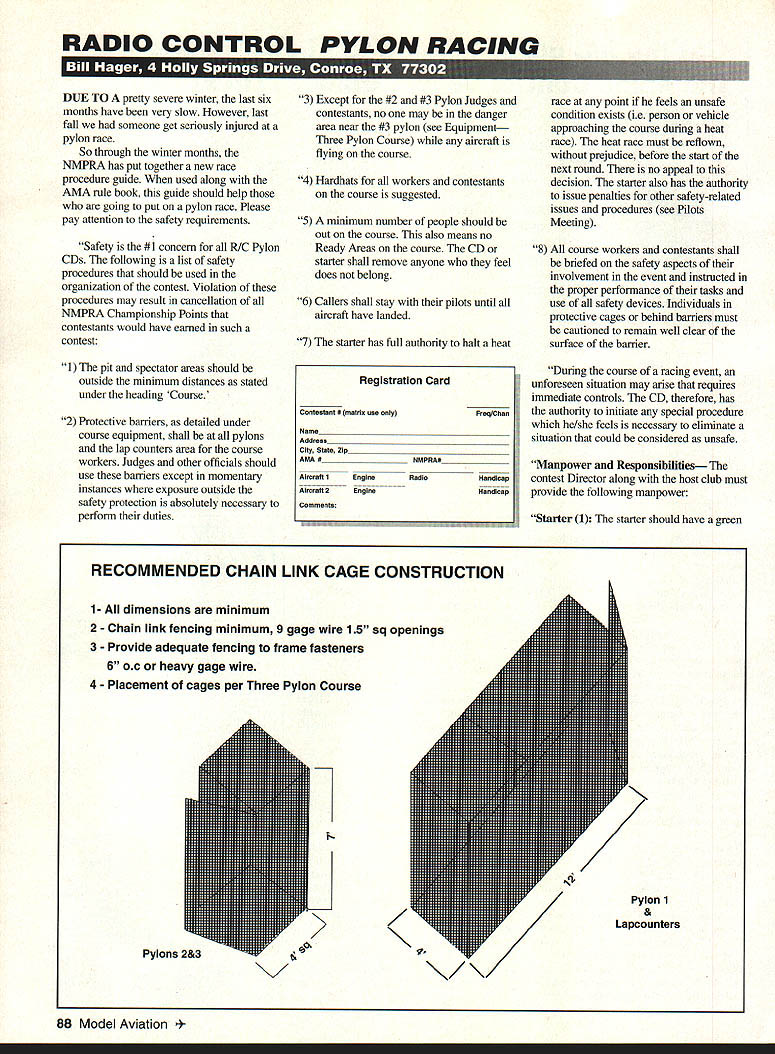
- Placement cages per the Three Pylon Course diagram (see Course Equipment).
- Communications between assistant starter, all pylon judges, lap counters, registration desk and pit boss.
Contestant Registration Card (recommended fields)
- Contestant # (matrix use only) — Freq/Chan
- Name
- Address — City, State, Zip
- NMPRA #
- AMA #
- Aircraft 1 — Engine, Radio, Handicap
- Aircraft 2 — Engine, Radio, Handicap
- Comments
Recommended Chain-Link Cage Construction
- All dimensions shown are minimums.
- Use chain-link fencing, minimum 9-gauge wire, 1½" square openings.
- Provide adequate fencing frame fasteners at 6" on center or heavy-gauge wire.
- Place cages per the Three Pylon Course layout (pylons 2 & 3; pylon 1 & lap counters).
Starter / CD Decisions and Starting Procedures
- The Starter and the CD should be two separate people. This provides an independent opinion to help settle disputes and calm arguments. The starter is the head official of the flight line and is expected to be fully backed up by the CD.
- The starter should stand to the left of the starting line closest to the #1 aircraft starting position.
- When aircraft are lined up on the starting line for a heat, the starter should have each contestant (starting with position #1) hold up the aircraft above the head for color/identification at the #1 pylon. Show top, bottom and sides.
- When all planes are identified, the starter should remind contestants to turn on their radios and announce the beginning of the starting period.
- The timing and method of release (single, staggered, or grouped) depend on the announcement at the Pilots' Meeting. The starter should confirm each pilot is ready before releasing their aircraft.
- The starter shall flag off aircraft or groups of aircraft in approximately one-second intervals only after the prescribed starting period has expired.
- If one or more contestants have difficulty starting their engines, the starter should still flag off the first aircraft when the starting period has elapsed. Each aircraft must be released when its flag is dropped.
- Example takeoff orders:
- Quarter Midget / Racehorse: 1, 2, 3, 4 — The #1 aircraft is released on the first flag, #2 on the second, #3 on the third, #4 on the fourth. If #1 fails to start, #2 still must wait for the second flag, etc.
- Formula 1, 424–428, Q500: either 1,2,3,4 or 1–3,2–4 takeoff orders (as announced).
- If an aircraft is released before it receives its flag, the starter shall impose a penalty (see Pilots' Meeting).
- If a contestant is disqualified for unsafe flying, or receives two cuts during a heat, they shall pull out of the race immediately after being personally notified (by their caller) or face automatic disqualification of their next heat.
- A disqualified pilot should not land until the remaining aircraft in the heat have finished. A disqualified aircraft should be flown at high altitude out of the way; however, if the pilot is experiencing difficulties they shall land immediately. The starter has sole authority to disqualify for unsafe flying and the decision is final.
- The starter should flag each aircraft as it crosses the finish line on its last lap.
- If a pilot cuts pylon #2 or #3 on the last lap but still receives a flag, the pilot shall fly another lap before being officially considered finished. If that last-lap cut is the pilot's second cut in the heat, the pilot is still disqualified even if they received the checkered flag.
- In a photo finish, the starter, assisted by the assistant starter, is the sole judge of which aircraft finished in front. Stopwatches should not be used to determine order of finish.
- If there is disagreement between pilots and officials concerning results, the starter should settle it immediately on the flight line. Official results may be changed only if a lap counter freely admits a mistake or if all pilots in the heat agree; if any pilot disagrees, the matter is dropped.
- If there is a foul-up at the #1 pylon (e.g., wrong flag/shutter/light), the offended contestant may request a refly. The refly will determine the finish position for aircraft in the contested heat only.
Assistant Starter
- The assistant starter keeps the heat score card at the starting line and confirms contestants are in correct starting order.
- Near the end of a heat, the assistant starter helps the starter ascertain order of finish.
- As aircraft cross the finish line, the assistant starter writes down the finishing position on the score card and records lap-counter stop-watch times. The score card is sent back to the registration desk with the heat winner.
- The pilot/caller with the heat score card shall weigh their aircraft before returning to the pits. The starter/CD may elect to weigh other aircraft.
Lap Counters (4)
- Choose the most experienced workers as lap counters. Each should have a stopwatch and flip cards for lap counting.
- Flip card system recommendations:
- Cards numbered 1–10, plus cut and double-cut indicators.
- Each successive card slightly larger than the previous to ensure only one flips at a time.
- Card should be visible to contestants.
- Card display rules:
- Start with no number showing.
- The card displayed is the number of laps completed (e.g., a '7' showing means 7 laps completed and on lap 8).
- Lap counters should identify and watch their assigned aircraft from the starting line and keep eyes on them throughout the heat.
- When informed that an aircraft has cut a pylon, the lap counter should flip the cut card instead of flipping the lap card for that lap.
- Depending on procedure, cuts may be posted at pylon #1 or at the lap counter cage.
- Lap counters start their watches when the starter drops the first flag. On the last lap they should shout "last lap, [color]" and point so the starter knows which aircraft is about to finish. Stop watches are stopped when the assigned aircraft crosses the finish line.
- There must be communications between assistant starter, pylon judges, lap counters, registration desk and pit boss.
Pylon 1 — Head Judge and Lane Judges
- The #1 pylon head judge should be a responsible adult with communications to the assistant starter and should relay all calls by the lane judges. The head judge has final authority at #1.
- Use of shutters at #1 is preferred; flags or lights are alternatives.
- Recommended flag colors (match to lane positions):
- #1 lane judge — yellow
- #2 lane judge — green
- #3 lane judge — white
- #4 lane judge — orange
- Judges should be stationed to the left of pylon #1 when viewed from the start/finish line; the #1 lane judge farthest from the pylon.
- During aircraft identification, each lane judge should wave the flag over their head (or blink lights / activate shutter) when their plane is held up.
- If more than one plane has the same color, the assistant starter should describe the aircraft to the #1 head judge, who relays to the appropriate lane judge.
- Lane judges must watch their aircraft at all times during the heat. Before the heat, flags should be raised; judges drop their flag smartly as their aircraft draws even with pylon #1.
- If an aircraft does not round pylon #1, the lane judge should point at the aircraft and shout "cut" while dropping their flag. The head judge then determines if a penalty is assigned.
- Decisions on cuts must be made immediately. If in doubt whether an aircraft cut a pylon, do not call the cut.
Pylon 2 & 3 Judges (6)
- Pylon #2 and #3 judges should be responsible adults positioned with the best view of their assigned pylon.
- Watch for cuts and unsafe operation near the pylons. If a cut is observed, point at the aircraft and shout "cut." The head judge will determine penalty.
- Judges must not stand in the danger area near pylons.
- Pylon judges should have communications with the assistant starter and signal immediately after an aircraft flies inside the pylon. If two aircraft fly inside simultaneously, give two signals and tell the assistant starter which two aircraft cut.
Pit Boss (1)
- The Pit Boss retrieves heat score cards from registration and calls contestants to the back-up area over the PA system.
- Contestants are called again when their heat moves to the ready line. It is the contestant's responsibility to be on the ready line when their heat moves to the starting line.
- On the back-up line, the Pit Boss assigns starting positions.
- The starting position for each contestant is recorded on the score card and given to one of the contestants going to the line.
- Either the Pit Boss or another official should notify the starter (via intercom or by waving a black flag) when an aircraft flies over the pit or spectator areas.
Starting Position Procedures
- Formula One: Aircraft handicap determines starting position. Ties broken by drawing numbers, coin flip, etc. The Best of Show aircraft takes first starting position and that heat uses the 1,2,3,4 takeoff.
- Q500, OM: Have each contestant draw a number (1–4) for starting lane position in that heat.
Fuel / De-Fuel Station (1 or 2 attendants; Q500, QMA, 1/2A)
- Provide two pumps near the back-up area: one to de-fuel and another to fuel the aircraft.
- Every contestant shall de-fuel/return their aircraft from these pumps before entering the back-up area.
- Aircraft must not be allowed to return to the pit area after the fueling operation.
- All appropriate AMA Rule Book regulations apply.
Registration (1 or 2)
- All contestants must register and show current AMA membership card and FCC license (ham only, if applicable).
- Pay entry fee if not pre-paid and fill out a registration card.
- Contestants may be asked to fill out the AMA Event Participation Form (Form 11) to aid the CD in final reporting.
Safety / Dimension Inspectors
- At registration each aircraft must be examined by a safety team consisting of at least two competent and knowledgeable individuals appointed by the CD.
- Inspectors should verify compliance with rules, safety hardware, control effectiveness and proper identification.
Specific Items to Inspect
- Clevises: Short pieces of rubber tubing used to secure all clevises to prevent them from becoming disconnected in flight.
- Engine mount: All screws holding the engine to the mount and the mount to the firewall must be in place and secure.
- Receiver and battery pack: Should be protected against vibration per manufacturer's recommendations. Servos operating elevator and aileron must be of sufficient size for the weight and speed of the aircraft.
- 1/2A: minimum servo torque 25 oz/in; minimum battery capacity 150 mAh.
- GM, Q500, FM: minimum servo torque 40 oz/in; minimum battery capacity 250 mAh.
- Giant scale: minimum servo torque 150 oz/in; minimum battery capacity 1200 mAh.
- Washers: Use washers on all screws holding servos to mounting trays and on screws holding trays to rails (washers approx. same diameter as grommets). Servos mounted directly to rails should also have washers on mounting screws. If screw head diameters are as large or larger than the grommet diameter, washers are not required. All servo trays, if used, must have at least one extra safety screw (not necessarily tightened) placed between grommets to prevent the tray from slipping out in flight.
- Pushrods: A keeper or collar should be on all pushrods that have a right-angle bend that connects to servos. Z‑bends are acceptable. If clevises are used at both ends of a pushrod, one clevis must be secured so the pushrod will not turn.
- Control surfaces: Must be firm on the hinge line without excess play (at the discretion of the safety inspector).
- Wing retention: Use positive, thread‑type wing bolts or screws on all two-piece aircraft.
- Wheels: A positive method of holding wheels onto axles must be used and wheels shall not bind.
- Airframe: Inspect the entire aircraft for any stress cracks.
- Registration numbers: Ensure each model entered has the correct contestant registration number on it.
- Any other applicable safety/dimension items per AMA and event-specific rules.
---
This guide summarizes recommended procedures and responsibilities for safe, fair pylon racing. Refer to the AMA rule book and the event Pilots' Meeting for class-specific procedures and penalties.
Transcribed from original scans by AI. Minor OCR errors may remain.

