
RADIO CONTROL PYLON RACING
Bill Hager, 4 Holly Springs Drive, Conroe, TX 77302
Handicap Judges
Criteria — Formula I only
The object of Formula I R/C Pylon Racing is to race miniature aircraft that resemble a specific full-scale Formula I aircraft. Since this is a semi-scale event and not a pure scale event, the purpose of judging is to ensure that models entered in the event are of high quality. A contestant may be required to supply three-view drawings and/or photographic proof that the plane entered resembles a full-size Formula I aircraft.
Judging should be done by two impartial officials. All aircraft should be lined up after registration. If there are a large number of aircraft, the judges should begin by tentatively dividing the aircraft into three or four rows based on average, good, and excellent workmanship. Any model that, in the judges' opinion, does not resemble a recognized full-size Formula I aircraft or does not have two photographs or three-view drawings should not be allowed to participate in the event. The Contest Director (CD) should make the final decision.
One effective approach is to select four to six pilots at random, have them rate each model from 1 to 4, discard the high and low scores, and average the remaining two to four scores to yield the final rating. "1" is the best rating.
When judging workmanship, officials should inspect the quality of construction and finish. Check for joints showing through the finish, fillets blending smoothly into the fuselage and wing, smooth finish without the texture of underlying material showing through, and other signs of careful construction. A multi-color paint scheme should generally be judged above an aircraft of one solid color; however, below-average workmanship on a three-color aircraft should be rated below good workmanship on a single-color aircraft. It is not necessary to have a super hand-rubbed finish for an aircraft to be considered excellent.
When judging realism, officials should consider cockpit detail (instruments, headrest), whether the aircraft has a pilot, and duplication of full-size construction methods (rivets, corrugated control surfaces, fuselage stringers, etc.). Such duplication should be considered but not given undue weight.
If a plane is judged with wheel pants, it must be flown with those pants on unless the CD determines that rough field conditions make their removal necessary. If the original wheel pants have been destroyed, the CD may allow a similar replacement. When wheel pants are present, aircraft without exposed engine heads should not be downgraded solely for enclosed heads; conversely, exaggerated bumps or cowlings that attempt to conceal an otherwise exposed engine should be downgraded. Bumps should not extend beyond the scale outline in top-side views.
After roughly ranking aircraft by workmanship and realism, judges should then consider scale outline. Judges should not go so far as to measure accuracy of the outline with a ruler or slide rule. Scale outline should be used as the deciding factor between aircraft of equivalent workmanship and realism. Judges should not pick up or handle a model unless it must be moved by the owner.
The aircraft designated Best Show may be selected without flying, but the aircraft must fly in at least one heat to qualify for contest awards. Judging should be done quickly, in a standing position; there is no reason to be closer than four or five feet to the model being judged. Airplanes should be marked in some way (for example, 1, 2, A, B) to ensure the proper handicap is assigned to the correct aircraft. Judges should have a list of contestants' names and rank aircraft according to the AMA Rule Book.
Alternate Handicap Judging Method
Refer to the "Focus on Competition" section.
Scorekeeper
This person (or persons) may also handle registration tasks once those duties are completed.
If a contestant is disqualified in a heat (penalty, underweight, etc.), the other contestants move up accordingly in heat positions. The scorekeeper converts heat finish positions into points.
- First place: 4 points
- Second place: 3 points
- Third place: 2 points
- Fourth place: 1 point
If all heats are three-place heats, then:
- First place: 3 points
- Second place: 2 points
- Third place: 1 point
No finish = 0 points.
Record points and times on the score board.
If a contestant is disqualified during or after the contest for cheating or unsportsmanlike conduct, their points will be reduced to zero and affected competitors will move up in the final standings. The CD will not go back into individual heats and change scores.
Matrix Overview
This section guides organizing aircraft by frequencies to arrive at a reasonably equitable series of heat races. Methods of selecting and recording can be tailored to local preferences and forms. The important points are to ensure frequency groups do not conflict and that there is a clear, readily interpreted list of groups available throughout the event.
Some basic rules should be kept in mind when operating a pylon race:
- A minimum of five rounds must be flown.
Transmitter Impound
A transmitter impound area should be provided near the ready area where all contestants shall impound their transmitters between heats. A contestant not doing so can be disqualified from the contest. The transmitter impound should be staffed by someone who will confirm that all transmitters are off. Transmitters should only be released when the contestant is in the back-up position to fly. Registration workers may also perform this task.
Contest Equipment
- Pylons — 15 feet min., 20 feet max., highly visible.
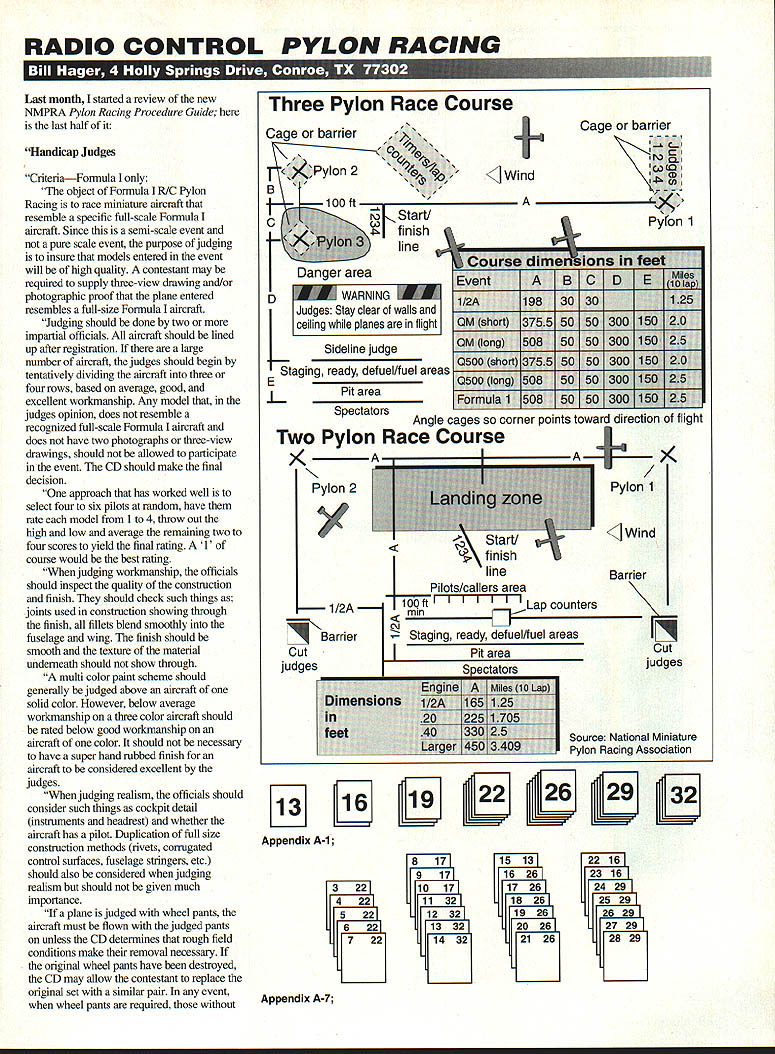
- Barriers for pylons 1, 2, 3, and lap counters (four sides and ceiling).
- Combination of hay bales and chain link fencing, or
- Chain link fencing (9 gauge x 1 1/2 inches min.). Provide adequate framing. Fasteners 6 inches on center or heavy gauge wire may be substituted. Cage material (7 feet high by 4 feet square) should not obstruct officials' vision. Composite or multi-layered barriers are encouraged (e.g., chain link plus Lexan or Kevlar, or two staggered layers of chain link).
- Steel mesh or equivalent material of sufficient strength to stop or capture the race model.
- Place warning signs of appropriate size on cages facing the inside.
- Lap/cut cards (one for each contestant in a heat).
- Shutter system, light system, or flags.
- Stopwatches (one for each timer/lap counter), and starter.
- Flags for starter — green, checkered, and black.
- Clipboards, paper, pencils.
- Communications between pylons 1, 2, 3, starter, and pit boss.
- Fuel and fuel pumps for Q500, QM, FAI.
- PA system.
- Scale for weighing aircraft.
- Score board.
The Course
The course should be laid out in accordance with the official diagram. All mandatory safety procedures shall be incorporated into the layout. The landing area should be set up outside the course opposite the pit area. Landings will not be made between pylons #2 and #3 at any time.
Pre-Race
You must publicize your race well in advance. All announcements for an R/C Pylon Contest should contain the following information: type of event, time, date, entry fee, prizes/trophies (to what places), number of rounds to be flown each day, classes to be flown, frequency control, starting time, registration time, any special rules, and the name and telephone number of the Contest Director. Also include deviations from normal race procedures, frequencies barred, road map to hotels and flying site, whether food will be available, etc.
A pre-entry form (optional) is recommended since it simplifies registration and frequency control. This form should include the pilot's name, address, AMA and FCC license numbers (Ham only), radio frequency/channel, NMPRA number, type of aircraft, make of engine, and radio manufacturer. Transfer this pre-entry information to the contestant's registration card before the contest.
Race Day
The registration desk should be staffed by one or more persons depending on expected entries. All contestants shall register at this desk and must show their current AMA and FCC licenses (for Ham frequencies only), pay the entry fee (if not prepaid), and confirm that their registration card is correct. All contestants not pre-entered must fill out a registration card.
At contests with low entries (usually one-day events), registration, safety/dimensional inspections, and optional handicap judging all occur before the event starts. Larger two-day events normally conduct these activities the night before.
When registration closes, the personnel responsible for generating the matrix use the registration cards to develop the matrix.
Pilots Meeting
The CD and starter shall brief all contestants before racing starts. Points to mention:
- Stress that all contestants should keep safety as their primary concern at all times.
- Explain any deviation from established contest procedures that will be used at the contest (e.g., takeoff options; 424, 428, Q500 and F1—1,2,3,4 or 1,2,3,4; QM—racehorse or 1,2,3,4). Decide whether contestants can fly without their wheel pants due to rough field conditions (Formula I only).
- Point out where Ready Box 1, Ready Box 2 (etc.), de-fuel/fuel, and transmitter impound (if used) areas are located.
- Designate an area for engine testing where the noise will not interfere with communications within the pit and spectator area.
- Explain the operation of the shutter system, light system, or flags; explain the lap counter cards (clip cards) and how and where cuts will be posted.
- Explain every situation that can lead to warnings, zero for the heat, or disqualification from a heat or the contest:
a. Low flying — warning, zero points. b. Retriever in landing flight path — instruct callers to stay with their pilot when landing so obstructions in the landing path can be pointed out. c. Early launch — warning, zero points. d. Flying over restricted areas, pits, spectators, etc. e. Altitude restrictions.
- Explain the option of early starting before the 90-second clock expires (QM, 428, Q500 only). If the starting clock is not used, the starter should explain the method used to designate the amount of time a contestant has left to start their engine.
- Point out any hazards on the flying field which may affect contestants while flying or landing.
- Starters' policy on flutter, parts falling off, mid-airs, and re-flies:
- If an aircraft is damaged during a heat and continues flying, the starter may disqualify the contestant if, in his/her opinion, the aircraft has sustained enough damage to make flying unsafe. In this situation, a contestant must land and be checked before resuming or face automatic disqualification.
- A re-fly should only be granted if the cause was organizational (internal radio problems, a transmitter left on but impounded, etc.). A pylon judge error, lap counter error, or impound worker not checking transmitters does not automatically constitute a re-fly.
Handicap Judges Criteria (Consolidated)
Formula R/C Pylon Racing requires models that resemble specific full-scale Formula aircraft. Judging aims to ensure high-quality semi-scale entries; contestants may be required to supply three-view drawings or photographs as proof of resemblance. Judging is performed by two impartial officials who line up aircraft after registration and tentatively divide them into categories (average, good, excellent) if many entries are present. Use the random-pilot-rating method (rate 1–4, drop high/low, average remaining) as a practical approach, with 1 being best.
Inspect workmanship (construction quality, finish, fillets, smoothness) and consider paint schemes appropriately. For realism, consider cockpit details, presence of a pilot, and duplication of full-size construction methods while avoiding over-emphasis on such methods. Wheel pants judged on the model must be worn during flight unless the CD authorizes removal; replacements are allowed if original pants are destroyed. Downgrade exposed engine heads and exaggerated bumps that misrepresent the outline. Use scale outline only as a tiebreaker between models of equal workmanship and realism. Do not handle models unless moved by the owner. Mark airplanes clearly so handicaps are assigned correctly.
Appendix-A Matrix Development
- Take the registration cards and separate them into different classes (e.g., expert, standard). For this example, use only one class. Count the cards, shuffle them, then separate different frequencies into groups.
- Divide the total number of cards by four, assuming four-plane heats. Round the result up to the next whole number. This is the ideal number of heats per round. Example: 26 contestants ÷ 4 = 6.5 → rounded = 7. The number of heats per round cannot be less than the largest frequency group. If four-plane heats cannot be worked out (frequency grouping too large or more than seven in any frequency group), divide by three and use three columns.
- Pick a numbered ball from a hat (1–4) to determine the starting column to fill. For example, pick column three.
- Take the largest frequency group and lay each card out vertically, starting from the bottom of the chosen random column. If the column is not filled, get the next largest frequency group that will fit and continue filling the column. Repeat until the column is filled or as close as possible. When selecting frequency groups, always choose the largest group that fits.
- Move to the next column (column four in this example) and repeat step four, filling from the bottom up.
- Repeat the process for columns one and two. Always fill columns sequentially (left to right), bottom to top, starting from the random starting column.
- Once all columns are filled, there may be empty positions at the top of one or more columns. Each heat is read across the columns (horizontal rows). Run the lesser plane heats first to help inexperienced workers adjust to pylon racing. Four-plane heats are preferred, then three-plane; never run two-plane heats when four-plane heats are expected. Break up four-plane heats to create more three-plane heats if necessary. Depending on frequencies, this example could produce five four-plane heats and two three-plane heats. Never deliberately position a contestant to face a specific other contestant — let the cards fall where they fall.
- With all cards positioned, start with the upper left-hand column and number each card (contestant number).
- Create a Master Round/Heat list by recording the heats (horizontal rows), in this case heats one through seven. To get the contest started, begin filling score cards while someone else continues with the master round/heat list.
- Published matrix tables (AMA Rule Book) may be used in place of steps 11 and 12. Simply match the matrix number with the contestant number. These tables also maintain a contestant's interval between rounds. Contestant numbers may also be used to tag transmitters if identification is necessary.
- Round two is created by shifting column two up one, column three up two, and column four up three. Record the horizontal rows onto the Master Round/Heat list for heats eight through fourteen.
- Repeat step 11 until repeats start to occur. Because seven is not evenly divisible by two or three, seven rounds can be created. For example, a four-by-six matrix will only produce five rounds using the tables before repeating; using the shift method, repeats occur after two rounds.
- During contests, the total number of table rounds may never be reached. Some contestants may never fly against others — the "luck of the draw." Decide beforehand how many rounds you will run to save yourself work.
There may be times when the desired number of rounds exceeds the tables. The tables could be repeated, but this causes contestants to fly against the same people. To vary the matchups, move contestants in the same frequency groupings to different columns (for example, move ch13 from column 3 to column 1 and ch16 from column 4 to column 2). Exercise care to maintain contestants' intervals from previous and upcoming heats. When satisfied, re-number the contest cards using a different color marker and repeat step 12.
Once the Master Round/Heat sheet is completed, transfer the names to the individual heat sheets (score cards) that will go to the line. Also include the contestants' frequency and handicap if applicable. Do not concern yourself with starting lane positions; the Pit Boss will assign lanes.
Next month we get back to what is going on in racing in early 1994. See ya!
Transcribed from original scans by AI. Minor OCR errors may remain.

