
RADIO CONTROL: PYLON RACING
Bill Hager, 4 Holly Springs Drive, Conroe, TX 77302
FLASH — Las Vegas Races
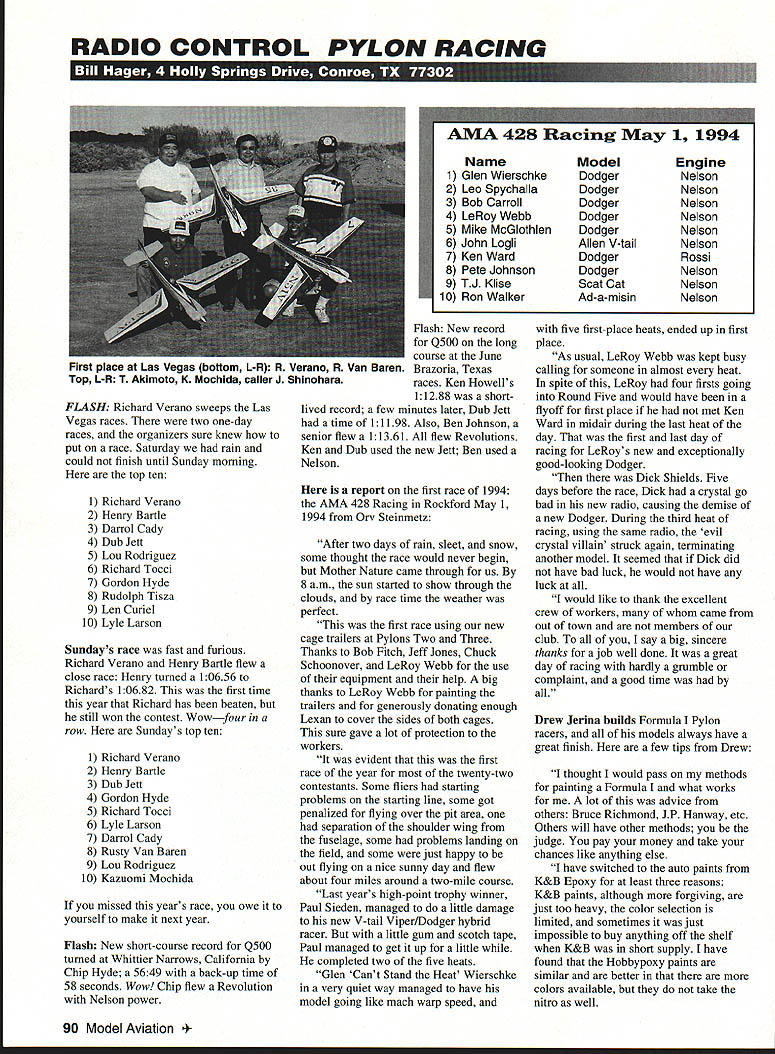
Richard Verano sweeps the Las Vegas races. There were two one-day races; rain on Saturday forced completion on Sunday morning.
Saturday's top ten
- Richard Verano
- Henry Bartle
- Darrol Cady
- Dub Jett
- Lou Rodriguez
- Richard Tocci
- Gordon Hyde
- Rudolph Tisza
- Len Curiel
- Lyle Larson
Sunday's race was fast and furious. Richard Verano and Henry Bartle flew a close race; Henry turned 1:06.56 to Richard's 1:06.82. This was the first time this year Richard was beaten in a heat, but he still won the contest — four in a row.
Sunday's top ten
- Richard Verano
- Henry Bartle
- Dub Jett
- Gordon Hyde
- Richard Tocci
- Lyle Larson
- Darrol Cady
- Rusty Van Baren
- Lou Rodriguez
- Kazuomi Mochida
If you missed this year's race, make plans to attend next year.
FLASH — Q500 Records
- New short-course record for Q500 at Whittier Narrows, California: Chip Hyde — 56.49 (backup 58.00). Chip flew a Revolution with Nelson power.
- New Q500 long-course record at the June Brazoria, Texas races: Ken Howells — 1:12.88 (short-lived); minutes later Dub Jett posted 1:11.98. Senior Ben Johnson flew 1:13.61. All flew Revolutions. Ken and Dub used the new Jett; Ben used a Nelson.
AMA 428 Racing — May 1, 1994 (Rockford)
Report by Orv Steinmetz
Name — Model — Engine
- Glen Wierschke — Dodger — Nelson
- Leo Spychalla — Dodger — Nelson
- Bob Carroll — Dodger — Nelson
- LeRoy Webb — Dodger — Nelson
- Mike McGlothlen — Dodger — Nelson
- John Logli — Allen V-tail — Nelson
- Ken Ward — Dodger — Rossi
- Pete Johnson — Dodger — Nelson
- T.J. Klise — Scat Cat — Nelson
- Ron Walker — Ad-a-misin — Nelson
After two days of rain, sleet, and snow some thought the race would never begin, but by 8 a.m. the sun started to show through the clouds and by race time the weather was perfect.
This was the first race using the new cage trailers at Pylons Two and Three. Thanks to Bob Fitch, Jeff Jones, Chuck Schoonover, and LeRoy Webb for the use of their equipment and their help. Special thanks to LeRoy Webb for painting the trailers and for generously donating enough Lexan to cover the sides of both cages — this provided a lot of protection for the workers.
It was evident this was the first race of the year for most of the twenty-two contestants. Some fliers had starting problems on the line, some were penalized for flying over the pit area, one had separation of the shoulder wing from the fuselage, some had problems landing on the field, and some were just happy to be out flying on a nice sunny day.
Last year's high-point trophy winner Paul Sieden suffered a little damage to his new V-tail Viper/Dodger hybrid racer, but with some gum and Scotch tape he managed to complete two of the five heats.
Glen Wierschke, quietly impressive, had his model running extremely well and with five first-place heats ended up in first place.
LeRoy Webb was kept busy calling for someone in almost every heat. He had four firsts going into Round Five and would have been in a flyoff for first place had he not met Ken Ward in midair during the last heat; that was the first and last day of racing for LeRoy's new Dodger.
Dick Shields had a run of bad luck: five days before the race a crystal failed in his new radio, causing the loss of a new Dodger. During the third heat, using the same radio, the crystal failed again and terminated another model. It seemed that if Dick did not have bad luck, he would not have any luck at all.
Thanks to the excellent crew of workers, many from out of town and not members of our club. A big, sincere thanks for a job well done. It was a great day of racing with hardly a grumble, and a good time was had by all.
Painting Tips — Drew Jerina (Formula I Pylon Racers)
Drew Jerina builds Formula I pylon racers and shares his methods for painting. Much of this advice comes from others (Bruce Richmond, J.P. Hanway, etc.). Methods vary by person; judge for yourself.
- Drew switched from K&B Epoxy paints to automotive paints for several reasons: K&B paints, while forgiving, are heavier, color selection is limited, and availability can be an issue. He found Hobbypoxy paints similar with better colors and that take nitro well.
- Auto paints are lighter and offer many colors, but are more expensive (many items come in gallons/quarts/pints). Using toners or base colors lets you mix colors rather than being stuck with a single pre-mixed can.
- Buy smaller quantities (two half-pints of different colors) to increase variety. Note that some toners are better for solids and others for metallics or pastels. Ask to see color charts for DMD toners and fleet colors.
- If ordering a mixed color, tell the shop to omit the clear — the finish will cover better. Some toners are too thin or transparent and require adding white to improve coverage.
- Drew uses the PPG DAU acrylic urethane system because it is readily available locally. He advises staying away from the DBU basecoat/clearcoat system; it is not fuelproof.
Cardinal rules
- The quality of the paint job is only as good as the surface preparation. Strive for perfection.
- Follow the manufacturer's instructions; do not experiment with mismatching catalysts, etc.
- Do not use anything with petroleum distillates on any surfaces before you paint.
- Do not use cheap masking tape — you do not want residue left behind.
- Use a mask with carbon filters when painting.
- Always strain the paint with disposable strainers: fine for paint, sealer, and clear; medium for primer.
- Try to paint outside on warm, calm, sunlit days.
- The manufacturer recommends painting within one week; if not, scuff the surface with 1000-grit before recoating.
- Filter your air supply for dirt and water, and use a compressor that gives 30–40 psi constant pressure. A regulator at the gun works best.
Primer/surfacer
- K36 gray primer / K201 catalyst / DT reducer. Mix 5:1:2.
- You can use DX-84 accelerator at 1 ounce per quart to speed drying.
Transcribed from original scans by AI. Minor OCR errors may remain.

