
RADIO CONTROL: PYLON RACING
Bill Hager 4 Holly Springs Drive, Conroe, TX 77302
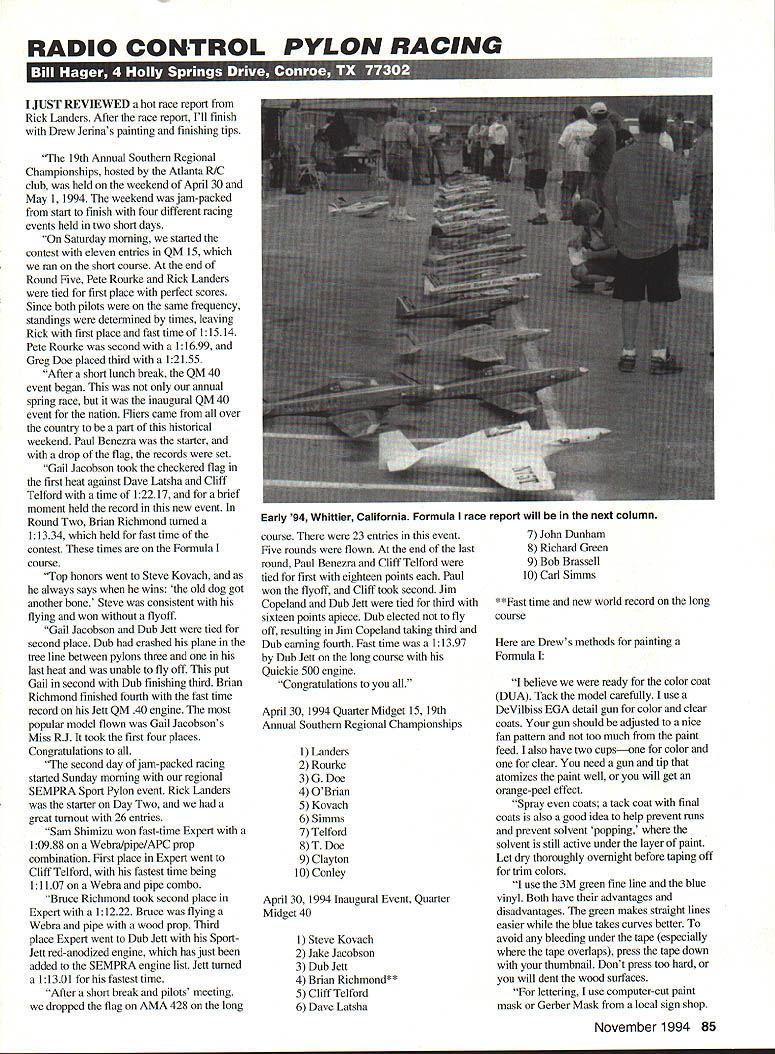
19th Annual Southern Regional Championships — Race Report
The 19th Annual Southern Regional Championships, hosted by the Atlanta R/C Club, were held the weekend of April 30–May 1, 1994. The two-day event featured four different racing events and drew competitors from across the country.
Saturday — QM-15 and QM-40
- QM-15 ran on the short course with eleven entries. After Round Five, Pete Rourke and Rick Landers were tied with perfect scores. Because both pilots were on the same frequency, standings were determined by times: Rick Landers took first with a fast time of 1:15.14; Pete Rourke was second with 1:16.99; Greg Doe placed third with 1:21.55.
- After lunch the inaugural QM-40 (also the annual spring race) was run. Paul Benezra dropped the flag to start the event. Gail Jacobson took the checkered flag in the first heat against Dave Latsha and Cliff Telford with a 1:22.17, briefly holding the record for the new event. In Round Two Brian Richmond turned a 1:13.34, which stood as the fast time for the contest (on the Formula I course).
- Top honors went to Steve Kovach, whose consistent flying earned him the win without a flyoff. Gail Jacobson and Dub Jett tied for second; Dub had crashed in the tree line between pylons three and one in his last heat and was unable to fly off, leaving Gail second and Dub third. Brian Richmond finished fourth. Gail Jacobson’s Miss R.J. was the most popular model and placed highly.
Sunday — SEMPRA Sport Pylon and AMA 428 Long Course
- The regional SEMPRA Sport Pylon event drew 26 entries. Sam Shimizu won fast-time in Expert with a 1:09.88 using a Webra with pipe and an APC prop. Cliff Telford won Expert (fastest 1:11.07 on a Webra/pipe combo). Bruce Richmond took second in Expert with a 1:12.22 (Webra/pipe with wood prop). Third in Expert went to Dub Jett, who turned a 1:13.01; the Sport-Jett red-anodized engine had just been added to the SEMPRA engine list.
- After a pilots’ meeting the AMA 428 long course was flown with 23 entries and five rounds. Paul Benezra and Cliff Telford tied for first with 18 points; Paul won the flyoff and Cliff was second. Jim Copeland and Dub Jett tied for third with 16 points; Dub elected not to fly off, giving Jim third and Dub fourth. Fast time on the long course was a 1:13.97 by Dub Jett on a Quickie 500 engine.
Official Results
April 30, 1994 — Quarter Midget 15 — 19th Annual Southern Regional Championships
- Landers
- Rourke
- G. Doe
- O'Brian
- Kovach
- Simms
- Telford
- T. Doe
- Clayton
- Conley
April 30, 1994 — Inaugural Event, Quarter Midget 40
- Steve Kovach
- Jake Jacobson
- Dub Jett
- Brian Richmond**
- Cliff Telford
- Dave Latsha
- John Dunham
- Richard Green
- Bob Brassell
- Carl Simms
** Fast time and new world record on the long course
Congratulations
Congratulations to all competitors and organizers for a successful, record-setting weekend.
Painting and Finishing Tips — Drew Jerina
Preparation and color coat
- Tack the model carefully before painting.
- Use a DeVilbiss EGA detail gun for color and clear coats. Adjust the gun to a nice fan pattern and avoid excessive distance from the paint feed.
- Keep two cups on the gun — one for color, one for clear.
- Use a gun tip that atomizes paint well to avoid orange peel.
- Spray even, light coats. Apply a tack coat followed by final coats to help prevent runs and solvent “popping” (trapped solvent under the paint).
- Let the color dry thoroughly overnight before taping off trim colors.
Masking and lettering
- Use 3M green fine-line tape for straight lines and blue vinyl for curves; each has advantages. Press the tape down with your thumbnail to avoid bleeding. Do not press too hard or you may dent wood surfaces.
- For lettering use computer-cut paint mask or Gerber Mask from a sign shop. Avoid plain vinyl lettering — it can peel the paint.
- I slant letters 15° for better appearance.
- Use six- or nine-inch green masking paper rolls and good-quality masking tape. Avoid cleaning tape residue between trim colors because removers often contain naphtha, which can seep under fine-line tape and ruin subsequent colors.
- Sequence colors so you can paint one after another without cleaning the surface when possible. Repeated light coats and tack coats reduce likelihood of bleed under fine-line tape.
Sanding and cleaning before clear
- After removing tape, use wet 1000-grit sandpaper to cut tape lines down (do not sand metallics).
- Clean and abrade the surface with Comet cleanser and water before clear coating; be gentle on metallics.
- Finally, wash with a light dishwashing soap and water solution — the surface should not bead water if clean.
- Inspect carefully for overspray or residue before clear coating. If overspray under clear is significant, apply one coat of Del Glo, then wet-sand with 600-grit to remove tape lines and flatten high spots. Del Glo dries fast and sands within 24 hours.
Clear coating and booth use
- If possible, use an auto body spray booth (ask a friend in the trade). Hang the plane at night and pick it up the next morning if you can use a booth after hours.
- Del Glo clears dry faster and are easier to repair and buff, but may need a couple of weeks before raw fuel can be used without discoloration. (Drew notes Del Glo takes about five to seven days to cure and is tougher against scuff, but more susceptible to attracting particles while clearing.)
- Tack the model twice with a new tack cloth before clearing. Wear old clothes, a long-sleeved shirt, and rubber gloves.
- Mist the booth and your clothing lightly with clear to try to trap airborne particles; let the booth’s positive airflow carry them away.
- Always do a tack coat, let set 5–10 minutes, then apply the final coat.
- Clear from bottom to top. Do parts and gear first to test the clear, then the wing, then the fuselage (this helps if particles land — you may sacrifice a wing rather than the fuselage when buffing).
Wet-sanding and buffing (the finish)
- To achieve a high-quality finish you must wet-sand and buff the clear. Recommended equipment and supplies:
- An electric circular buffer (e.g., 7-inch — Black & Decker model around $50).
- Meguiar’s compounds #2, #3, and #9 (about $8 each).
- Two or three 7-inch terry cloth polishing bonnets (about $3 each).
- 1000- and 2000-grit wet sandpaper with a rubber sanding block.
- Soft rags, towels, etc.
- Let the clear cure for at least 72 hours before wet-sanding.
- Soak sandpaper in water with a few drops of dishwashing liquid overnight to keep the paper from scratching the clear.
- Wet-sand with 1000-grit first, using a rubber block and a back-and-forth motion (avoid circular motion to prevent circular scratches). Keep the area wet and clean frequently.
- Follow with 2000-grit soaping and sanding until surface stops improving. Wipe clean and dry thoroughly.
- Use a clean bonnet over the lamb’s-wool pad and start with Meguiar’s #2 compound. Too much compound will gum up and stop cutting. A tablespoon or two of compound is usually plenty to start.
- When buffing, place the work on towels on a flat surface, hold it with one hand, and buff with the other; have someone else hold large pieces like wings while you machine-buff.
- Work patiently; buffing out imperfections is a test of character but yields a glossy professional finish.
Final note
- Practice good cleanliness and light, controlled application at every stage. Tack coats, light repeated coats, careful masking, and patient wet-sanding/buffing are the keys to a durable, attractive finish.
Transcribed from original scans by AI. Minor OCR errors may remain.

