
Radio Control: Pylon Racing
Wayne Yeager 15387 Forrister Rd., Clayton, MI 49235
Overview
Several racers told me they weren't going to the 1994 Nats because it was "too hot," "too dusty," or "too windy." I hate to say "I told you so," but the weather was lovely. It got quite warm in the afternoons after the day's flying finished, but mild temperatures and a steady morning breeze kept things comfortable. In fact, the weather for this Nats was some of the best since I've been involved.
Contestant entries were down across the board — sailplane, helicopter, pattern, control line, etc. — to about one-quarter of typical totals. Pylon entries were down as well, but there were adequate numbers in everything except FAI.
Quickee
We processed 102 Quickee models on the 15th and ended up with 63 entries, producing a 4-by-16 matrix. With a daily time allocation of 7 a.m.–1 p.m., we initially guessed about ten rounds.
On the first race day we had to wait to remove cages, flag poles, chairs, tables, etc., from the AMA truck because the strip was still open to commercial aviation. By the time the course was set up and we held a 15-minute pilot meeting, it was 8:30 a.m. — an hour-and-a-half late. Nothing else was flying that day, so we could have extended the schedule, but that would have been hard on the workers.
Early in the day our radio-communication units began failing due to low batteries. We discovered later that all units had new batteries installed and needed to be cycled a little; after the first day we had no further problems.
Safety changes and course length
A committee formed by AMA President Don Lowe examined safety practices and decided the longer Formula I course would be used for Quarter and Quickee. The rationale: Quickee had become too fast with new high-performance engines, and the short course did not give the average flier enough time to set up proper pylon turns. Many flyers disliked the change, but others praised it — one local flyer said the long course eliminated models buzzing over his head.
Day-by-day — Quickee highlights
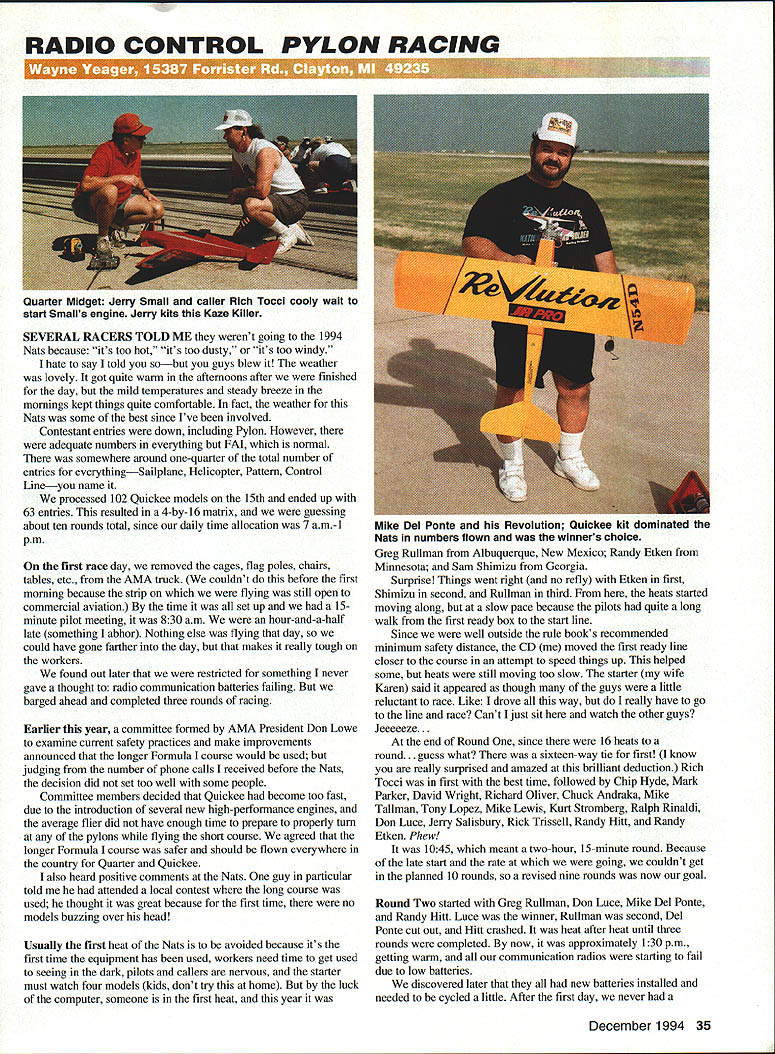
- First heat: Mike Del Ponte's Revolution was among the notable entries. The Quickee kit dominated the Nats in numbers flown and was the winner's choice.
- Round One: There was a 16-way tie for first (one winner per heat in Round One). The pilots in that tie included:
- Rich Tocci (best time), Chip Hyde, Mark Parker, David Wright, Richard Oliver, Chuck Andraka, Mike Tallman, Tony Lopez, Mike Lewis, Kurt Stromberg, Ralph Rinaldi, Don Luce, Jerry Salisbury, Rick Trissell, Randy Hitt, Randy Etken.
- By 10:45 a.m. Round One had taken about two hours and 15 minutes. Because of the late start and pace, we revised the target from 10 rounds to nine rounds.
- Round Two: Greg Rullman, Don Luce, Mike Del Ponte, and Randy Hitt were on the line. Luce won; Rullman was second; Del Ponte cut out; Hitt crashed.
- End of Day One: Tony Lopez and David Wright were tied for the lead, both with perfect scores. Many earlier leaders had lost points.
- Wind problems forced us to move the course 45° so takeoffs were almost directly into the wind. That made takeoffs easier but caused visibility issues for pilots trying to find the course; cuts increased because pilots couldn't use the runway edge as an aiming reference.
- Day Two: Rounds Four and Five completed; Lopez and Wright still shared the lead (all wins). After Round Six, both leaders registered zeros and fell in the standings. Chip Hyde then led, with Gary Schmidt one point back and Rich Tocci two points back.
- Day Three: Standard 7:30 a.m. start; Round Seven flown. At the end of Round Eight and Nine we had several ties that required flyoffs. We attempt to fly off all trophy positions even if a frequency change is needed.
- Flyoffs and final Quickee placings:
- 10th place flyoff: Sam Shimizu beat David Wright and took the tenth-place trophy.
- 7th–9th places: Jim Allen won among Richard Huffman and Jerry Small (Allen 7th, Huffman 8th, Small 9th).
- 6th: Mike Tallman (no flyoff).
- 5th: Tony Lopez (no flyoff).
- 3rd/4th flyoff: Ralph Rinaldi beat Rich Tocci (Rinaldi 3rd, Tocci 4th).
- 1st place flyoff: Gary Schmidt vs. Chip Hyde — see final recap below for winners and fast times.
Quarter Midget
This was the first Nats for the new .40-sized Quarter Midget; there were 24 entries. The .40 is slightly smaller than a Formula I, uses a Quickee-type engine with muffler and 15% fuel, and at this meet was theoretically faster than Quickee (and proved to be so).
Racing began with Tom Doe, Dub Jett, Bryan Shadel, and Bill Hager. Shadel won the opening heat. We had a perfect 4-by-6 matrix for Quarter Midget; the first round ended in a six-way tie for first among Richard Oliver, Tony Lopez, Travis Flynn, Richard Huffman, Bryan Shadel, and Jerry Small.
After Round Two the lead was down to two: Travis Flynn and Bryan Shadel. Rounds went quickly — with only six heats per round there were times when many pilots were staged at once, so we paused 10–15 minutes during rounds to let late pilots get ready.
At day's end:
- Rich Tocci led with a three-point advantage over Jerry Small.
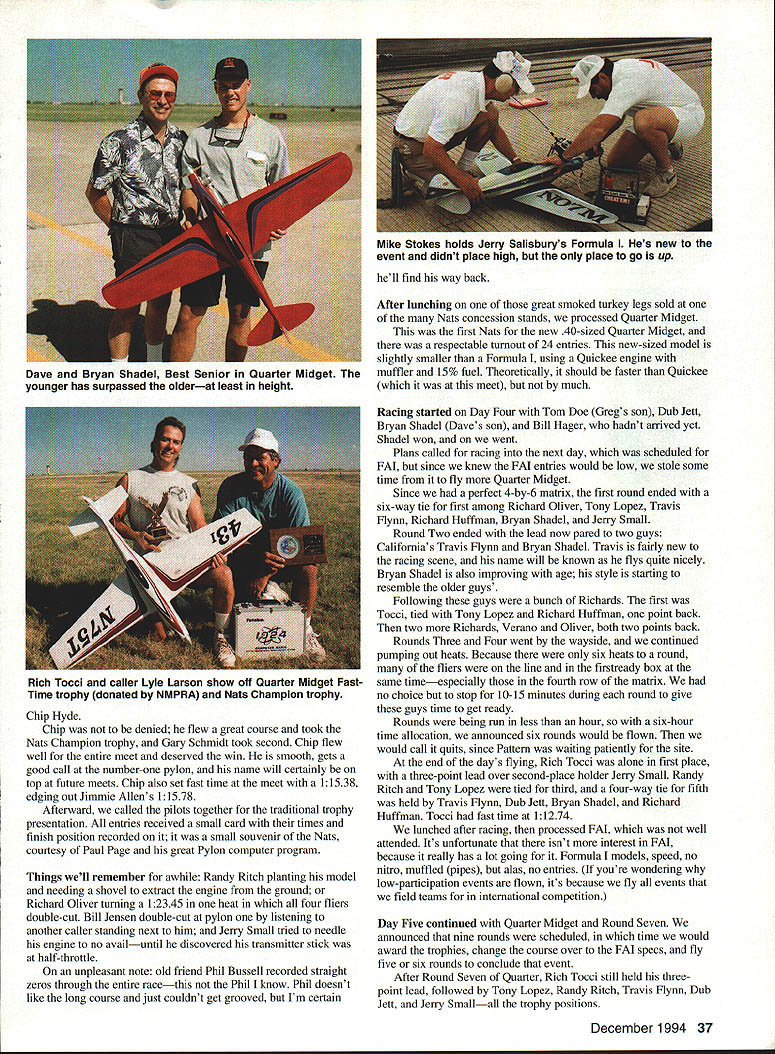
- Rounds Eight and Nine concluded with Rich Tocci as National Quarter Midget Champion.
- Final Quarter Midget results:
- Rich Tocci (fast time 1:12.74)
- Tony Lopez
- Randy Ritch
- Dub Jett
- Travis Flynn
- Jim Allen
FAI
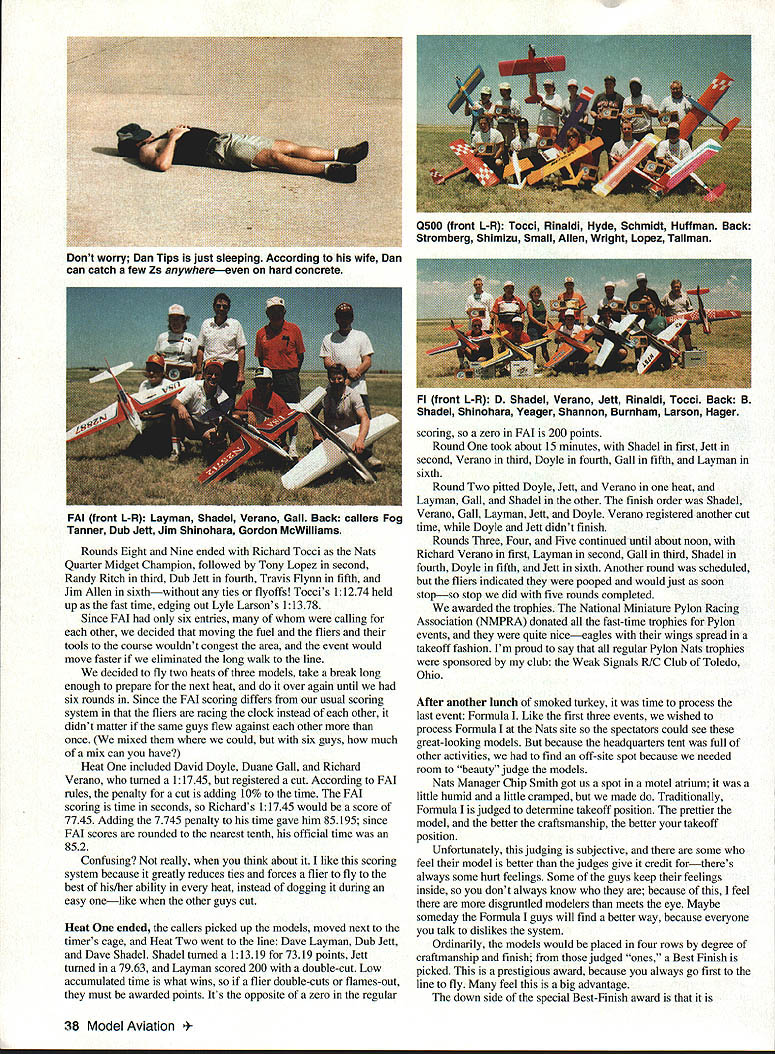
FAI entries were low (six entries). Because of the small field we adjusted format to speed the event: two heats of three models, short breaks to prepare, and repeat — mixing pilots where possible. FAI scoring is based on elapsed time in seconds; cuts incur a 10% time penalty, and a DNF or double cut is effectively penalized heavily (a zero in regular scoring equates to 200 points in FAI).
Examples:
- Heat One: David Doyle, Dune Gall, Richard Verano. Verano turned 1:17.45 but cut a pylon. Adding 10% (7.745 s) gave 85.195 s, rounded to 85.2 official seconds.
- Heat Two: Dave Layman, Dub Jett, Lance Shadel. Shadel 1:13.19 (73.19), Jett 79.63, Layman 79.0 (double cut).
After five rounds the standings were:
- Richard Verano
- Dave Layman
- Dune Gall
- Lance Shadel
- David Doyle
- Dub Jett
Fliers elected to stop after five rounds (they were pooped), so trophies were awarded at that point.
Formula I
We processed Formula I off-site in a motel atrium for beauty judging. Traditionally, Formula I models are judged for takeoff position: the prettier and better-crafted models get the best takeoff positions. This judging is subjective and can create ill will; to reduce that, we used the system promoted by NMPRA president Lloyd Burnham:
- Three judges score independently on items such as cockpit detail, craftsmanship, wheelpants/landing gear, canopy, paint scheme, paint craftsmanship, and quality of finish.
- Orange-peel finishes are downgraded; smooth finish is required.
- Scores are totaled to assign a 1, 2, 3, or 4 rating. Judges can immediately show builders which items were downgraded.
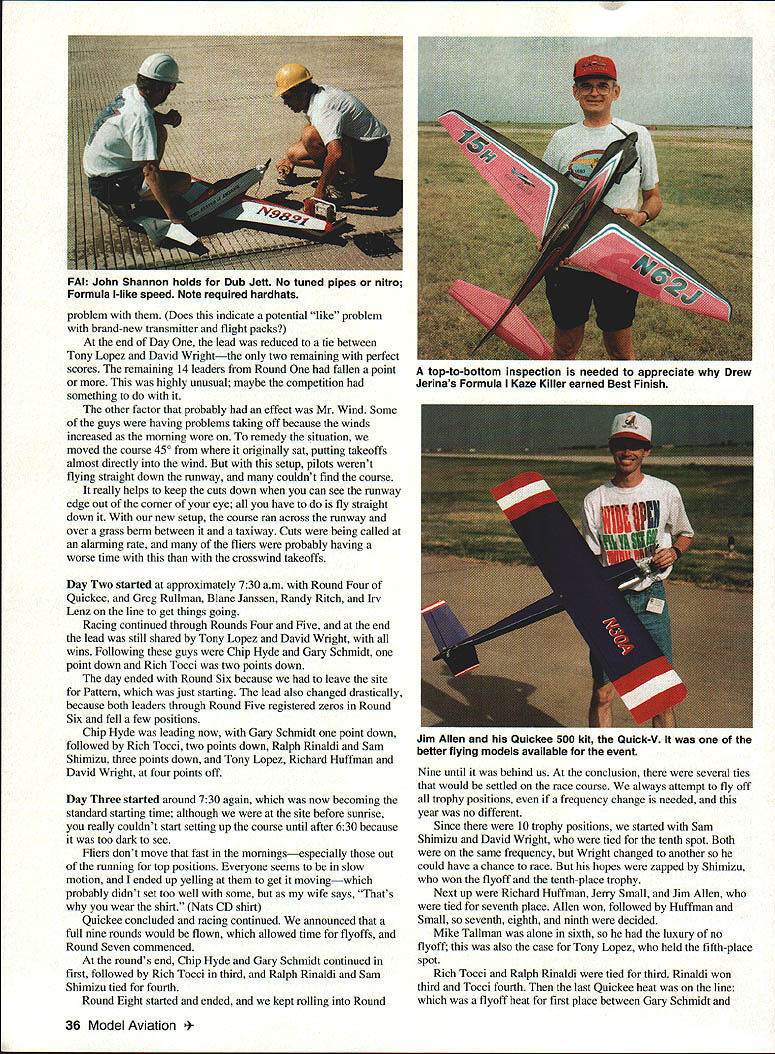
From the models judged first, the judges select the best five, then the best two; from those I select Best Finish. This year the top two models belonged to the same pilot; I followed the judges' majority and awarded Best Finish to Drew Jerina from Garland, Texas.
Formula I racing
Formula I racing commenced Thursday morning with 25 entries, forming a 4-by-7 matrix (three three-model heats, four four-model heats). We usually start with smaller heats to ease the workers in. First-round winners included Dave Shadel, Richard Verano, Rich Tocci, Lyle Larson, Russ Tokouoka, Dave Layman, and Travis Flynn. Shadel had the best time in Round One at 1:15.45.
After Round Two the leaders were Shadel, Verano, and Larson with perfect scores. Racing continued through Rounds Three, Four, and Five. We stopped at five rounds due to time and to accommodate other events. At that point the lead was shared by Lyle Larson and Dave Shadel, with Larson holding the best time of 1:10.099 (reported as 1:10.10 earlier). D. B. Jett was third, Richard Verano fourth, and Bill Hager and Ralph Rinaldi shared fifth.
Awards and fast times
The National Miniature Pylon Racing Association (NMPRA) donated all the fast-time trophies for the Pylon events. The Weak Signals R/C Club of Toledo, Ohio, sponsored the regular Pylon Nats trophies.
Fast times at the meet:
- Quickee best time: Chip Hyde — 1:15.38
- Quarter Midget best time: Rich Tocci — 1:12.74
- FAI best time: Dave Shadel — 1:10.31
- Formula I best time: Richard Verano — 1:10.03
Because the best times across events were so close (within roughly 0.5 seconds), one has to wonder whether we have too many different events — food for thought.
Closing
After flyoffs and trophies, everyone said their goodbyes and went home. The Nats provided good racing, good weather, and one more set of memories — plus some great smoked turkey legs from the concession stands. Thanks to the workers, judges, sponsors, and fliers who made the event possible.
Transcribed from original scans by AI. Minor OCR errors may remain.

