
Radio Control: Pylon Racing
Ed Rankin
JERRY CHRISTENSEN has done a tremendous job in writing this column, and I hope that I can measure up to his standards. My format will be to report to the AMA membership on the latest NMPRA activities, District Races, NMPRA Championship Race, AMA Nationals, new products, how to get started in racing, racing techniques, and construction tips. Hopefully, this information will be interesting to the active race pilots and to those who are contemplating entering pylon racing. I will appreciate any help to implement this goal, so please send me information that will be pertinent to this column including F-I and QM events. (My address is: 6072 Wonder Dr., Fort Worth, Tex. 76133.)
Contest Procedure for Pylon Racing: The biggest and foremost question facing most people is how to operate a pylon race because it is the most complicated of any RC event, requiring a lot of manpower and organization. The general rules are covered in the AMA rule book. However, there isn't enough space to cover all of the aspects of contest procedure. Therefore, the NMPRA has prepared a lengthy Contest Procedure Guide. This was first published in the July 1972 RCM magazine. It contains the following subjects: safety, race preparation, registration, handicap scale judging, heat make-up and matrix system, and the function of each official.
It is mainly designed for F-I racing, but will apply to the QM event except for scale judging. AMA Headquarters has published this in booklet form and it is available upon request. In addition, the 1974 January, February and March issues of the NMPRA newsletter contain race procedure information. The race procedure is constantly being updated and recorded in the NMPRA newsletter. The latest update is a required safety check of all airplanes; hardhats for everyone; and a 1-2-3-4 classification for scale judging.
The National Miniature Pylon Racing Assoc.: Some AMA members do not understand why there should be special interest groups like the NMPRA. Notice the number of such groups located on the flyleaf of the July MA issue. The reason is that the AMA Contest Board oversees the general and broad issues of rules making, and is not necessarily in close contact with each event. Therefore, special events must be governed by pilots actively participating in the event, and who have a greater insight on how the event should be run. The NMPRA, born in 1965, is probably one of the original special groups, and has set the pace for other groups to follow. We have made rule proposals to the RC Contest Board through the years, and so far the board has approved our recommendations 100 percent. AMA members, entering race contests, are not required to join the NMPRA, but it is strongly recommended.
What Is It? A special interest group reporting to AMA Headquarters and the AMA RC Contest Board, which represents the F-I, F-II, FAI, and QM Pylon pilots on all matters related to racing, including rules making and conduct of contests.
How It Functions: We have a President, Secretary, Treasurer, Editor, and seven Vice-Presidents who represent the NMPRA in their districts. (Divided according to interest, and does not match the AMA district divisions.) In addition, an Executive Vice-President heads the QM activities with support of seven Assoc. Vice-Presidents. (Designed especially for QM fliers to govern themselves without influence of the F-I pilots.)
What Are the Benefits? Have a part in the making of racing rules and procedures; compete in District and National Championships; compete in National Season-Point Championship; receive the monthly newsletter (a timely report of current racing activities including: NMPRA business, rules voting, contest reports, new product reports, engines, airplanes, accessories, district and national point standings); receive NMPRA Racing Number, NMPRA patches and decals; purchase extra patches and decals and NMPRA Racing Book (compiled by the So. Cal. Dist., chairmanned by Terry Prather, a must for all race pilots).
How To Join: Fill out form on the flyleaf of July MA, or secure from NMPRA District V.P., and mail to Bud Anders, 16509 Saticoy St., Van Nuys, Calif. 91406. Dues are $10.00 per year.
As President of the NMPRA in 1973, I can confirm that the organization functions very well. We proposed to the RC Contest Board: the F-I 1,000 engine rule; moving the race course to 500 feet from the spectators; and the QM rules. Also we recommended that several proposals not processed by the NMPRA be disapproved. The 1,000 engine rule was studied by the C.B. long and hard. They were concerned that 1,000 engines of all brands would flood the market and couldn't be consumed, and would be unfair to the manufacturers. However, they passed this rule and now over 1,000 ST, OPS, OS, HP and K&B's have been produced, and now you can hardly find one. The intent of this rule was to make all of the engines available to all pilots instead of just a chosen 100 top pilots. Maybe we should now raise this to 2,000 so that the intent of the rule can be fulfilled. Also we have had a 1,000 rule in the QM rules, and now these engines are hard to find.
Quarter Midget Event: I have been a strong supporter of QM and, as 1973 President, I worked very hard getting the event recognized as an AMA event. Now I am very disappointed with some of QM flyers in their lack of participation in the NMPRA. The voters turned the vote into the NMPRA with a large majority. We proposed the 1973 Toledo Meeting QM rules made by QM flyers in the QM organization within the NMPRA headed by an Exec. V.P., reporting only to the President. This was done so that QM pilots could govern themselves without influence from F-I pilots. Bill Cooper, 2930 Burlwood Dr., Winston-Salem, N.C. 27103, did a tremendous job in 1973-74, and has now taken the job again for 1975. NMPRA President Glen Spickler, 4208 Santa Cruz, Bakersfield, Calif. 93307, was responsible for this event being added to the AMA Nationals.
We have allocated proportional space in the newsletter for QM events and contest reports. This is fine, but there is still a lack of participation in the organization.
There is one QM racing column in a leading magazine that has not given the NMPRA credit for much of the activity that exists among QM flyers. Recently, some QM rules were proposed, including shortening the race course and idle requirements, that were being processed through the NMPRA-QM organization. After talking to QM flyers all over the USA, and reading club newsletters sent to me by the AMA, I'm afraid that these ideas are not representative of the majority of QM flyers.
continued A recent survey of the CB is that this proposal likely will be defeated. I think that a shorter course would cause a safety problem, and a slower idle requirement would favor pro-engine men, thus being a disadvantage to the stock engine flyer. I guess that some QM pilots are just uninformed or unwisely think they can exist without the NMPRA. Hopefully, these facts will change your mind, and you will cooperate with Bill Cooper and Glen Spickler in a centralized government of the event. The South Central West District headed by Don Downing, is enjoying increased activity in this event with an average of 30 entries per contest and with about 80 percent NMPRA membership participation. This is an example of QM flyers recognizing the value of a central organization to represent them.
The NMPRA Championship Race: This fly-off race was the original idea of Pete Reed, 1971 President. Dr. Fowler, 1972 president, recommended that I pursue this as I took office in 1973. Three race sites were established: California, Florida, and Texas. The first two have been a tremendous success, and have proven to be a true Tournament of Champions.
This year the Race will be held on Oct. 25-26 in Mesquite, Tex. (10 miles east of Dallas), and will be hosted by the NMPRA, RCM, TF, The Fort Worth Thunderbirders, and the Dallas R/C Club. Don Downing, SCW V.P., 3200 W. Pioneer Dr., #118, Irving, Tex., 75061, is the Contest Manager and has some tremendous plans. A contest committee was formed from both host clubs, and has had many meetings. Here are some of the plans:
- F-I event only.
- Trophies through 20 places. Trophies for fastest time, best scale, best finish (manufacturer award), Sportsmanship.
- The Roadway Inn East has been confirmed as headquarters and is only two miles from the contest site. A block of 60 rooms has been reserved for $16.00 per day regardless of number of people in room. They will furnish a banquet room on Saturday night for 150, and an office for Race Headquarters. They will also furnish a bus to and from the field, in addition to a bus to and from downtown Dallas for the ladies.
- Ten to 20 percent or minimum of ten from each district will qualify, in addition to the top 10 at the 1975 AMA NATS and all NMPRA officers. Glen Spickler says that qualification for the race will end Oct. 1.
- Pre-entry required. Pre-safety check and inspection check signed by experienced F-I Contest Director.
- $2,000 merchandise prizes for workers and contestants.
- Grandstands for spectators. Blocked off pit area for contestants.
- Billboard advertisements for manufacturers in addition to advertisements in contest brochure.
- Local and National TV coverage.
- Plans are now being formulated for an NMPRA QM Championship Race in Oklahoma City, Okla. one week before, during their trade show. Be a part of the NMPRA and qualify for these great Races.
District Activities: South Central West: Ten F-I and 12 QM races are scheduled for this district. In addition, the AMA NATS and the NMPRA Championship Race will be held in this district. The season started with a QM race in Ft. Worth, Feb. 16 with 27 entries and seven rounds being flown. Gale Helms, Charles Monnett, and James White won the trophies. Dennis Drysdale and Bill Akin won the Novice awards.
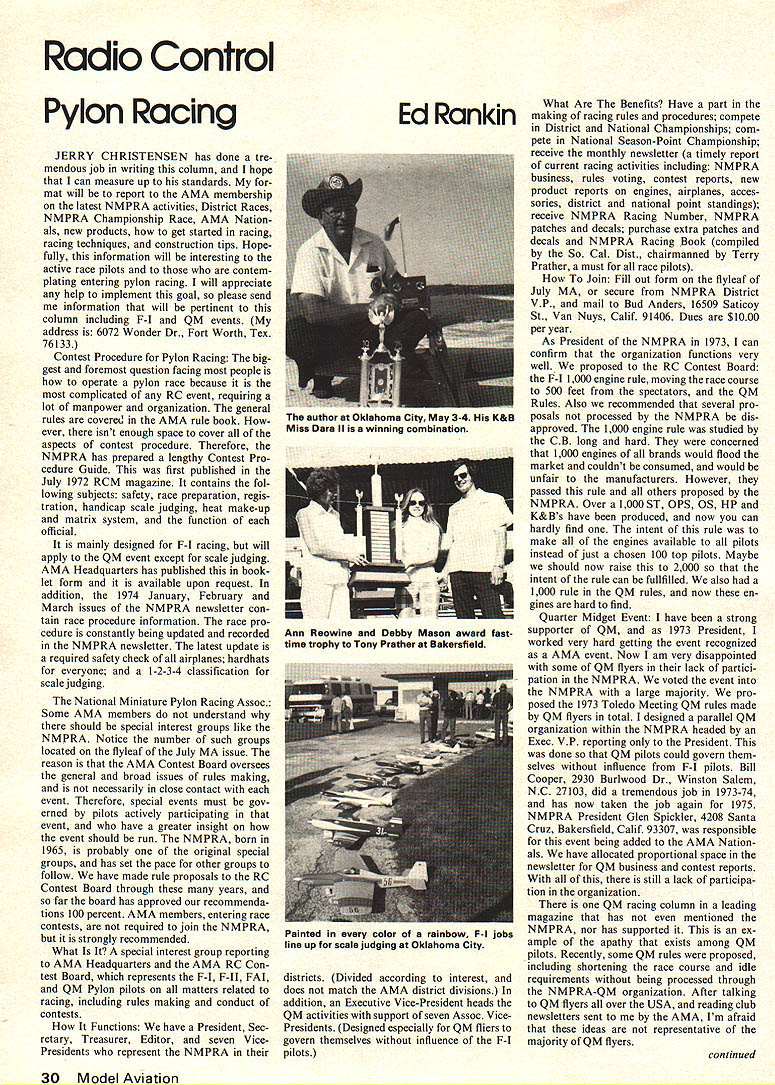
The April 12 QM Race in Dallas drew 26 entries. At the end of five rounds the winners were Gale Helms, Charles Monnett, James White and Bob Barrett. On April 20 in Beaumont the QM Race had 20 entries, and Don Downing, John Emry, and Bobby Sellers were the winners. In the May 3-4 QM and F-I Oklahoma City race, Charles Monnett, Jerry Small, Warren Lawrence, and Bob Barrett took the trophies. In QM with 22 entries and five rounds flown, no prototype airplanes were used; K&B and Enya engines were used in several races.
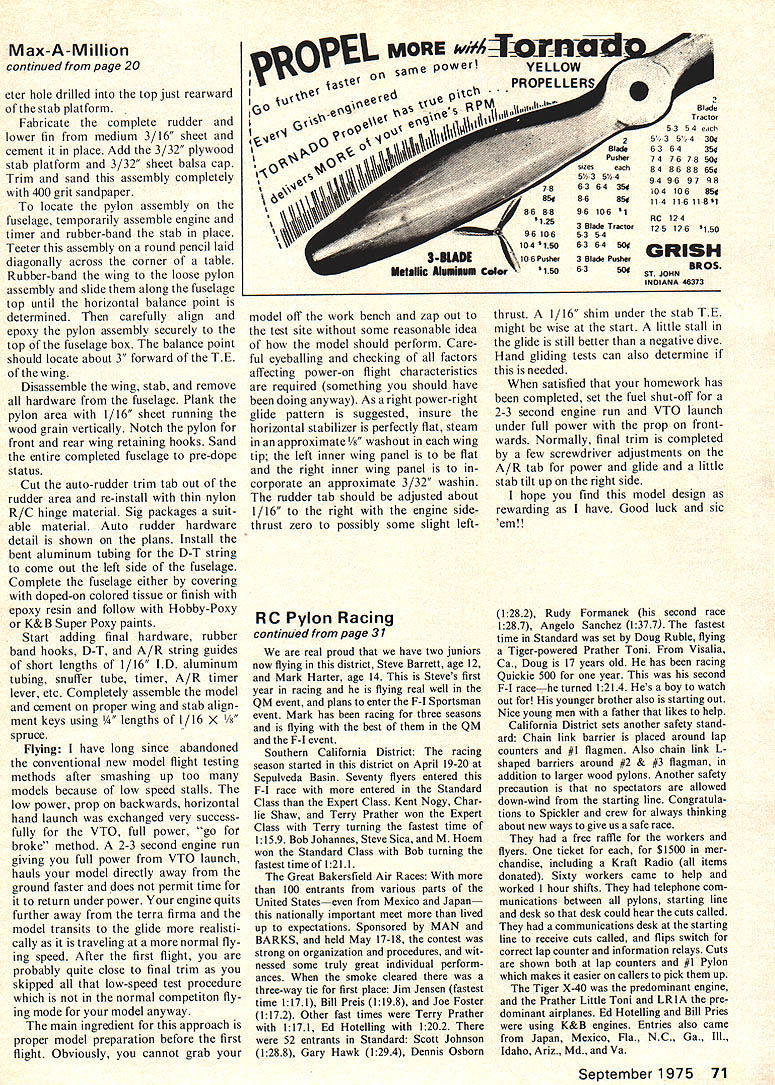
In the F-I event at Oklahoma City with 20 entries and seven rounds, Ed Rankin, Jim Bengtson, Bob Barrett, and Gale Helms took the trophies. The predominant airplane and engine combination was the Prather Little Toni and the Terry Tiger. The Merle Dallas in 1st Nightingale K&B proved to be the winning combination. Wayne Browning showed a lot of improvement over last year and tied Rankin for the fastest time on 10-11-70. GM, F-I and F-I Sportsman were scheduled in Fort Worth. On Saturday, James White, Bob Holm (1:46), Charles Monnett, and Gale Helms took the QM trophies with 24 entries and eight rounds. The rains came on Sunday and the F-I events were rescheduled to June 21, the day before the Dallas F-I contest.
Radio Control: Pylon Racing
RC Pylon Racing continued from page 31
We are real proud that we have two juniors now flying in this district, Steve Barrett, age 12, and Mark Harter, age 14. This is Steve's first year in racing and he is flying real well in the F-I event, and plans to enter the F-I Sportsman event. Mark has been racing for three seasons and is flying with the best of them in the QM and the F-I event.
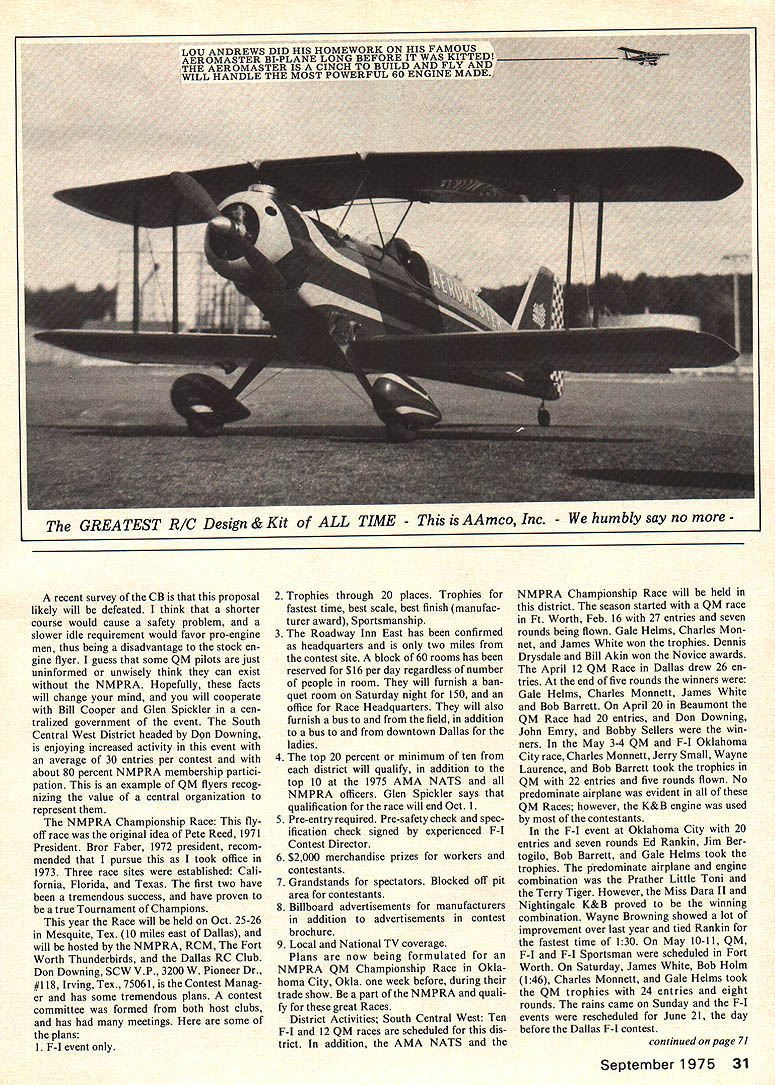
Southern California District: The racing season started in this district on April 19-20 at Sepulveda Basin. Seventy flyers entered the F-I race with more entered in the Standard Class than the Expert Class. Kent Norris, Charley Shaw, and Terry Prather won the Expert Class with Terry turning the fastest time of 1:15.9. Bob Johansen, Steve Sica, and M. Hoern won the Standard Class with Bob turning the fastest time of 1:21.1.
The Great Bakersfield Air Races: With more than fifty entrants from various parts of the United States — even from Mexico and Japan — this was a really important meet and more than lived up to expectations. Sponsored by the M.A.N. and BARKS, and held May 17-18, the contest was strong on organization and procedures, and witnessed some truly great individual performances. When the smoke cleared there was a three-way tie for first place: Alvin Jensen (fastest time: 1:17.1), Bill Rees (1:19.8), and Joe Foster (1:17.2). Other fast times were Terry Prather with 1:17.1, Ed Hotteling with 1:20.2. There were 52 entrants in Standard: Scott Johnson (1:28.8), Gary Hawk (1:29.4), Dennis Osborn (1:28.2), Rudy Formanek (1:28.7), Angelo Sanchez (1:37.7). The fastest time in Standard was set by Doug Ruble, flying a Tiger-powered Prather Toni. From Visalia, Cal., Doug is 17 years old. He has been racing Quickie 500 for one year. This was his second F-I race — he turned 1:21.4. He's a boy to watch out for! His younger brother also is starting out. Nice young men with a father that likes to help.
California District sets another safety standard: Chain link barrier is placed around lap counters and #1 flags. Also chain link barrier is placed around #2 & #3 flags, in addition to larger wood pylons. Another safety precaution is that no spectators are allowed close to the starting line. Congratulations to this club for providing a very fine meet.
They had a free raffle for the workers and flyers. One ticket for each flyer, for $1,500 in merchandise, including a Zenith Radio (all items donated). Sixty workers came to help and worked 15 hour shifts. They had two constant attendance telephones between all pylons, the starting line and tower, and the desk could hear the contestants all the time. They also had a contestants' tower and public address system with two radiophone booths on the main field. This meet was one of the finest ever run on the West Coast.
The Tiger X-40 was the predominant engine, the Prather Little Toni and LRA the predominant airplanes. Ed Hotteling and Bill Pires were using K&B engines. Entries also came from Japan, Mexico, Fla., N.C., Ga., Ill., Idaho, Ariz., Md., and Va.
Transcribed from original scans by AI. Minor OCR errors may remain.

