
RADIO CONTROL PYLON RACING
Duane Gall, 1267 S. Beeler Ct., Denver CO 80231; E-mail: stinger4@earthlink.net
1) Q-500 airplanes
V-tails. They fly great as sport airplanes. This is the best choice for the giftee who is thinking about Pylon Racing, but hasn't taken the plunge.
Q-500 airplane prices range from $40 to $400, depending on the degree of completion and how recently the model was used to set a national record.
- Intimidator: National Balsa, (413) 796-1925
- V-Max: Apex Composites, (209) 848-0861
- Vortex: Chuck Bridge, (209) 847-3459
- Bird of Prey: California Speed Pros, (605) 787-6340
- V-Vector: Morris Hobbies, (800) 599-6887
- Dominator 500: Lanier R/C, (770) 532-6401
- Mad Dog: Matney's Models, (734) 848-8195
- HurriKane: Dan Kane Jr., (312) 775-2951
- Rev'lution: Mike Del Ponte, (303) 693-7519
- Conspirator: Archie Adamisin, aadamisin@aol.com
- X-1: Craig Farthing, (303) 933-1772
2) Quickie 500 engines
These are the two-stroke glow variety, with .40 cubic-inch displacement—the legal maximum for racing. The premium competition engines are not known for idling, so sport engines are a better choice if the giftee hasn't practiced landing "dead-stick" (power off, never to return). Prices are $275 to $350 for the premium engines, and $65 to $100 for the sport engines.
Premium competition engines:
- Nelson: Nelson Performance Specialties, (702) 265-7523, perfspec@aci.net
- Jett: Jett Engineering, (713) 680-8113, jett@pdq.net
- Edmunds: Edmunds Engineering, (301) 423-1825
Sport engines — all available through local hobby shops and catalog houses:
- Thunder Tiger Pro .40
- Magnum .40
- SuperTigre GS .40
3) Quarter 40 (Q40) airplanes
Elves, do not "surprise" your giftee with one of these, unless you know for a fact he/she is well beyond the beginner stage.
- Dago Red, Napier-Heston, Vendetta: California Speed Pros, (605) 787-6340
- Miss Ashley II: Rusty Van Baren, (559) 582-7715
- TRC-1 Sidewinder: Small Creations, (817) 379-6468
- Loki, Miss Foxy Lady: H&M Racing, (306) 446-4021
- Napier-Heston: Matney's Models, (734) 848-8195
- Proud Bird: Keith Davidson, (858) 578-5651
4) Quarter 40 engines
See "Quickie 500 engines." If you want one of the premium engines, call the manufacturer and specify the Quarter 40 version, so you don't get the Quickie variety. There are small but important differences between the two.
5) Accessories
Each racing aficionado has a list in the back of his/her mind of "wanna-gets"—items that would make life so much easier, but haven't been in the budget. Elves, if you're hesitant to go for a big-ticket item, such as an airplane or an engine, consider one of the following and you can't go wrong. I have purchased, borrowed, or witnessed others using each of these items successfully. The sources have other goodies available; contact them for further gift ideas.
- Long-life lithium airborne batteries and charger: Darrol Cady, (360) 573-0987
- Pit box: Matney's Models, (734) 848-8195
- Airplane stand, glow-driver: H&M Racing, (306) 446-4021
- Propeller pitch gauge
Remote signaling system and Cyber-flying
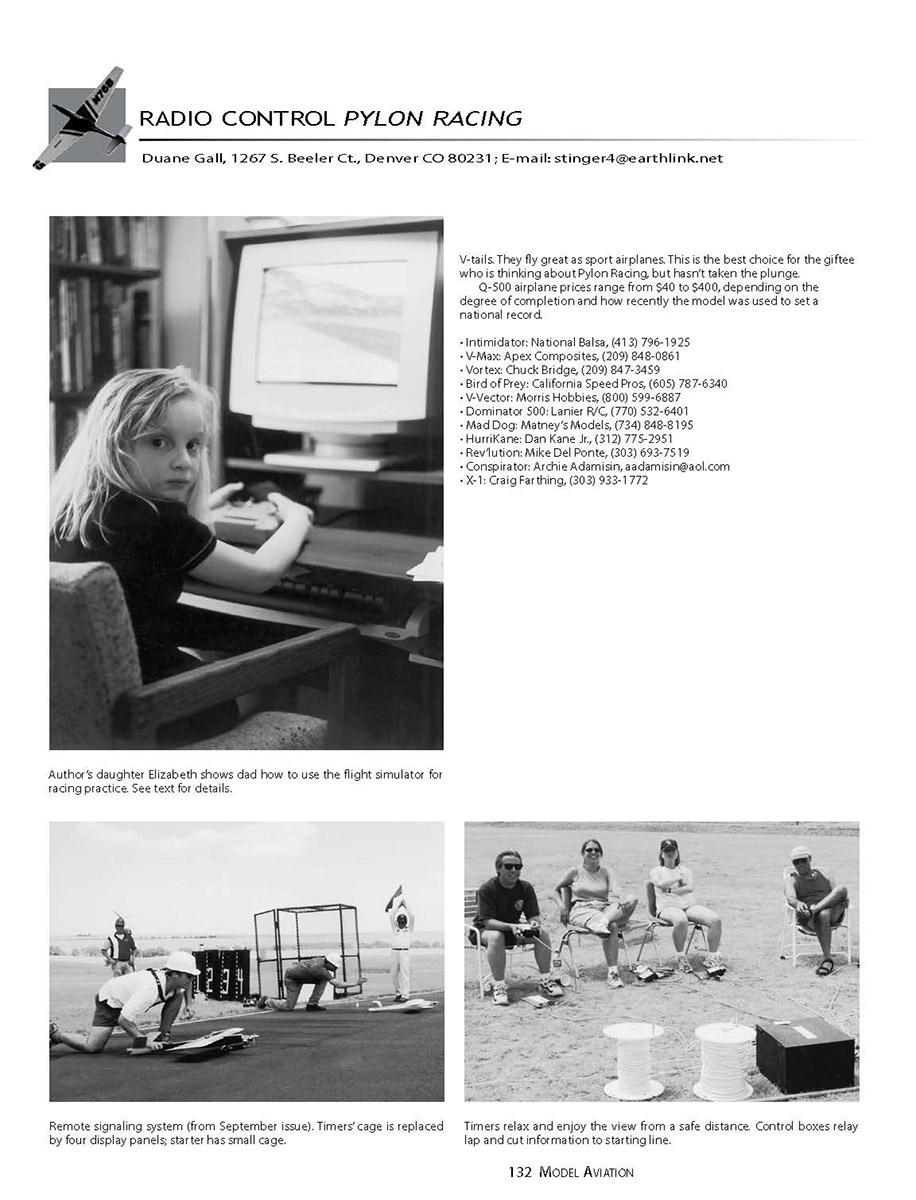
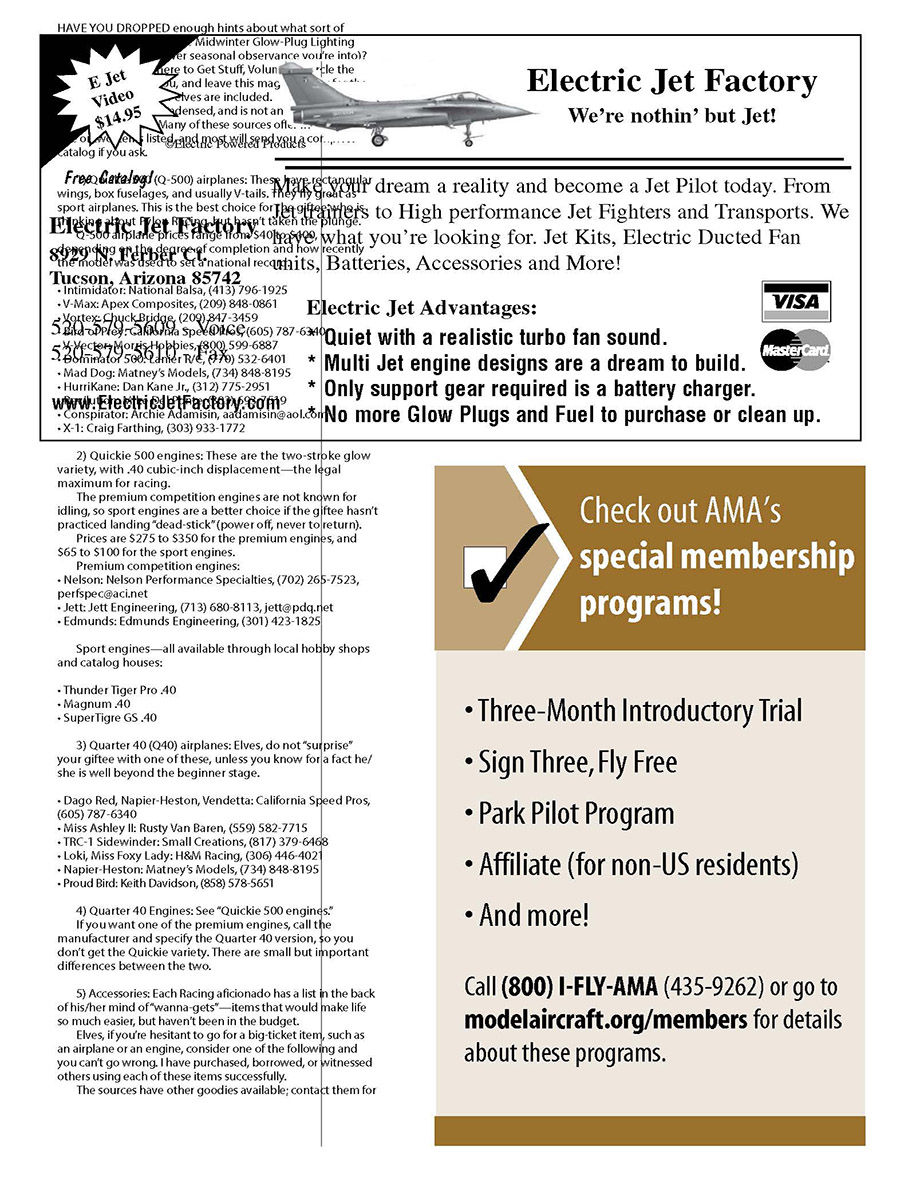
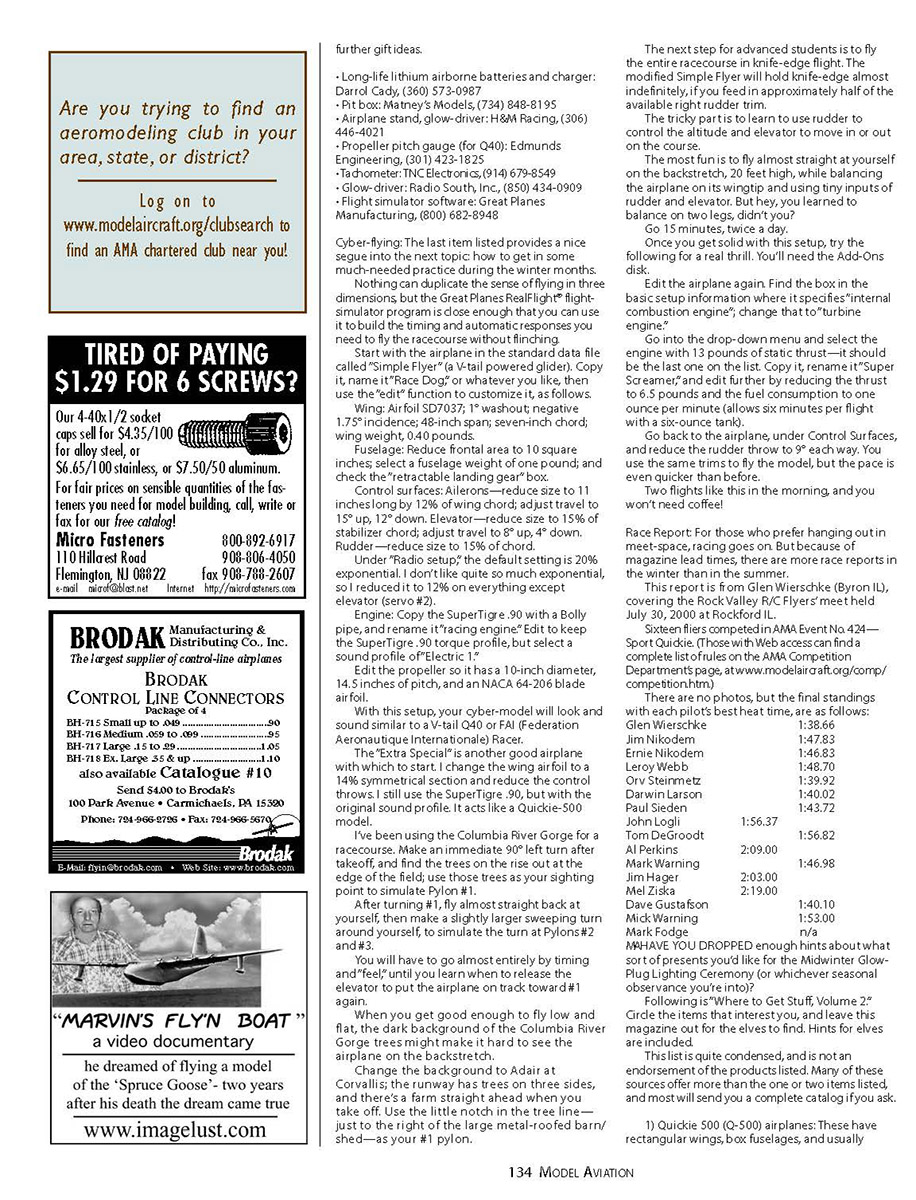
Remote signaling system (from September issue). Timers' cage is replaced by four display panels; starter has small cage. Timers relax and enjoy the view from a safe distance. Control boxes relay lap and cut information to the starting line. The author's daughter Elizabeth shows dad how to use the flight simulator for racing practice. See text for details.
Cyber-flying: The last item listed provides a nice segue into the next topic: how to get in some much-needed practice during the winter months.
Nothing can duplicate the sense of flying in three dimensions, but the Great Planes RealFlight flight-simulator program is close enough that you can use it to build the timing and automatic responses you need to fly the racecourse without flinching.
Start with the airplane in the standard data file called "Simple Flyer" (a V-tail powered glider). Copy it, name it "Race Dog" or whatever you like. Then use the "edit" function to customize it as follows.
- Wing: Airfoil SD7037; 1° washout; -1.75° incidence; 48-inch span; 7-inch chord; wing weight 0.40 lb.
- Fuselage: Reduce frontal area to 10 square inches; select a fuselage weight of 1.0 lb; check the "retractable landing gear" box.
- Control surfaces:
- Ailerons — reduce size to 11 inches long by 12% of wing chord; adjust travel to 11° up, 12° down.
- Elevator — reduce size to 15% of stabilizer chord; adjust travel to 8° up, 4° down.
- Rudder — reduce size to 15% of chord.
- Radio setup: Default setting is 20% exponential. The author prefers 12% exponential on everything except elevator (servo #2).
- Engine: Copy the SuperTiger .90 with a Bolly pipe, and rename it "racing engine." Edit to keep the SuperTiger .90 torque profile, but select a sound profile of "Electric 1."
- Propeller: 10-inch diameter, 14.5-inch pitch, NACA 64-206 blade airfoil.
With this setup, your cyber-model will look and sound similar to a V-tail Q40 or FAI (Fédération Aéronautique Internationale) racer.
The "Extra Special" is another good airplane with which to start. Change the wing airfoil to a 14% symmetrical section and reduce the control throws. Use the SuperTiger .90 with the original sound profile. It acts like a Quickie-500 model.
The author has been using the Columbia River Gorge for a racecourse. Make an immediate 90° left turn after takeoff, and find the trees on the riverbank at the far edge of the field; use those trees as your sighting point to simulate Pylon #1.
After turning #1, fly almost straight back at yourself, then make a slightly larger sweeping turn around yourself, to simulate the turn at Pylons #2 and #3.
You'll have to go almost entirely by timing and "feel"—until you learn when to release the elevator to put the airplane on track toward #1 again.
When you get good enough to fly low and flat, line up the backstretch so that the far trees on the river gorge might make it hard to see the airplane on the backstretch.
Change the background to Adair at Corvallis; the runway has trees on three sides, and there's a farm straight ahead when you take off. Use the little notch in the tree line—just to the right of the large metal-roofed barn/shed—as your #1 pylon.
The next step for advanced students is to fly the entire racecourse in knife-edge flight. The modified Simple Flyer will hold knife-edge almost indefinitely, if you feed in approximately half of the available right rudder trim.
The tricky part is to learn to use rudder to control the altitude and elevator to move in or out on the course.
The most fun is to fly almost straight at yourself on the backstretch, 20 feet high, while balancing the airplane on its wingtip and using tiny inputs of rudder and elevator. Practice 15 minutes, twice a day.
Once you get solid with this setup, try the following for a real thrill. You'll need the Add-Ons disk.
Edit the airplane again. Find the box in the basic setup information where it specifies "internal combustion engine"; change that to "turbine engine."
Go into the drop-down menu and select the engine with 13 pounds of static thrust—it should be the last one on the list. Copy it, rename it "Super Screamer," and edit further by reducing the thrust to 6.5 pounds and the fuel consumption to 1 ounce per minute (allows six minutes per flight with a six-ounce tank).
Go back to the airplane, under Control Surfaces, and reduce the rudder throw to 9° each way. Use the same trims to fly the model, but the pace is even quicker than before.
Two flights like this in the morning, and you won't need coffee!
Race Report
For those who prefer hanging out in meet-space, racing goes on. But because of magazine lead times, there are more race reports in the winter than in the summer.
This report is from Glen Wierschke (Byron, IL), covering the Rock Valley R/C Flyers' meet held July 30, 2000, at Rockford, IL.
Sixteen fliers competed in AMA Event No. 424—Sport Quickie. (Those with Web access can find the complete list of entries on the AMA Competition Department's page, at www.modelaircraft.org/comp/competition.htm.)
Final standings with each pilot's best heat time:
- Glen Wierschke — 1:38.66
- Jim Nickodem — 1:47.83
- Ernie Nickodem — 1:47.83
- Leroy Webb — 1:48.70
- Orv Steimetz — 1:39.92
- Dan Larson — 1:40.82
- Paul Seiden — 1:43.72
- John Logli — 1:56.37
- Tom DeGroodt — 1:56.82
- Al Perkins — 2:09.00
- Mark Waning — 1:46.98
- Jim Harger — 2:03.40
- Mel Ziska — 2:19.00
- Dave Gustafson — 1:40.11
- Nick Warning — 1:53.00
- Mark Fodog — n/a
Transcribed from original scans by AI. Minor OCR errors may remain.

