
RADIO CONTROL PYLON RACING
Duane Gall, 1267 S. Beeler Ct., Denver, CO 80231; E-mail: stinger4@earthlink.net
(Editor's note: Duane Gall has graciously offered his column space this month to Henry Bartle, who wrote a report on the 2001 F3D Pylon Racing World Championships held July 30–August 3. This report was received too late to run as a feature article, but we are happy to be able to bring it to you in this format.)
F3D WORLD CHAMPION
That has a nice sound to it. The best three pilots and mechanics the US had to offer went to Bundaberg, Australia — a town of 20,000 people, three hours north of Brisbane — which is locally known as the town where the Great Barrier Reef begins.
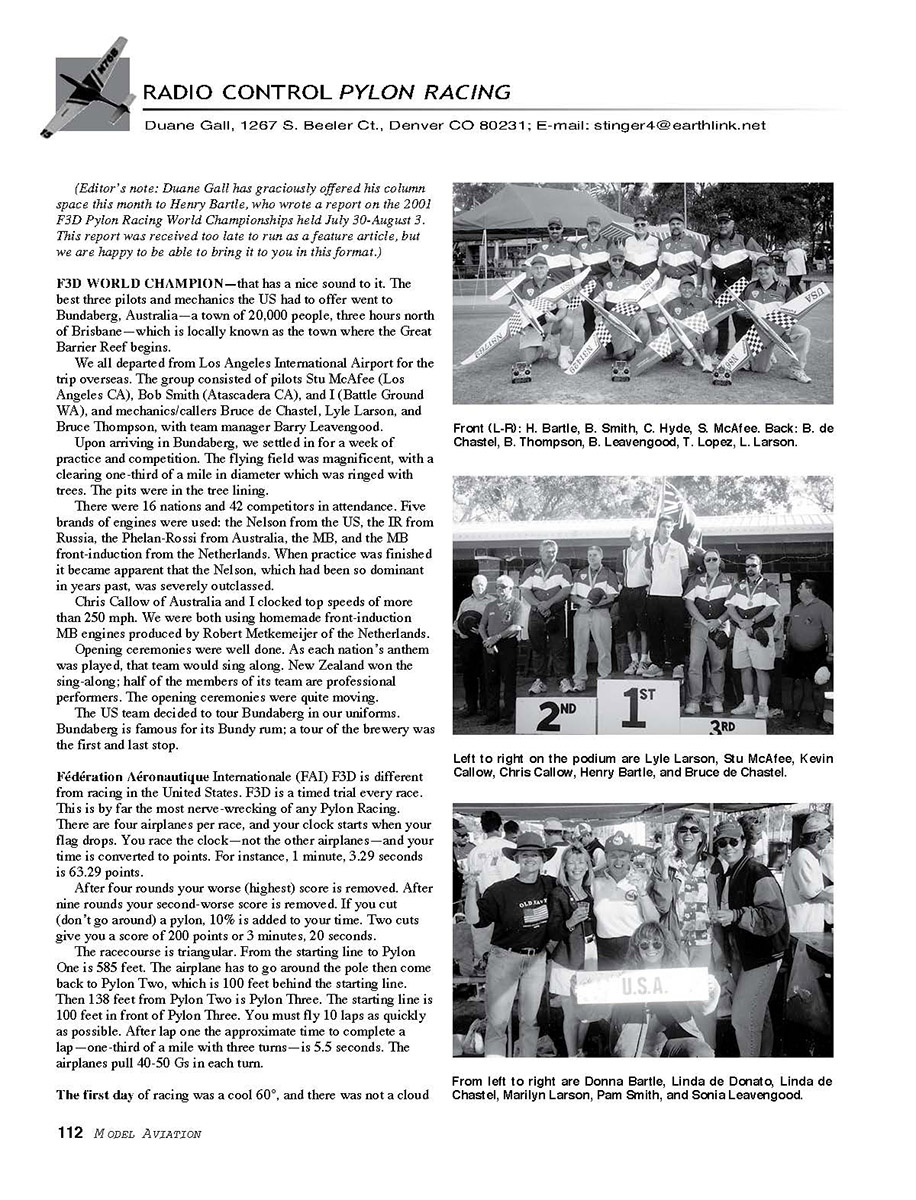
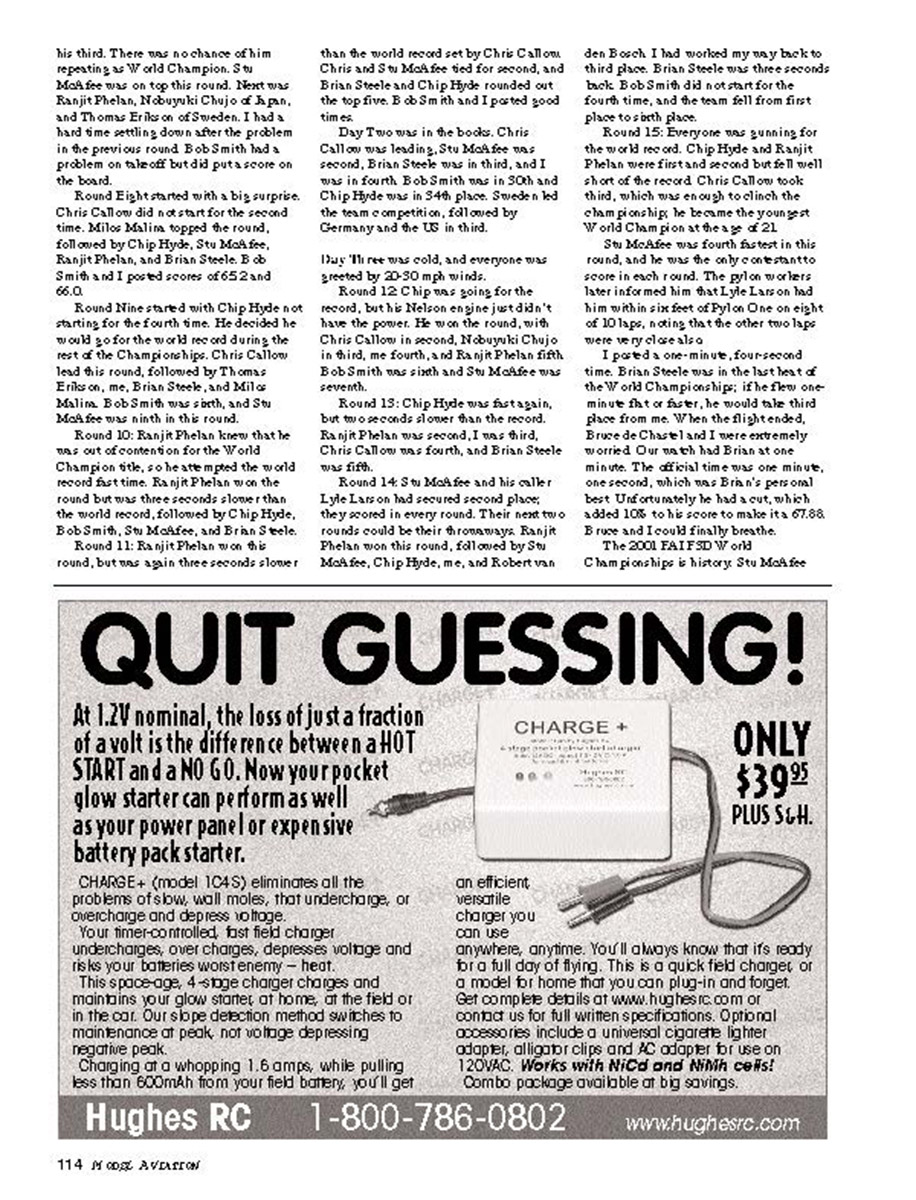
We all departed from Los Angeles International Airport for the trip overseas. The group consisted of pilots Stu McAfee (Los Angeles, CA), Bob Smith (Atascadero, CA), and I (Battle Ground, WA), and mechanics/callers Bruce de Chastel, Lyle Larson, and Bruce Thompson, with team manager Barry Leavengood.
Upon arriving in Bundaberg, we settled in for a week of practice and competition. The flying field was magnificent, with a clearing one-third of a mile in diameter which was ringed with trees. The pits were in the tree lining.
There were 16 nations and 42 competitors in attendance. Five brands of engines were used: the Nelson from the US, the IR from Russia, the Phelan-Rossi from Australia, the MB, and the MB front-induction from the Netherlands. When practice was finished it became apparent that the Nelson, which had been so dominant in years past, was severely outclassed.
Chris Callow of Australia and I clocked top speeds of more than 250 mph. We were both using homemade front-induction MB engines produced by Robert Metkemeijer of the Netherlands.
Opening ceremonies were well done. As each nation's anthem was played, that team would sing along. New Zealand won the sing-along; half of the members of its team are professional performers. The opening ceremonies were quite moving.
The US team decided to tour Bundaberg in our uniforms. Bundaberg is famous for its Bundy rum; a tour of the brewery was the first and last stop.
Fédération Aéronautique Internationale (FAI) F3D is different from racing in the United States. F3D is a timed trial every race. This is by far the most nerve-wracking of any pylon racing. There are four airplanes per race, and your clock starts when your flag drops. You race the clock — not the other airplanes — and your time is converted to points. For instance, 1 minute, 3.29 seconds is 63.29 points.
After four rounds your worst (highest) score is removed. After nine rounds your second-worst score is removed. If you cut (fail to go around) a pylon, 10% is added to your time. Two cuts give you a score of 200 points, or 3 minutes, 20 seconds.
The racecourse is triangular. From the starting line to Pylon One is 585 feet. The airplane has to go around the pole then come back to Pylon Two, which is 100 feet behind the starting line. Then 138 feet from Pylon Two is Pylon Three. The starting line is 100 feet in front of Pylon Three. You must fly 10 laps as quickly as possible. After lap one the approximate time to complete a lap — one-third of a mile with three turns — is 5.5 seconds. The airplanes pull 40–50 Gs in each turn.
The first day of racing was a cool 60°, and there was not a cloud in the sky. The wind was blowing 20–30 mph at a 45° angle to the racecourse. August is the middle of winter, and the sun does not get high off the horizon. They have very dark over-glasses to combat the problem of flying through the sun.
Round One: Chip Hyde (1999 World Champion) was the winner, followed by Stu McAfee, Robert van den Bosch of the Netherlands, me, and Chris Callow in fifth. The piston of Bob Smith's Nelson came apart, and he scored a 200.
Round Two: Chip Hyde had fast time of 1:01.3 for a score of 61.3 points. Chris Callow was next, followed by me and Stu McAfee, and Paolo Mucolda of Italy was fifth. Bob Smith put a score on the board of 67.7.
Round Three: Chip Hyde did not start. Stu McAfee won this round, followed by Chris Callow, Bob Smith, Robert van den Bosch, and Ranjit Phelan of Australia. I scored a 59 but had a cut that added 10% to my score.
Round Four: Chris Callow posted a 60.9-second win, followed by Robert van den Bosch, Chip Hyde, me, and Brian Steele of Australia tied with Milos Malina of the Czech Republic for fifth. Bob Smith's Nelson pipe snapped apart for his second 200 score.
Round Five: Bob Smith did not start. He scored his third 200. This was devastating because you're only allowed to remove two high scores. Bob had to stay clean the rest of the World Championships for the US team to have an opportunity to medal. Chris Callow was fastest, followed by Stu McAfee, me, Brian Steele, and Jean Y. Perret of France. Chip Hyde also received his second 200 score.
This concluded the first day of racing. Chris Callow was leading, Stu McAfee was in second place, and I was in third. Robert van den Bosch and Peter van Doesburg, both of the Netherlands, were in fourth and fifth. Team competition had the Netherlands in first, Germany in second, and France in third. The US team was in eighth place.
Day Two was cold, and the wind had lessened to 15 mph.
Round Six: Chris Callow did not waste any time setting a world record of 58.6 seconds. Chip Hyde was next, followed by Robert van den Bosch, Bob Smith, and Ranjit Phelan. I had a great run going, but on the eighth lap the propeller main shaft broke and spit the propeller off, and my model glided the last two laps. Under FAI rules, any parts that are jettisoned or fall off constitute a score of 200.
Round Seven: To go from hero to zero took Chris Callow only one round. After he set the world record, his airplane would not start and he scored his first 200. Chip Hyde also scored a 200, which gave him his third. There was no chance of him repeating as World Champion. Stu McAfee was on top this round. Next was Ranjit Phelan, Nobuyuki Chujo of Japan, and Thomas Erikson of Sweden. I had a hard time settling down after the problem in the previous round. Bob Smith had a problem on takeoff but did post a score on the board.
Round Eight started with a big surprise. Chris Callow did not start for the second time. Milos Malina topped the round, followed by Chip Hyde, Stu McAfee, Ranjit Phelan, and Brian Steele. Bob Smith and I posted scores of 65.2 and 66.0.
Round Nine started with Chip Hyde not starting for the fourth time. He decided he would go for the world record during the rest of the Championships. Chris Callow led this round, followed by Thomas Erikson, me, Brian Steele, and Milos Malina. Bob Smith was sixth, and Stu McAfee was ninth in this round.
Round Ten: Ranjit Phelan knew that he was out of contention for the World Champion title, so he attempted the world record last time. Ranjit Phelan won the round but was three seconds slower than the world record, followed by Chip Hyde, Bob Smith, Stu McAfee, and Brian Steele.
Round Eleven: Ranjit Phelan won this round, but was again three seconds slower than the world record set by Chris Callow. Chris and Stu McAfee tied for second, and Brian Steele and Chip Hyde rounded out the top five. Bob Smith and I posted good times.
Day Two was in the books. Chris Callow was leading, Stu McAfee was second, Brian Steele was in third, and I was in fourth. Bob Smith was in eighth and Chip Hyde was in 34th place. Sweden led the team competition, followed by Germany and the US in third.
Day Three was cold, and everyone was greeted by 20–30 mph winds.
Round Twelve: Chip was going for the record, but his Nelson engine just didn't have the power. He won the round, with Chris Callow in second, Nobuyuki Chujo in third, me fourth, and Ranjit Phelan fifth. Bob Smith was sixth and Stu McAfee was seventh.
Round Thirteen: Chip Hyde was fast again, but two seconds slower than the record. Ranjit Phelan was second, I was third, Chris Callow was fourth, and Brian Steele was fifth.
Round Fourteen: Stu McAfee and his caller Lyle Larson had secured second place; they scored in every round. Their next two rounds could be their throwaways. Ranjit Phelan won this round, followed by Stu McAfee, Chip Hyde, me, and Robert van den Bosch. I had worked my way back to third place. Brian Steele was three seconds back. Bob Smith did not start for the fourth time, and the team fell from first place to sixth place.
Round Fifteen: Everyone was gunning for the world record. Chip Hyde and Ranjit Phelan were first and second but fell well short of the record. Chris Callow took third, which was enough to clinch the championship; he became the youngest World Champion at the age of 21.
Stu McAfee was fourth fastest in this round, and he was the only contestant to score in each round. The pylon workers later informed him that Lyle Larson had him within six feet of Pylon One on eight of 10 laps, noting that the other two laps were very close also.
I posted a one-minute, four-second time. Brian Steele was in the last heat of the World Championship; if he flew one minute flat or faster, he would take third place from me. When he finished, Bruce de Chastel and I were extremely nervous. Our watch had Brian at one minute. The official time was one minute, one second, which was Brian's personal best. Unfortunately he had a cut, which added 10% to his score to make it a 67.68. Bruce and I could finally breathe.
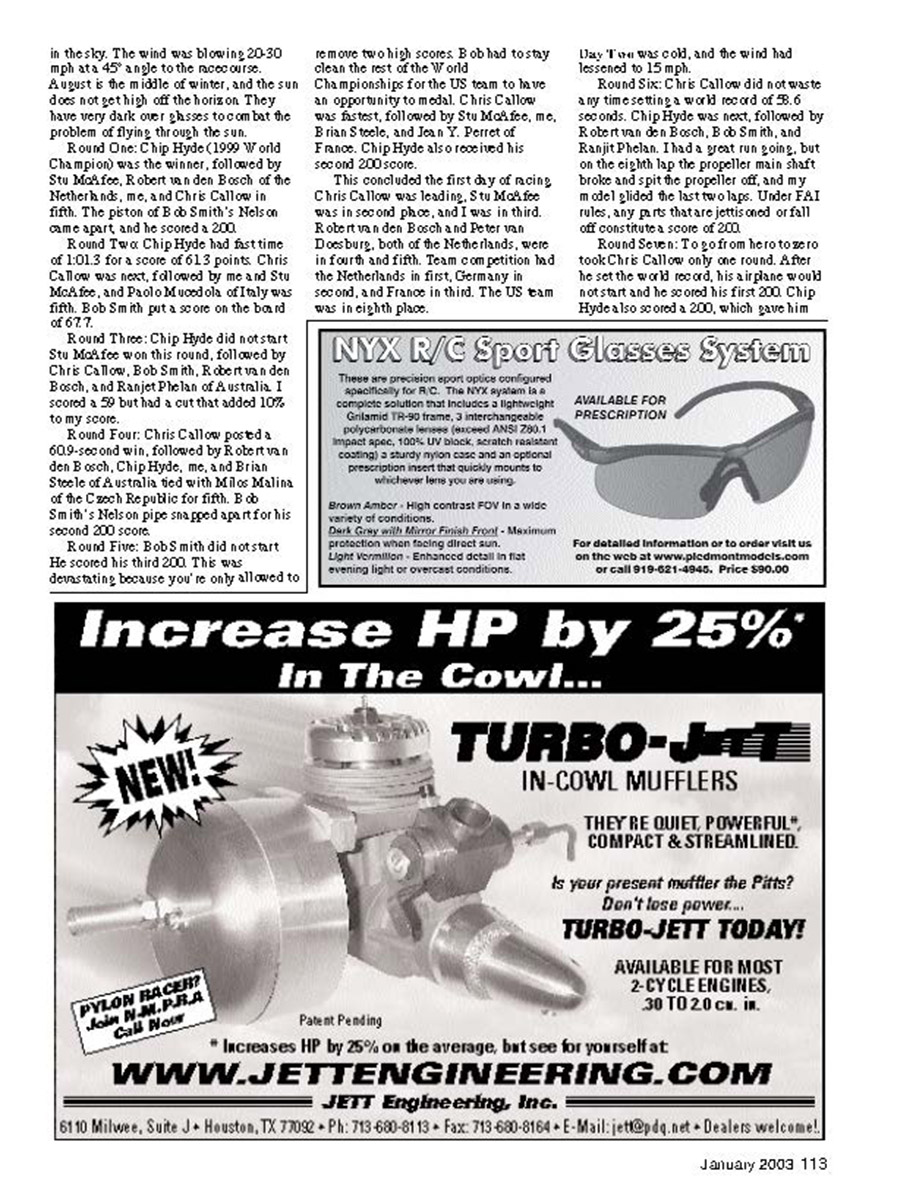
The 2001 FAI F3D World Championships in history: Chris Callow was the winner, Stu McAfee finished second, and I was third. Bob Smith was 35th and Chip Hyde was 31st. The team standings were Sweden in first place, Germany second, and Australia third. The US team ended up in sixth place.
The winning combination came from Bruce de Chastel at www.bigbuceracing.com. He designed and built the Evolution airplane. He also developed and produced the propellers and pipes for the first-, third-, and fourth-place finishers. All three of those pilots used the front-induction MB engine.
Chris Callow went to Japan two weeks later for the Japan Nationals. His slowest time in 10 rounds was faster than the world record; he set the Japanese record at 56.0.
The FAI F3D World Championships was extremely well organized and officiated. There are many people to thank, including Contest Director David Axon and starters Barry Murphy and Warren Hathaway. The Bundaberg Radio Control Club members should be proud that they put on a great world-championship race; many thanks to them.
The next FAI F3D World Championships contest will be in the Czech Republic in the summer of 2003.
HB
Transcribed from original scans by AI. Minor OCR errors may remain.

