
Radio Control Pylon Racing
Duane Gall, 1267 S. Beeler Ct., Denver CO 80231; E-mail: stinger4@earthlink.net
The Nationals
THE NATIONALS! Aspiring competitors speak of this annual contest in hushed, reverent tones, the way journeymen baseball players in the movie Bull Durham spoke of "The Show" — the major leagues. Seasoned pilots try to affect an offhand attitude, as though the Nationals, or Nats, were just another well-publicized local meet. They drop the name casually, the way one might say, "As I was telling Steve Spielberg at lunch just the other day ..."
But the fact is, this is where it all comes together. Nowhere else can you be assured of matching wits and horsepower with a wider spectrum of talented pilots from across North America.
There's no prequalification and no invitation required. The contestant next to you on the starting line is just as likely to be a big-name former champ as a local hero who has quietly sharpened his or her skills in some rural locale you've never heard of and is ready to elbow past you and everybody else on the way to the top.
Radio Control (RC) Pylon is as strong as ever according to the numbers, with more than 80 entries in Quickie 500 (AMA event 428) and 60 in Quarter 40 (AMA event 422). An elimination format was used for both.
In this system the field is divided into an "A" matrix and a "B" matrix, as though they were separate contests. After seven rounds, the points are tallied and the top 14 finishers from each matrix (a total of 28 competitors) fly against each other in a five-round final tournament. Those who do well in the preliminary rounds are punished with as much flying as they can handle in a field with no easy heats (as if there had been easy heats before). Those who don't do so well in the preliminary are rewarded with the opportunity to relax a little, swap racing lore, tour the AMA museum and the other world-class flying sites and facilities in Muncie, and, of course, sit back and watch the "best of the best" beat up on each other out on the racecourse.
The big story in 2003 was the weather. Storms stalked the Midwest like ogres, appearing out of the sultry overcast to hurl avalanches of water onto the already-drenched landscape. How wet was it? Low-lying portions of the International Aeromodeling Center had their own temporary lakes, complete with cattails and a resident frog population to serenade those who camped out overnight in tents and motor homes.
Yet we only lost approximately two hours of flying time during the entire week. Event Director Mike Condon stayed in close touch with the National Weather Service to track each storm cell with split-second precision.
Saturday and Sunday, July 5 and 6, provided an opportunity for those who arrived early to do some on-site test flying. This is a luxury well worth indulging in if you have the time, and local hotels made it easier by offering competitors discounted rates. Sunday afternoon was the official kickoff to the festivities, with aircraft processing at the field under a big canvas tent.
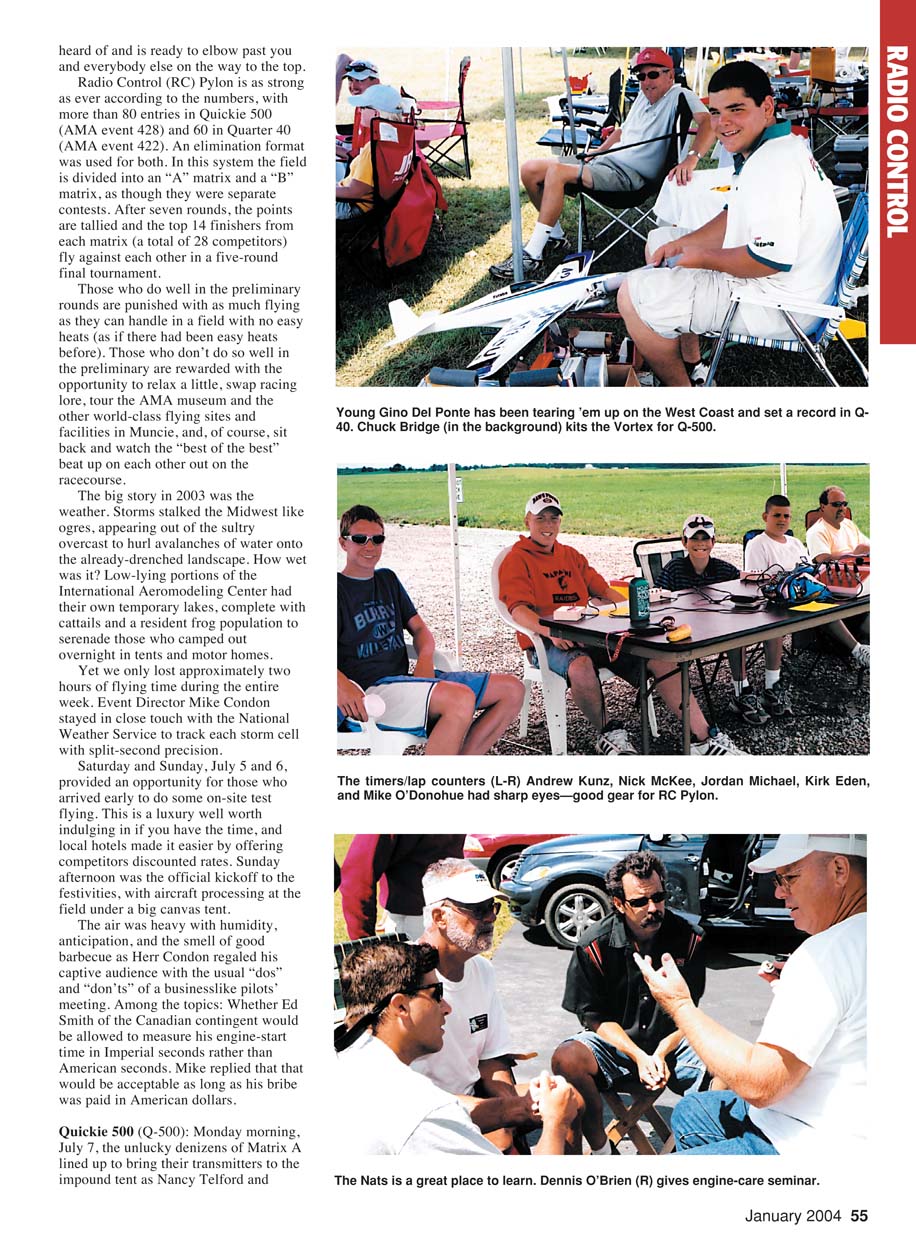
The air was heavy with humidity, anticipation, and the smell of good barbecue as Herr Condon regaled his captive audience with the usual "dos" and "don'ts" of a businesslike pilots' meeting. Among the topics: whether Ed Smith of the Canadian contingent would be allowed to measure his engine-start time in Imperial seconds rather than American seconds. Mike replied that that would be acceptable so long as his bribe was paid in American dollars.
Quickie 500 (Q-500)
Monday morning, July 7, the unlucky denizens of Matrix A lined up to bring their transmitters to the impound tent as Nancy Telford and volunteer competitor Dave Doyle applied identification stickers and fired up the scorekeeping computer. With Tammy Seaman's able assistance, Nancy and Dave maintained order and good humor for the rest of the week — even when sudden downpours brought the competitors scrambling to retrieve their transmitters and muddied the sod under their feet.
Q-500 is the slower of the two Nats events, but not by much. Airframe specifications are the same as for the entry-level Sport Quickie (event 424) category: box fuselage, constant-chord wing, 500 square inches.
However, unlike Sport Quickie, the .40-cubic-inch power plant for Q-500 may employ a tuned muffler, or "folded pipe," boosting the output from a nominal 2 horsepower to somewhere closer to 3. This translates to straightaway speeds near 160 mph. Yet with power off, these highly efficient models can ride thermals and will land as gently as a feather.
The trend in Q-500 airframe design is toward smoothly finished, laminar airfoils such as the NACA 66-012. Until recently it was considered heresy to use a laminar foil on a small RC model that demands momentary bursts of high lift, as a racing model does on the racecourse. Laminar flow is tricky to maintain, even on full-scale aircraft at high speeds. But with enough airspeed, the Reynolds number increases to the point at which a model can fool the air into behaving. Three of the most popular airframes used in this event — Chuck Bridge's Vortex, Lyle Larson's Bird of Prey, and Terence Palaschuk's Neme-Q — use symmetrical or nearly symmetrical, laminar sections.
Composite (all-molded, prebuilt) wings offer guaranteed straightness, a smooth finish, and convenience for serious competitors who are willing to invest in them. However, a well-built balsa-and-foam wing can do equally well if you trade time for money.
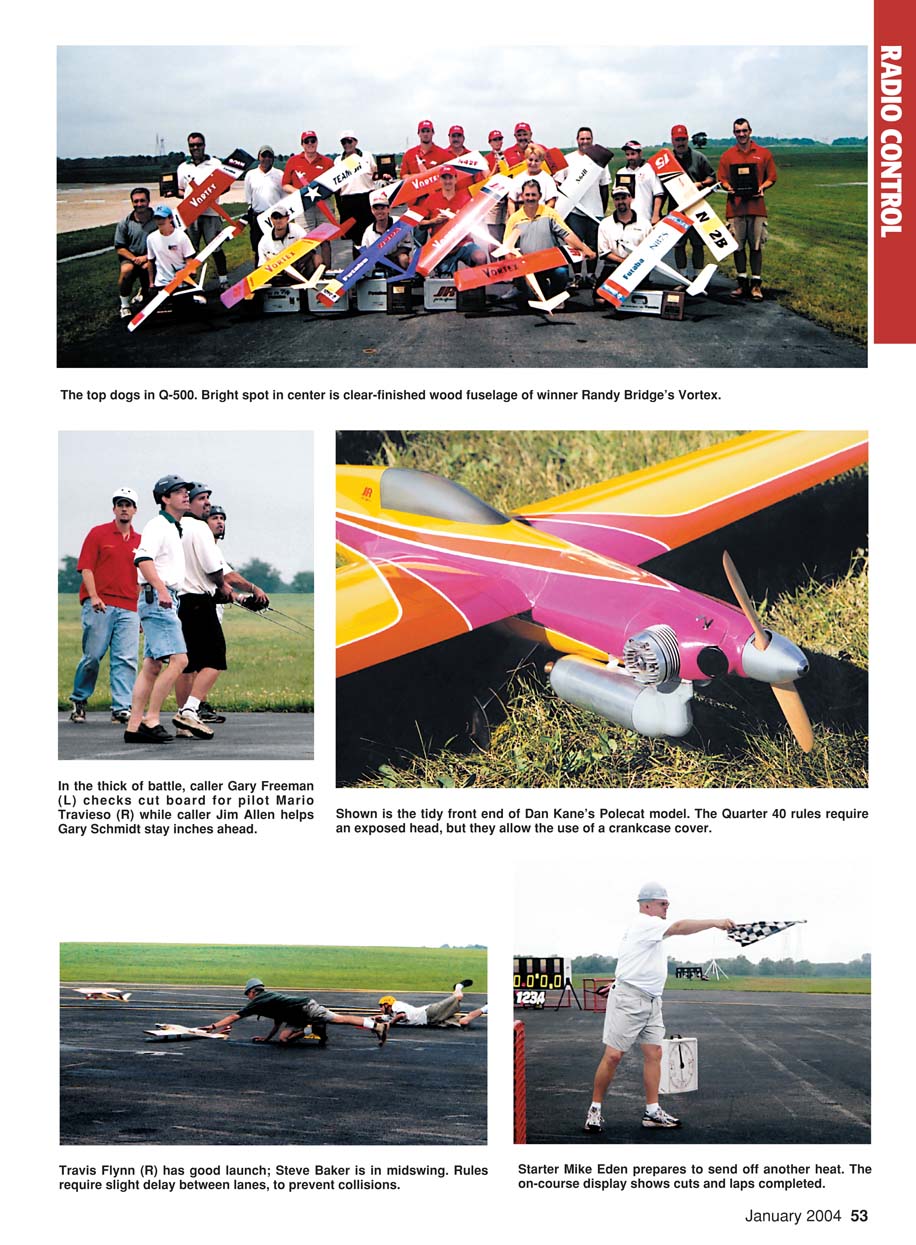
Fuselage construction appears equally divided between wood and fiberglass, with a pack of wood-fuselaged Vortexes placing high at this meet. Wood is light and stiff; fiberglass is quick and uniform. Take your pick.
From the get-go, it was clear that the competitors had their work cut out for them. Some came equipped with Nelson engines featuring a slightly longer intake channel (aka "deep throat"). With the correct head spacing, they could reliably turn the standard APC 8.8 x 8.75 propeller to 20,000 rpm, up from the previous mark of roughly 19,400. Since the pipe is tuned for an optimum takeoff rpm of somewhat less, a few contestants were able to load the engine with propeller pitch up to 9.25 or even 9.5.
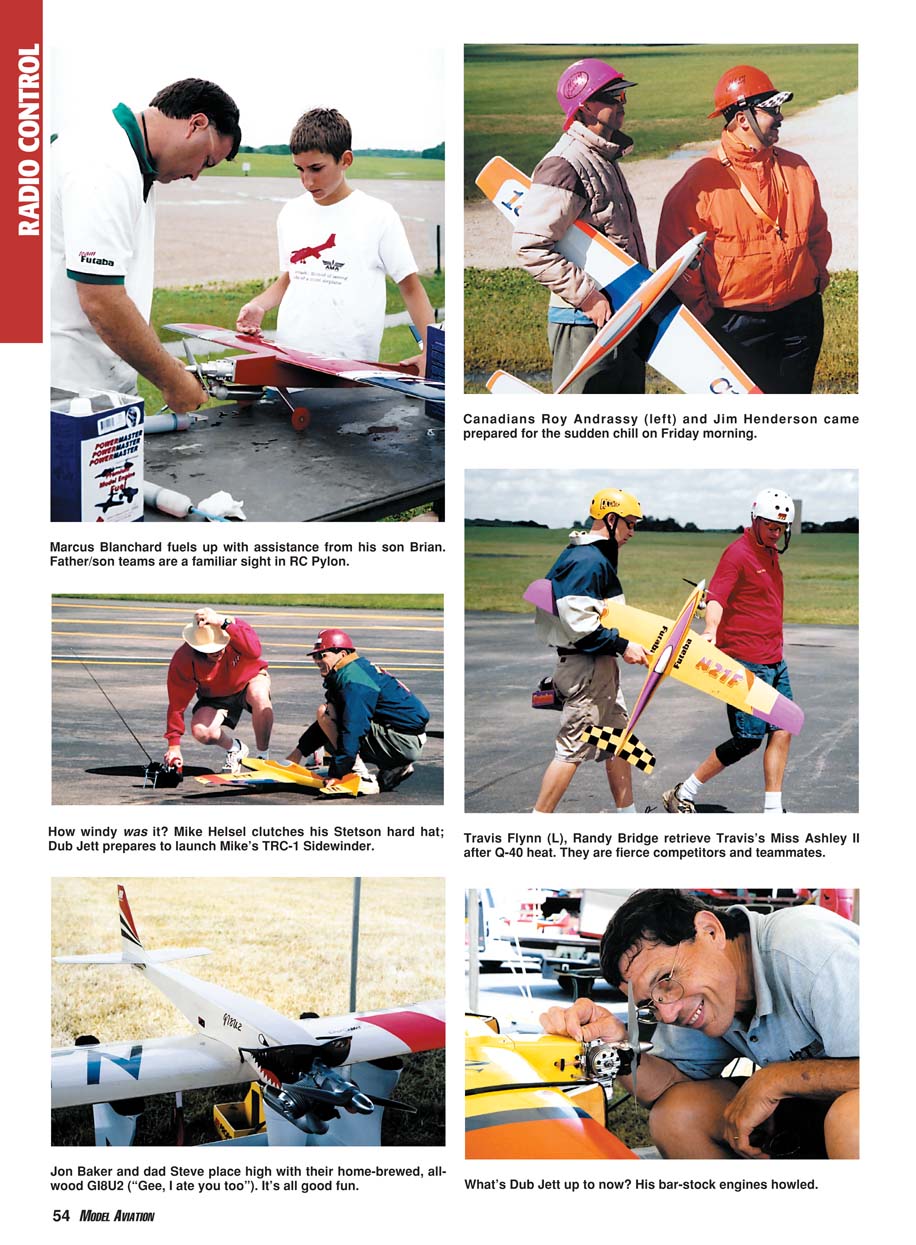
Dub Jett brought new hardware, with crankcases machined from a solid block of aluminum. His teammate Mike Helsel used one to post a time of 1:07.07 — the second-fastest time of the contest behind winner Randy Bridge's 1:06.35.
The pressure was on to get as much flying done as possible in case of rain delays later. As a contestant in Matrix B, I had the privilege of observing all morning and was safely "parked" at approximately noon on Monday when a rain squall of biblical proportions marched toward us from the south, obliterating the RC helicopter flying site before suddenly, unaccountably, changing direction and moving east away from us.
As it happens, Chip Hyde no longer flies RC Pylon; he has gone for helicopter events instead. Hmmm. You have to wonder ...
Racing resumed an hour later with contestant-volunteer Rick Moreland running the starting line. Those of us in Matrix B were reminded that racing luck never leaves you on top for long as Rich kept us hopping until nearly sunset when the threat of a worker and contestant revolt forced an end to the festivities after four rounds.
Tuesday, July 8, dawned much clearer with a forecast for strong storms, which fortunately didn't materialize. We completed the last three rounds with the leaders emerging: Gary Freeman Jr., Terry Frazer, and Mike Helsel in Matrix A, and Randy Bridge, Chuck Anderson, and Marcus Blanchard in Matrix B.
The final rounds brought a fresh start for those who stumbled early but managed to garner enough points to qualify. For others it brought heartbreak. In these heats there could be no backing off; with four aircraft running neck and neck, every turn had to be right over the pole or one risked losing a precious airplane length that couldn't be regained without cutting inside the course. That in itself meant a greater risk of cuts. In many of the 35 heats of the final, the cut board showed at least one for each of three, or sometimes all four, pilots.
In the end, three of the top seven finishers showed a double cut (zero points for the heat) as one of their five scores in the final. Of these, Terry Frazer and Travis Flynn had otherwise perfect scores (four points per heat) and would have been in contention with Randy Bridge for first place or Jim Allen for second.
As it was, they matched up with Gary Schmidt in a three-way flyoff for third. A takeoff collision between Travis and Gary ended the fight before it began, leaving Terry in third and Travis in fourth with one less airplane. The pilots' times were used to decide the tie.
Quarter 40 (Q-40)
Quarter 40 (Q-40) is the successor of the old Formula I in the hearts and minds of speedheads everywhere. Unlike the strict rules that limit Quickie to box fuselages and constant-chord wings, the Q-40 formula encourages streamlining in a slightly smaller, slightly heavier airframe. Designs must be approved by a five-member committee to ensure that they don't stray too far from the appearance of some identifiable full-scale aircraft.
Other than a liberal sprinkling of new and improved airplane designs, the only innovation in Q-40 this year was the legalization of a specific size and style of APC propeller; it's injection-molded from a carbon-fiber material and must be used without modification. Modified wooden propellers were also legal, as always. This slight easing of the propeller rule does appear to have "leveled the playing field" a bit, allowing the less adept woodworkers to go fast for an investment of $8 and none of their time. It was interesting to see the results.
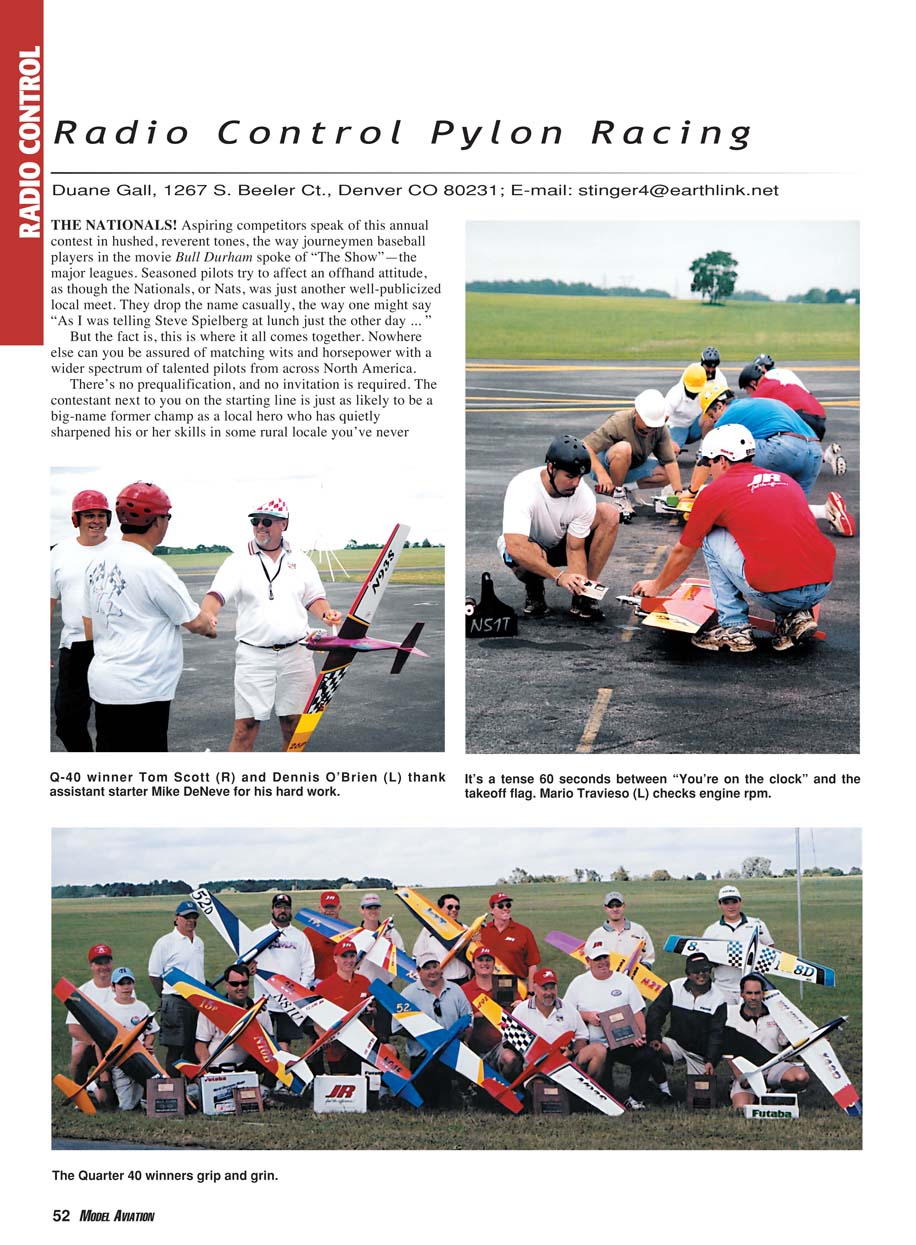
Tom Scott won using a home-brewed wood propeller on his Nelson-powered Polecat, setting the fast time of the meet at 1:03.26. Lloyd Burnham put an APC propeller on his Jett-powered Sidewinder and went 1:04. Both pilots are top notch. So it may truly be said that the difference between wood and plastic propellers in this event is lost in the static.
Another innovation, although not recent, was the 1999 adjustment allowing a shorter, more scale-like fuselage profile on non-Mustang-type designs. All fuselages must have 12.5 square inches of frontal area at some point, and the Mustang types (e.g., Dago Red, Vendetta, and Miss Ashley) must still be 6 inches high to account for the belly scoop. However, non-Mustang types need only be 5 inches high.
The result has been a number of new and cool kits, including the Polecat, flown by several Ohio Valley and Florida contestants, and a Proud Bird fielded by some from the West Coast.
Q-40 started promptly on Wednesday morning, July 9, after it rained all night. Again, the weather cleared more than we ever dared hope. Starter Mike Eden clicked off heat after heat until we had finished three rounds each of Matrix A and Matrix B by the end of the day. A rain delay cut us one round of each.
Remember me mentioning racing luck? Young Nick Brandon, on his way to a Best Junior trophy, matched up with me for a two-airplane heat that should've been an easy win for him, but he suffered a no-start instead. That allowed me my only four-point heat of the contest — an opportunity to get the Stinger dialed in and even to horribly ruin my eighth lap in public without paying the price. Fortunately I was able to salvage my pride later by double cutting, allowing a more deserving person to move on to the final. After all of that excitement, I needed the rest.
At roughly that point some spectators happened by. They were friendly and polite, visiting from somewhere and watching all of the different events, including RC Pylon. They asked a question that took me by surprise: Why would you race as opposed to participating in any of the other RC events that are available?
After a moment's hesitation, I blurted out the three reasons that every Pylon flier probably knows by heart but rarely needs to verbalize. "Well, it makes for a good contest because the results are usually pretty clear-cut, without a lot of subjective judgment calls; it's by far the cheapest motor sport you'll ever find, even at a national level like this; and besides, it's the most fun you can have with all your clothes on!"
We had all our clothes on Friday morning, certainly. At last the sun came out to stay and we were treated to brilliant blue skies and tumbling white clouds. But this spectacular aerial scenery was accompanied by a chilly wind that steadily increased in intensity in preparation for the final rounds.
The last few heats of Matrix B had many cuts and double cuts at Pylon One as the airplanes struggled to make headway against the fierce wind. This threw off the callers' timing, since at 180-plus mph the airplanes normally only take a couple of seconds to cover the 608 feet of front straightaway. And although this contest was unusually free of mishaps, the toll began to grow because of the wind and other factors.
Going into the final, the leader board listed Jim Allen, Tom Scott, and Lloyd Burnham for Matrix A, and Mike Helsel, Dan Kane Jr., and Gary Freeman Jr. for Matrix B. Tom and Gary were flying Polecats, and each held the fast time in his matrix: 1:04 for Tom and 1:05 for Gary. This would prove prophetic.
As in Q-500, the race would go to the smart — as in the person who could resist temptation and stay clean while everybody else cut. Heat 14 had Jim Allen and Dan Kane duking it out. With Jim nipping at his heels, Dan stayed cool and hung on for the win.
In Heat 15, Randy Bridge stayed the course while the double cuts accumulated around him. It was a four-way furball, with near collisions seemingly at every turn.
Fred Burgdorf, Jim Henderson, Bill Johanson, and Terry Frazer provided the entertainment in Heat 16. With Terry lagging because of engine trouble (uncharacteristically, but there's that racing luck again), Fred milked out a narrow lead when Bill and Jim held a smidge longer before turning at Pylon One to avoid cutting. Bill nudged the Polecat ahead to begin a careful march to reel in Fred's Proud Bird while Jim sat back and waited for the two of them to cut. In this case it didn't work; both stayed clean, and Fred held off Bill's charge until sometime after they both crossed the finish line.
A decisive duel emerged in Heat 19, when 1999 champ Jaime De La Vega, here from Mexico for the first time since then, brought out what appeared to be the same well-groomed Miss Ashley, matched up with Tom Scott and the Polecat. The Polecat showed its stuff as both entered the second and third turns simultaneously, and the Polecat peeled away just a length or two ahead each time. The difference appeared to be a tiny advantage in turning efficiency, but it was clearly visible from the pits and seems to have been the edge that Tom needed to take the Q-40 gold.
In all, it was a great Nats. Many thanks to those who placed ahead of us for giving us a good example, to those who placed behind us for giving us a break this time, and, most of all, thanks to the volunteers and contestant-volunteers who made it all possible. We will dry out our mukluks and come back next year!
Transcribed from original scans by AI. Minor OCR errors may remain.

