
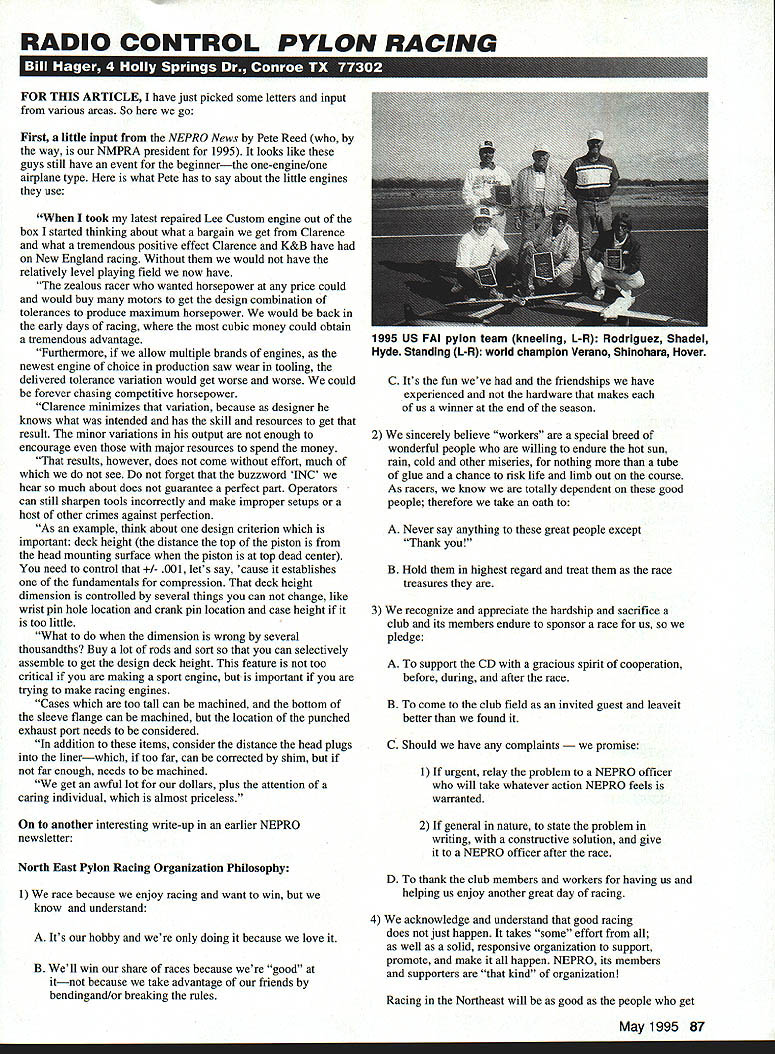
Radio Control: Pylon Racing
Bill Hager, 4 Holly Springs Dr., Conroe TX 77302
For this article, I have just picked some letters and input from various areas. So here we go:
First, a little input from the NEPRO News by Pete Reed (who, by the way, is our NMPRA president for 1995). It looks like these guys still have an event for the beginner—the one-engine/one-airplane type. Here is what Pete has to say about the little engines they use:
"When I took my latest repaired Lee Custom engine out of the box I started thinking about what a bargain we get from Clarence and what a tremendous positive effect Clarence & K&B have had on New England racing. Without them we would not have the relatively level playing field we now have.
"The zealous racer who wanted horsepower at any price could and would buy many motors to get the design combination of tolerances to produce maximum horsepower. We would be back in the early days of racing, where the most cubic money could obtain a tremendous advantage.
"Furthermore, if we allow multiple brands of engines, as the newest engine of choice in production saw wear in tooling, the delivered tolerance variation would get worse and worse. We could be forever chasing competitive horsepower.
"Clarence minimizes that variation, because as designer he knows what was intended and has the skill and resources to get that result. The minor variations in his output are not enough to encourage even those with major resources to spend the money.
"That result, however, does not come without effort, much of which we do not see. Do not forget that the buzzword 'INC' we hear so much about does not guarantee a perfect part. Operators can still sharpen tools incorrectly and make improper setups or a host of other crimes against perfection.
"As an example, think about one design criterion which is important: deck height (the distance the top of the piston is from the head-mounting surface when the piston is at top dead center). You need to control that to ±.001 (inch), because it establishes one of the fundamentals for compression. That deck height dimension is controlled by several things you cannot change, like wrist-pin hole location and crank-pin location and case height if it is too little.
"What to do when the dimension is wrong by several thousandths? Buy a lot of rods and sort so that you can selectively assemble to get the design deck height. This feature is not too critical if you are making a sport engine, but is important if you are trying to make racing engines.
"Cases which are too tall can be machined, and the bottom of the sleeve flange can be machined, but the location of the punched exhaust port needs to be considered.
"In addition to these items, consider the distance the head plugs into the liner—which, if too far, can be corrected by shim, but if not far enough, needs to be machined.
"We get an awful lot for our dollars, plus the attention of a caring individual, which is almost priceless."
On to another interesting write-up in an earlier NEPRO newsletter:
North East Pylon Racing Organization Philosophy
- We race because we enjoy racing and want to win, but we know and understand:
- A. It's our hobby and we're only doing it because we love it.
- B. We'll win our share of races because we're "good" at it — not because we take advantage of our friends by bending and/or breaking the rules.
- C. It's the fun we've had and the friendships we have experienced and not the hardware that makes each of us a winner at the end of the season.
- We sincerely believe "workers" are a special breed of wonderful people who are willing to endure the hot sun, rain, cold and other miseries, for nothing more than a tube of glue and a chance to risk life and limb out on the course. As racers, we know we are totally dependent on these good people; therefore we take an oath to:
- A. Never say anything to these great people except "Thank you!"
- B. Hold them in highest regard and treat them as the race treasures they are.
- We recognize and appreciate the hardship and sacrifice a club and its members endure to sponsor a race for us, so we pledge:
- A. To support the Contest Director (CD) with a gracious spirit of cooperation, before, during, and after the race.
- B. To come to the club field as an invited guest and leave it better than we found it.
- C. Should we have any complaints — we promise:
- If urgent, relay the problem to a NEPRO officer who will take whatever action NEPRO feels is warranted.
- If general in nature, state the problem in writing, with a constructive solution, and give it to a NEPRO officer after the race.
- D. To thank the club members and workers for having us and helping us enjoy another great day of racing.
- We acknowledge and understand that good racing does not just happen. It takes some effort from all, as well as a solid, responsive organization to support, promote, and make it all happen. NEPRO, its members and supporters are that kind of organization!
Racing in the Northeast will be as good as the people who get involved. All it takes from here on to ensure a growing and improving racing program is for each of you to accept the philosophy of NEPRO, make it part of your racing activity, and personally contribute whatever you can of yourself to make NEPRO work better for you.
Also from the same newsletter, here are some helpful hints for the CDs and workers:
NEPRO Worker Training (for CDs)
Planning:
- Contact suppliers two to three months in advance for handouts.
- Approximately one month before the race, the CD should line up workers, plan positions, give workers a job sheet, and line up alternates if possible.
- One week before, check workers (remind), mail job sheet if needed.
- Contact local CAP, Air Scouts, etc., for spectators and/or future course workers.
Training:
- Provide an easy-to-understand duties sheet for each person on course.
- Day before: set up cages, provide opportunity for locals to practice and for workers to get used to cages; simulate two- or three-man races; have race pilots help workers through a simulated race.
- Use time prior to race for test flights with workers in cages; let workers try "for real."
Pilot Assistance:
- Racers should offer to "spell" workers, especially those who are out of the competition. Do not leave fellow racers stuck in cages.
- Answer loudspeaker calls for assistance.
- Racers should encourage the fun and excitement of the "up close and personal" vantage point of working.
- Racers should encourage reward systems as established by the CD and NEPRO.
- Publicly thank workers at club meetings and contest award meetings.
- Contest Director options: offer reduction in entry fee to racers bringing workers with them to races; include an extra dollar in entry fee for worker prizes.
Suggestions:
- Give raffle tickets to workers at each race; collect and keep all tickets until the season ends. Raffle at end of year for suggestions such as banquet, radio, cash prizes, etc.
- Include workers in NEPRO News mailing. Have a separate mailing similar to old PRO News.
- Include a short write-up or pictures of workers in NEPRO News.
- No pilots to receive worker raffle prizes.
- All workers registered with CD including name, address, etc.
Sample Instructions for Workers
#### Pylon 1 The purpose of the course workers in Pylon 1 is to ensure that each plane rounds the pylon. Each worker is assigned a lane, and each lane will have the predominant markings of an airplane assigned to it (such as lane 1: blue; lane 2: stripes, etc.).
- Once your lane has had its color assigned, notify the starter and pilot that you can recognize that plane by pulling the shutter. If you are not sure, have the pilot show the plane again.
- Upon the start of the race, try to pick up your assigned plane as it leaves the ground, and watch as it approaches Pylon 1. The planes will approach the pylon near knife-edge, making it easy to see the markings.
- When your plane has passed the imaginary line between the flag and a white stake driven in the ground, pull the shutter down and hold it for three to five seconds.
- If your plane does not reach the pylon, or turns too early, do not pull the shutter. Do not anticipate: if you pull the shutter too early, you have notified the flier that it is time to turn, and he will. That is then a legal turn, and you have just given one pilot an unfair advantage over the others. You cannot call it back.
On rare occasions, a plane will "button hook," which is a turn that begins after passing the poles but turns too sharply and passes back through the poles without ever rounding the flag. If this should happen, call out to the pylon judge that "blue button hooked," and post a cut.
#### Posting a Cut
- If the plane turns too early or button hooks, notify the judge and then drop the cut signal. The judge can overrule you, as he is directly under the flag and has a slightly better perspective from the flag's location.
- Once you have posted a cut, your plane must fly an extra lap. If, after the first cut, your plane cuts again, pull the cut signal all the way up, and your pilot is out.
- In most cases, if most of the plane passes outside of the flag, give the flier a break. Above all, be consistent, and be sure not to anticipate. Many fliers and their callers tend to anticipate, and if both of you do, cuts get called.
We all appreciate your help, and hope you have a fun day. Maybe you would like to try it yourself.
#### Pylons 2 and 3 The purpose of the course workers in Pylons 2 and 3 is to ensure that each plane rounds the pylon. Each plane will have the predominant markings of an airplane assigned to it. If you are not sure you can identify them, have the starter call for the plane to be shown again.
- If an airplane does not reach the pylon, or turns too early, it gets a cut.
- At some races, you will have a small free horn. A short blast notifies the fliers that someone has cut (they generally know who).
- Then use the phone to notify the timer cage, saying something like "stripes cut 2" or "blue cut 3." Try to call in as soon as possible, and do not hesitate to ask if it was received if you do not get acknowledgment from the timer cage.
Transcribed from original scans by AI. Minor OCR errors may remain.

