
RADIO CONTROL PYLON RACING
Bill Hager, 4 Holly Springs Dr., Conroe TX 77302
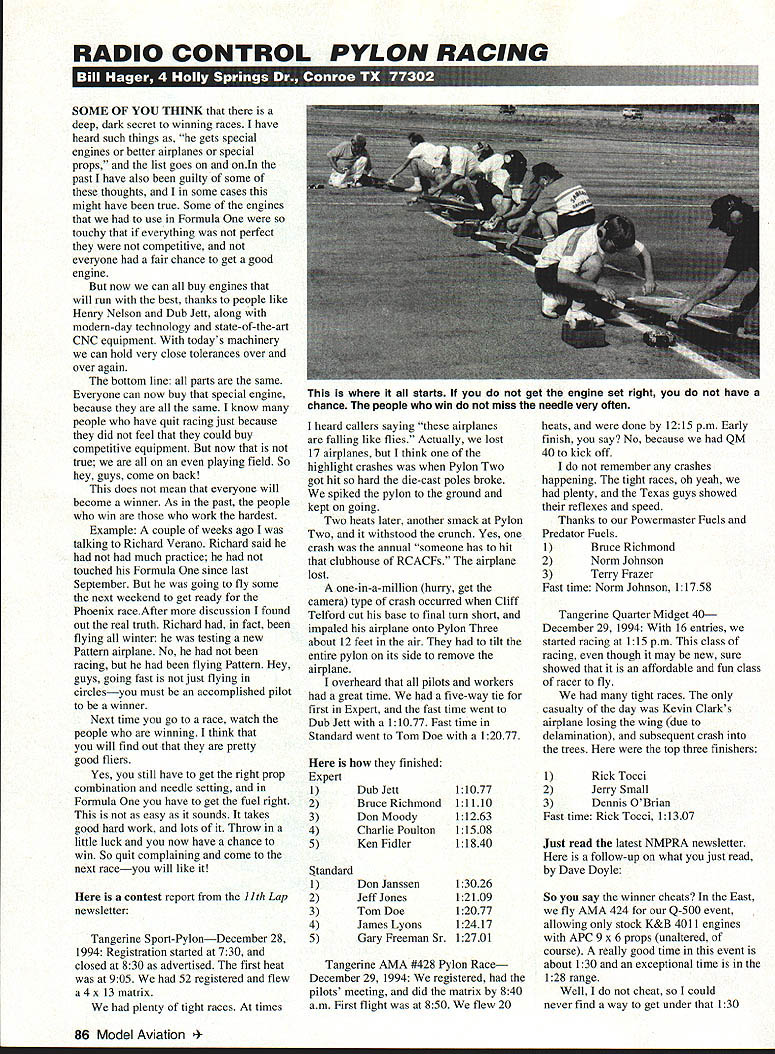
Some of you think that there is a deep, dark secret to winning races. I have heard such things as, "he gets special engines or better airplanes or special props," and the list goes on and on. In the past I have also been guilty of some of these thoughts, and in some cases this might have been true. Some of the engines that we had to use in Formula One were so touchy that if everything was not perfect they were not competitive, and not everyone had a fair chance to get a good engine.
But now we can all buy engines that will run with the best, thanks to people like Henry Nelson and Dub Jett, along with modern-day technology and state-of-the-art CNC equipment. With today's machinery we can hold very close tolerances over and over again.
The bottom line: all parts are the same. Everyone can now buy that special engine, because they are all the same. I know many people who have quit racing just because they did not feel that they could buy competitive equipment. But now that is not true; we are all on an even playing field. So hey, guys, come on back!
This does not mean that everyone will become a winner. As in the past, the people who win are those who work the hardest.
Example: A couple of weeks ago I was talking to Richard Verano. Richard said he had not had much practice; he had not touched his Formula One since last September. But he was going to fly some the next weekend to get ready for the Phoenix race. After more discussion I found out the real truth. Richard had, in fact, been flying all winter. He was testing a new Pattern airplane. No, he had not been racing, but he had been flying Pattern. Hey, guys, going fast is not just flying in circles—you must be an accomplished pilot to be a winner.
Next time you go to a race, watch the people who are winning. I think that you will find out that they are pretty good fliers.
Yes, you still have to get the right prop combination and needle setting, and in Formula One you have to get the fuel right. This is not as easy as it sounds. It takes good hard work, and lots of it. Throw in a little luck and you now have a chance to win. So quit complaining and come to the next race—you will like it!
Contest report (from the 11th Lap newsletter)
Tangerine Sport-Pylon — December 28, 1994 Registration started at 7:30, and closed at 8:30 as advertised. The first heat was at 9:05. We had 52 registered and flew a 4 x 13 matrix.
I heard callers saying "these airplanes are falling like flies." Actually, we lost 17 airplanes, but I think one of the highlight crashes was when Pylon Two got hit so hard the die-cast poles broke. We spiked the pylon to the ground and kept on going.
Two heats later, another smack at Pylon Two, and it withstood the crunch. Yes, one crash was the annual "someone has to hit the clubhouse" of RCACF's. The airplane was lost.
A one-in-a-million (hurry, get the camera) type of crash occurred when Cliff Telford cut his base to final turn short, and impaled his airplane onto Pylon Three about 12 feet in the air. They had to tilt the entire pylon on its side to remove the airplane.
I overheard that all pilots and workers had a great time. We had a five-way tie for first in Expert, and the fast time went to Dub Jett with a 1:10.77. Fast time in Standard went to Tom Doe with a 1:20.77.
Expert results
- Dub Jett — 1:10.77
- Bruce Richmond — 1:11.10
- Don Moody — 1:12.63
- Charlie Poulton — 1:15.08
- Ken Fidler — 1:18.40
Standard results
- Don Janssen — 1:30.26
- Jeff Jones — 1:21.09
- Tom Doe — 1:20.77
- James Lyons — 1:24.17
- Gary Freeman Sr. — 1:27.01
Tangerine AMA #428 Pylon Race — December 29, 1994 We registered, had the pilots' meeting, and did the matrix by 8:40 a.m. First flight was at 8:50. We flew 20 heats, done by 12:15 p.m. Early finish, you say? No, because we had QM 40 to kick off. I do not remember any crashes happening. The tight races, oh yeah, we had plenty, and the Texas guys showed their reflexes and speed. Thanks to Powermaster Fuels and Predator Fuels.
- Bruce Richmond
- Norm Johnson
- Terry Frazer
Fast time: Norm Johnson — 1:17.58
Tangerine Quarter Midget 40 — December 29, 1994 With 16 entries, we started racing at 1:15 p.m. This class of racing, even though it may be new, sure showed that it is an affordable and fun class of racer to fly. We had many tight races. The only casualty of the day was Kevin Clark's airplane losing the wing (due to delamination), and the subsequent crash into the trees.
- Rick Tocci
- Jerry Small
- Dennis O'Brian
Fast time: Rick Tocci — 1:13.07
Follow-up (from the NMPRA newsletter — Dave Doyle)
So you say the winner cheats? In the East, we fly AMA 424 for our Q-500 event, allowing only stock K&B .4011 engines with APC 9 x 6 props (unaltered, of course). A really good time in this event is about 1:30 and an exceptional time is in the 1:28 range. Well, I do not cheat, so I could never find a way to get under that 1:30 mark, although I did manage to hit it a few times. I know it had to be my engine or the prop.
In August, we have a grand two-day race in Ellington, and just about everybody comes out to the race. Dub Jett was going to be in town, so we convinced him that he should try our form of Q-500, which we ran separate from the 428 version. I convinced Dub that all he needed to do was to bring an old AMA-legal Q-500 airframe and I would supply him with an engine and a prop—a good one, naturally.
Dub naturally had trouble adjusting to the blazing speed of our event, and cut out many times and just could not seem to get things together—the first day, that is. I heard him remark, "Boy, you just have to fly right on those poles to get a good time in this event!" It seems that he got it all together on the second day, because he had nothing but good times—one of which set a new course record.
Before Dub headed back to Texas, he gave me my engine and prop back and said very quietly, "Here is your powerhouse back, Dave—now you have no excuses."
You know, I used that engine and prop for the rest of the season and still did not break the 1:30 mark, and I even used the same brand of airplane (ReV/ution). So next time you think the fast guys are cheating, give them a little slack—just maybe they fly better than you do.
Come to think of it, Dub did have a slightly different landing gear, and that spinner he had on was different—no, he gave me that spinner and I used it—well, I know he had a shorter rudder and those things he had on his stabs, they were small and almost nobody noticed; I bet Shadel has them, too.
Fuel systems and engine handling
Reliability is one of the most significant factors in attaining success in Formula One racing. Your engine must run even laps without a notable change in needle setting. I have seen many engines ruined before their time because of improper or no break-in, or because of an inadequate fuel system.
An engine test stand is one of the best investments you can make. They are a lot cheaper than burned-up engines. An 11-oz. fuel tank should be raised to approximate the elevation as it will be in your airplane. You will need a test prop that will turn about 2,000 rpm higher than your flying props. I use a carbon-fiber prop, as weather does not affect it.
Run the engine at least three times on your test stand with 35% to 50% nitro:
- Start the engine rich and let it run for one minute before leaning the needle.
- Take the engine near peak and let it run for about 30 seconds, then go back to rich for another minute.
- Repeat the process, being sure to run the engine rich before shutting it off.
Alternating from rich to near-peak will temperature-cycle the piston and allow the molecular structure within the piston to stabilize.
Put on your flying prop and your flying fuel (60–65%) and run it on the test stand. I look for about 22,500 rpm from my racing props. If the rpm is right and the needle sets well, your engine is now ready to fly.
The fuel system in your airplane must be as reliable as your test stand. Three critical aspects of fuel tank installation are:
- elevation,
- attitude, and
- isolation from vibration.
Use a small block of Styrofoam to make a platform for your fuel tank. This will fit inside the fuselage ahead of the wing to the firewall. It should hold the tank as high as possible while allowing for foam rubber padding all the way around the tank. The tank should sit about 1/8" lower at the back when the fuselage is in level flight attitude.
When satisfied with the fit of your tank in the fuselage, use a few dabs of silicone to secure the platform inside the fuselage. Make a "bumper" for your tank from 1/16" sheet balsa that will extend past the front of the tank and keep the fuel lines from pinching. Tape this to the bottom of the tank.
Make a blanket or sleeve that wraps all the way around the tank from 1/4" foam rubber. Install your tank, being sure that your fuel lines are not pinched in any manner. Pack around the tank with additional foam as needed to be sure it will not shift in flight. The plumbing to your engine should be as direct as possible, without any possibility of the fuel lines pinching.
You have now replicated your test-stand setup in your airplane. Your engine runs properly and the prop tachs okay. Be sure that your fuel shutoff works reliably before flying. Now go fly.
Start with a conservatively rich needle setting for the first few flights. Work gradually toward your ideal needle setting—your engine will run better and last longer.
This is not classified information, so share it freely. Be advised that if you shortcut the break-in or tank installation, it will cost you. And don't get too greedy on your needle setting. I have yet to see an engine that produces more horsepower by going lean.
Transcribed from original scans by AI. Minor OCR errors may remain.

