
RADIO CONTROL PYLON RACING
Bill Hager, 4 Holly Springs Dr., Conroe TX 77302
I am going to try to print some race reports from different parts of the country so you will know what other guys are doing in different parts of the world. We will also include some words of wisdom from Dave Doyle.
Wow — the racing season is upon us!
Central California Racing Association (CCRA) / Merced County Flyers
First-ever QM40/Quickie race in California — April 22–23 Course: 2.5-mile long
Saturday started cool but reached the upper 70s by noon with low humidity — a day made for fast times. There were five events: QM40 (with 9mm venturi), Quickie .428 Expert, .428 Novice, .428 Standard, and 25 (.25-size engine on Q500 airframe).
Turnout in QM40 was low at first; many were taking a wait-and-see attitude. By the end of the day they were believers.
QM40 highlights
- Heat 1: Lyle Larson (Napier Heston) vs. Jeff Carpenter (Mustang). Carpenter had a good takeoff but Larson caught him before the end of lap one and pulled a half lap ahead. Larson pushed hard and cut on lap eight; Carpenter cruised to a new QM40 record of 1:12.06.
- Heat 2: Larson lowered the record to 1:09.43.
- Heat 3: Larson posted 1:07.50 and later set a final record of 1:07.38. Notably, Lyle flew the same glow plug six times that Saturday with record-setting results.
- Other competitors: Mickey Crawley and Bob Dible made it very competitive. Crawley, who had just moved up to Quickie .428 this year, flew four rounds below 1:12.65; Carpenter flew three rounds below 1:12; Dible went sub-1:12 once.
- Larson was generous with tips and wanted to help others go fast.
Quickie .428 Expert highlights
- Heats produced wingtip-to-wingtip finishes on several occasions.
- Heat 2: Bob Dible’s custom-built Runt faced Fred Burgdorf, Mickey Crawley, and Seth Tomblin. Tomblin went slightly off-line mid-race; Crawley crashed at Pylon One. Dible and Burgdorf battled to the finish with Dible setting a new .428 2.5-mile record of 1:11.63.
- Heat 3: Burgdorf and Tomblin vs. Bruce Coffey and Mickey Crawley. Burgdorf and Crawley initially pulled away, changed leaders frequently, and by lap three Crawley pulled ahead to set a new Senior record of 1:13.03.
Sunday recap
- QM40 competition continued fast and furious. Dible suffered firewall problems and was out for the day.
- Heat 1: Larson got off first with Crawley and Carpenter chasing. By lap five all three planes were even; Larson edged out the win at 1:11.64.
- Heat 2: Carpenter took off first, but Larson used more power to pass and finished with 1:09.16.
- Larson eventually withdrew due to the flu. Carpenter and Crawley provided exciting battles through the remaining heats.
Youth involvement
CCRA had a strong showing of young racers helping to keep the sport vital:
- Mickey Crawley (18)
- David Wright (18)
- Seth Tomblin (16)
- Tony Cuneo (16) — .428 Standard
- Steve Hulse (16) — Novice
- Jeremy Bettencourt (18) — 25 class
The .25-size engines on Q500 airframes have attracted many sport fliers, young and old, into pylon racing. Expect to hear these names in years to come.
District 5 — Hamilton, Ohio (HAWKS)
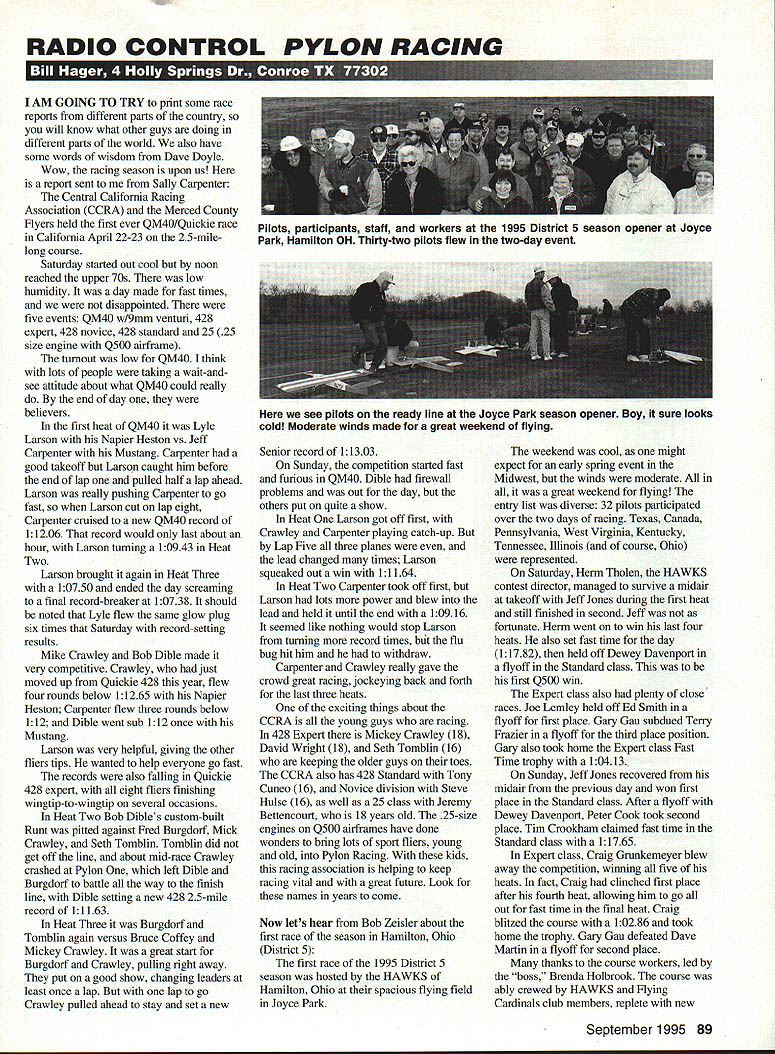
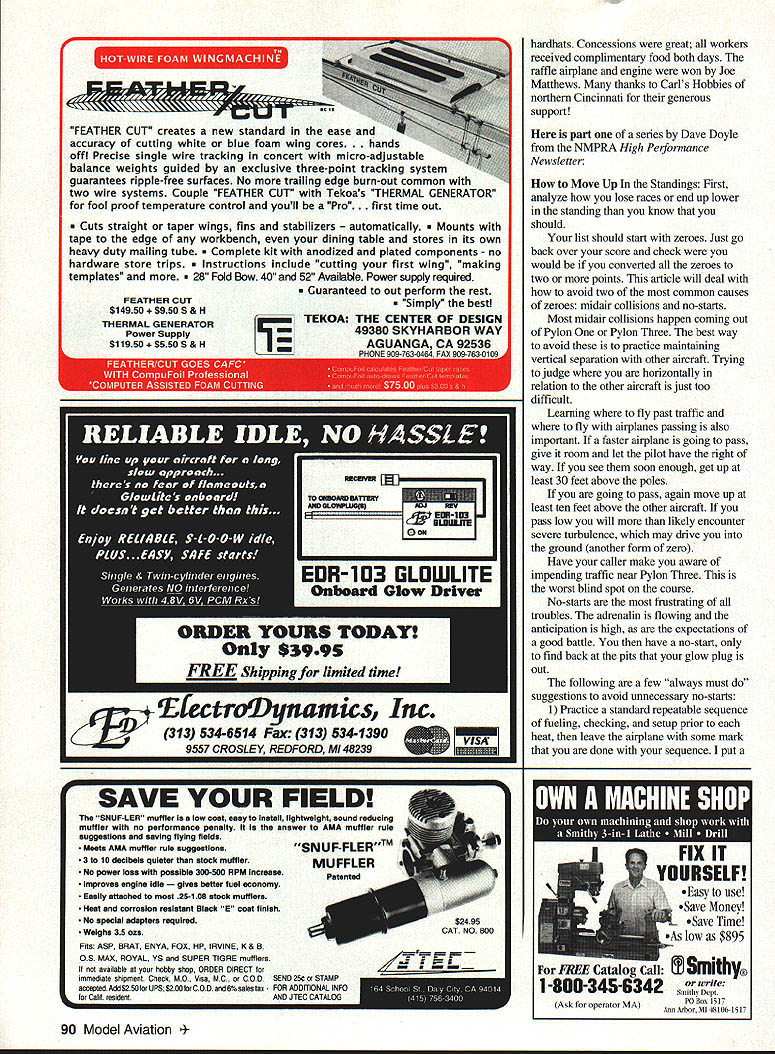
Report by Bob Zeisler Event: First race of the 1995 District 5 season — hosted by the HAWKS at Joyce Park
The weekend was cool with moderate winds — good flying weather. Thirty-two pilots participated over the two days, representing Texas, Canada, Pennsylvania, West Virginia, Kentucky, Tennessee, Illinois, and Ohio.
Saturday
- Herm Tholen (HAWKS contest director) survived a midair at takeoff involving Jeff Jones during the first heat and still finished second in that heat. Jeff Jones was not as fortunate initially.
- Herm won his last four heats, set fast time for the day at 1:17.82, and won the Standard class after a flyoff — his first Q500 win.
- Expert class: Joe Lemley held off Ed Smith in a flyoff for first. Gary Gau defeated Terry Frazier in a flyoff for third place and also took Expert fast time at 1:04.13.
Sunday
- Jeff Jones recovered from the Saturday midair and won first place in Standard after a flyoff. Dewey Davenport and Peter Cook took second and third. Tim Crookham claimed fast time in Standard at 1:17.65.
- Expert class: Craig Grunemeyer dominated, winning all five heats. He had clinched first after the fourth heat and went all-out for fast time in the final heat, posting 1:02.86. Gary Gau defeated Dave Martin in a flyoff for second place.
Thanks to course workers led by Brenda Holbrook. The course crew included HAWKS and Flying Cardinals members; concessions and worker support were excellent. Raffle airplane and engine were won by Joe Matthews. Thanks to Carl’s Hobbies of northern Cincinnati for their support.
How to Move Up in the Standings
First, analyze how you lose races or end up lower in the standings than you should. Start your list with zeroes: go back over your score and check where you would be if you converted all the zeroes to two or more points.
This article deals with two of the most common causes of zeroes: midair collisions and no-starts.
Avoiding midair collisions
- Most midair collisions occur coming out of Pylon One or Pylon Three.
- Practice maintaining visual separation with other aircraft. Judging horizontal position relative to another airplane is difficult; focus on vertical separation and clear passing paths.
- If a faster airplane is going to pass, give it room and yield the right of way. If you see the pass early, move up at least 30 feet above the poles.
- If you are passing, move up at least 10 feet above the other aircraft. Passing low often puts you into severe turbulence, which can lead to loss of control.
- Have your caller alert you to impending traffic near Pylon Three — it is the worst blind spot on the course.
Avoiding no-starts
No-starts are among the most frustrating issues — the adrenaline is flowing and you’re ready to race, only to find a failed plug or other preventable problem.
Always-do suggestions to avoid unnecessary no-starts:
- Practice a standard, repeatable sequence of fueling, checking, and setup before each heat. Use a visible mark to indicate the sequence is complete (e.g., attach a hemostat to the fuel line). If you get interrupted and the mark isn’t in place, repeat the entire routine.
- Inspect the glow plug: remove it and examine the element. If it appears frosted rather than shiny or the coils are distorted, change it even if it lights. Frosting means the engine ran a bit lean and the element is near failure.
- If the coil looks good, light it briefly and make sure it visibly glows. Battery indicators can show current even when the plug is shorted.
- After installing a new plug, test for leaks by spraying a mixture of Windex and water on the plug area while turning through the compression stroke. If bubbles appear at the post, discard the plug. If bubbles appear at the thread, remove the plug, clean the seal point, and replace. Repeat the test.
- If running a recently rebuilt or adjusted engine, check head bolts with the plug removed after two runs and again after about six runs.
- Check propeller tightness after each run if possible to help prevent the spinner from coming off at the line when you use the starter.
Recommended pre-event and pre-flight sequence (example):
- Before assembling the airplane for the day: check battery with an expanded-scale voltmeter; check all servos, servo rails, clevises, engine mounting bolts, and firewall bolts.
- Before each flight: remove and inspect the plug, test it, check head bolts (as above), replace the plug, and test for leaks. Re-fuel the tank. Check the wheels for binding and correct if needed. Attach the hemostat to the fuel line to prevent siphoning and to indicate completion of the routine.
- Add or remove items in the sequence depending on the class. For example, for NEPRO Q500, check the carburetor for tightness as it sometimes comes loose in flight.
- Part Two of this series will cover starting on the line, the takeoff, and flying the course.
Thanks to Dave Doyle for these tips. We will continue this series next month and bring more news in pylon racing.
Transcribed from original scans by AI. Minor OCR errors may remain.

