
Radio Control: Pylon Racing
Report by Lou Rodriguez — Phoenix Formula One
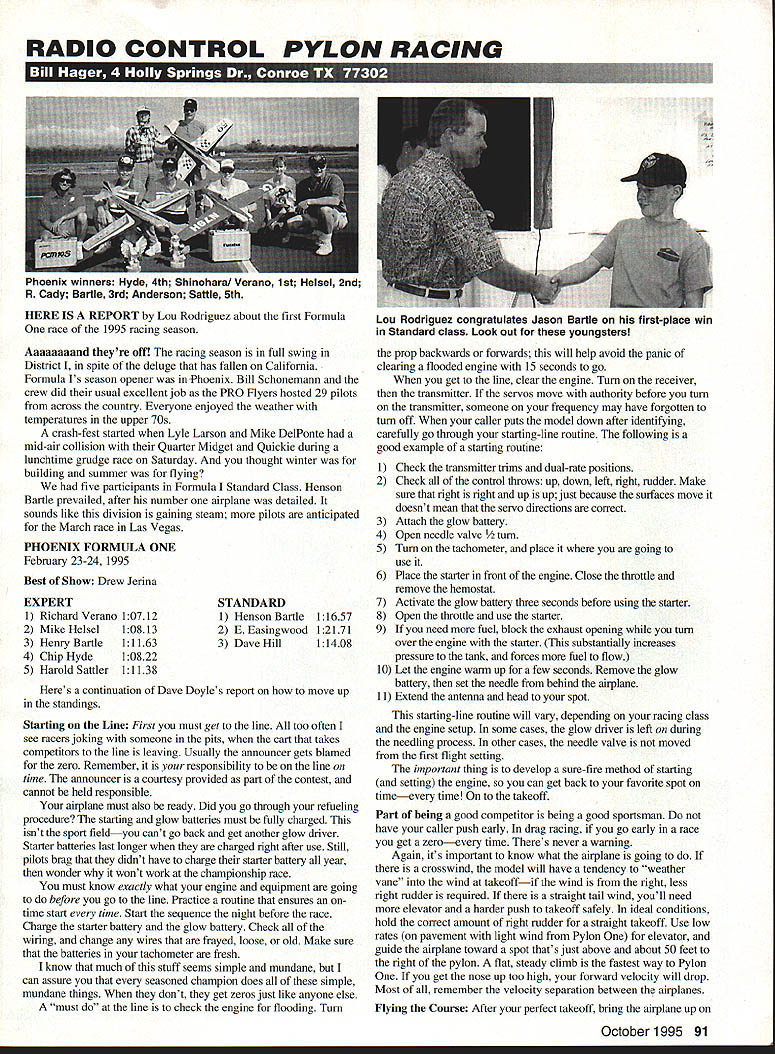
Aaaaaaand they're off! The racing season is in full swing in District I, in spite of the deluge that has fallen on California. Formula I's season opener was in Phoenix. Bill Schonemann and his PRO Flyers crew did their usual excellent job as the PRO Flyers hosted 29 pilots from across the country. Everyone enjoyed the weather, with temperatures in the upper 70s.
A crash-fest started when Lyle Larson and Mike DelPonte had a mid-air collision with their Quarter Midget and Quickie during a lunchtime grudge race on Saturday. And you thought winter was for building and summer was for flying?
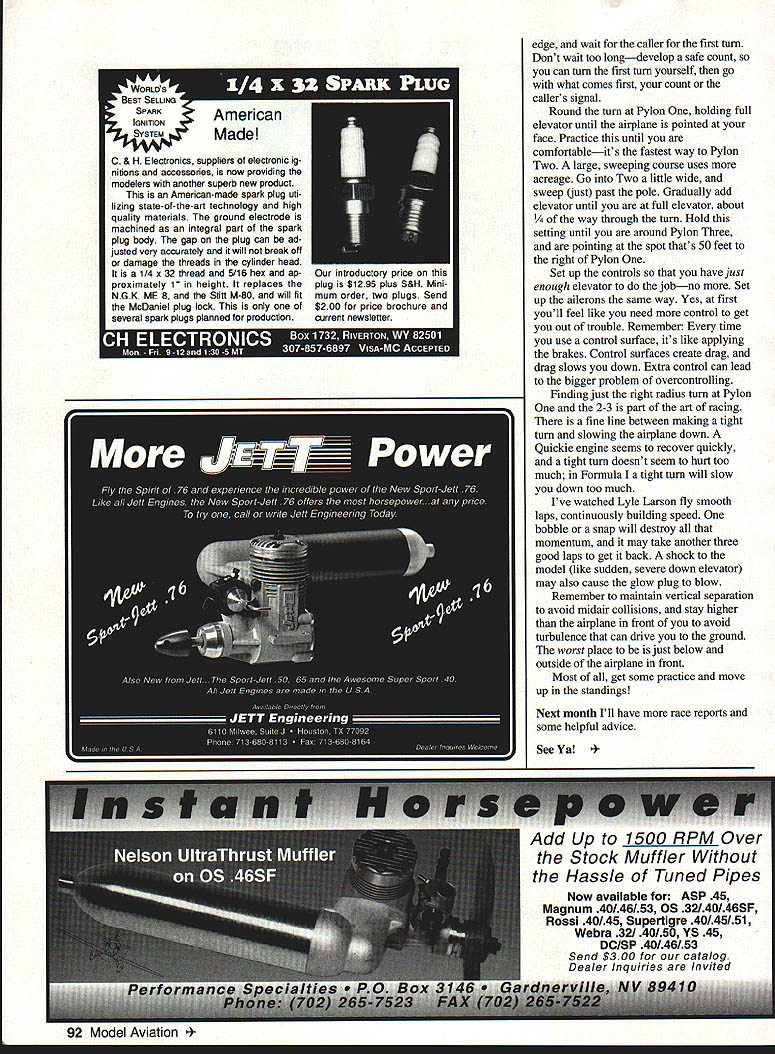
We had five participants in Formula I Standard Class. Henson Bartle prevailed after his number-one airplane was detailed. It sounds like this division is gaining steam; more pilots are anticipated for the March race in Las Vegas.
Phoenix Formula One
February 23–24, 1995 Best of Show: Drew Jerina
EXPERT
- Richard Verano — 1:07.12
- Mike Helsel — 1:08.13
- Henry Bartle — 1:11.63
- Chip Hyde — 1:08.22
- Harold Sattler — 1:11.38
STANDARD
- Henson Bartle — 1:16.57
- E. Easingwood — 1:21.71
- Dave Hill — 1:14.08
---
How to Move Up in the Standings — Dave Doyle (continued)
Starting on the Line: First you must get to the line. All too often I see racers joking with someone in the pits when the cart that takes competitors to the line is leaving. Usually the announcer gets blamed for the zero. Remember: it is your responsibility to be on the line on time. The announcer is a courtesy provided as part of the contest and cannot be held responsible.
Your airplane must also be ready. Did you go through your refueling procedure? The starting and glow batteries must be fully charged. This isn't the sport field—you can't go back and get another glow driver. Starter batteries last longer when they are charged right after use. Still, pilots brag that they didn't have to charge their starter battery all year, then wonder why it won't work at the championship race.
You must know exactly what your engine and equipment are going to do before you go to the line. Practice a routine that ensures an on-time start every time. Start the sequence the night before the race. Charge the starter battery and the glow battery. Check all of the wiring, and change any wires that are frayed, loose, or old. Make sure that the batteries in your tachometer are fresh.
I know that much of this stuff seems simple and mundane, but I can assure you that every seasoned champion does all of these simple, mundane things. When they don't, they get zeros just like anyone else.
A "must do" at the line is to check the engine for flooding. Turn the prop backward, or forward; this will help avoid the panic of clearing a flooded engine with 15 seconds to go.
When you get to the line, clear the engine. Turn on the receiver, then the transmitter. If the servos move with authority before you turn on the transmitter, someone on your frequency may have forgotten to turn off. When your caller puts the model down after identifying, carefully go through your starting-line routine. The following is a good example of a starting routine:
- Check the transmitter trims and dual-rate positions.
- Check all of the control throws: up, down, left, right, rudder. Make sure that right is right and up is up; just because the surfaces move it doesn't mean that the servo directions are correct.
- Attach the glow battery.
- Open needle valve 1/2 turn.
- Turn on the tachometer, and place it where you are going to use it.
- Place the starter in front of the engine. Close the throttle and remove the hemostat.
- Activate the glow battery three seconds before using the starter.
- Open the throttle and use the starter.
- If you need more fuel, block the exhaust opening while you turn over the engine with the starter. (This substantially increases pressure to the tank and forces more fuel to flow.)
- Let the engine warm up for a few seconds. Remove the glow battery, then set the needle behind the airplane.
- Extend the antenna and head to your spot.
This starting-line routine will vary depending on your racing class and the engine setup. In some cases, the glow driver is left on during the needling process. In other cases, the needle valve is not moved from the first-flight setting.
The important thing is to develop a sure-fire method of starting (and setting) the engine, so you can get back to your favorite spot on time—every time!
On to the Takeoff
Part of being a good competitor is being a good sportsman. Do not have your caller push early. In drag racing, if you go early in a race you get a zero—every time. There's never a warning.
Again, it's important to know what the airplane is going to do. If there is a crosswind, the model will have a tendency to "weather vane" into the wind at takeoff—if the wind is from the right, less right rudder is required. If there is a straight tail wind, you'll need more elevator and a harder push to take off safely. In ideal conditions, choose the correct amount of right rudder for a straight takeoff. Use low rates (on pavement with light wind from Pylon One) for elevator, and guide the airplane toward a spot that's just above and about 50 feet to the right of the pylon. A fast, steady climb is the fastest way to Pylon One. If you get the nose up too high, your forward velocity will drop. Most of all, remember the velocity separation between the airplanes.
Flying the Course
After your perfect takeoff, bring the airplane up on edge and wait for the caller for the first turn. Don't wait too long—develop a safe count so you can turn the first turn yourself, then go with what comes first: your count or the caller's signal.
Round the turn at Pylon One, holding full elevator until the airplane is pointed at your face. Practice this until you are comfortable—it's the fastest way to Pylon Two. A large, sweeping course uses more acreage. Go into Two a little wide, and sweep (just) past the pole. Gradually add elevator until you are at full elevator, about 1/4 of the way through the turn. Hold this setting until you are around Pylon Three and are pointing at the spot that's 50 feet to the right of Pylon One.
Set up the controls so that you have just enough elevator to do the job—no more. Set up the ailerons the same way. Yes, at first you'll feel like you need more control to get you out of trouble. Remember: every time you use a control surface, it's like applying the brakes. Control surfaces create drag, and drag slows you down. Extra control can lead to the bigger problem of overcontrolling.
Finding just the right radius turn at Pylon One and the 2–3 is part of the art of racing. There is a fine line between making a tight turn and slowing the airplane down. A Quickie engine seems to recover quickly, and a tight turn doesn't seem to hurt too much; in Formula One a tight turn will slow you down too much.
I've watched Lyle Larson fly smooth laps, continuously building speed. One bobble or a snap will destroy all that momentum, and it may take another three good laps to get it back. A shock to the model (like sudden, severe down elevator) may also cause the glow plug to blow.
Remember to maintain vertical separation to avoid midair collisions, and stay higher than the airplane in front of you to avoid turbulence that can drive you to the ground. The worst place to be is just below and outside of the airplane in front.
Most of all, get some practice and move up in the standings!
Next month I'll have more race reports and some helpful advice.
See ya!
Transcribed from original scans by AI. Minor OCR errors may remain.

