
RADIO CONTROL PYLON RACING
Bill Hager, 4 Holly Springs Dr., Conroe TX 77302
How To Move Up In The Standings
For the last couple of months we have featured a series by Dave Doyle on how to do well in racing. I hope this has helped some of you better understand what it takes to win in pylon racing.
This is the last in the present series of "help" articles. If you have comments or questions or want information, please write and we will get an answer and publish the questions and the answer.
We just returned from the Nats and found that the rough draft of this part III (which was to be printed before the Nats) needed some serious help. We interviewed some of the fastest pilots in the various events and found that variety is, in fact, the spice of life when it comes to finding the best needle setting. It is impossible to cover all varieties of needle-setting techniques. We can say that the engines appear to be quite versatile and there is definitely more than one way to get them to run hard.
Needle-setting Principles
Setting the needle correctly will provide you with the optimum power available from your engine. Note that we say correctly and not lean.
I can recall hearing Richard Verano exclaim that he had a rich run after turning a 1:05 in Formula I. I have heard the same thing from many fliers, suggesting that perhaps they could have gone faster if the setting were a little leaner. Well, just maybe. More than likely the run would not have been as good and would have put hard time on the engine. I have never heard a pilot exclaim that he had a lean run and turned a 1:05.
One click rich from the ideal setting will produce a good hard run while a setting one click lean will overheat the engine, slow it down and shorten its competitive life.
The method required to obtain the optimum needle setting varies greatly from engine class to engine class and with the particular engine setup within the class. Formula I seems to be the hardest, due to the number of variables involved.
One of the greatest deterrents to a good needle setting is running a prop that's too big or trying to run an engine that is not broken in. The needle will be easier to set if you run the engine lightly loaded and well broken in. A new engine may act erratic or unsteady until it has a few runs on it.
Class-specific Notes
- NEPRO / K&B 4011
- A K&B 4011 used in NEPRO must have about a half-gallon of fuel run through it on the rich side before it will take a racing setting.
- Once the K&B is broken in, you still must take care in setting the needle. The engine should never be leaned to the peak with the needle, as this will make the engine too hot and it will slow down and not come back unless it is cooled by running very rich for 15 seconds or more.
- AMA Quickie engines
- Can be needled about the same way as others, leaving 200–600 rpm between the set position and full lean.
- Quickie engines also seem bolder in their setting and will stand further adjustment during the day provided the prop and the weather don't change too much.
- Brass-lined engines seem a little easier on the needle and more forgiving. Aluminum-lined engines should have the needle set very close to peak.
- Quarter Midget .40
- Can be needled the same way, leaving between 1,200–2,000 rpm depending on prop rpm.
- F-1A
- Reported to be easy to set—once you set up right they will run up over 26,000 rpm.
- Start rich, keep the clips on the glow plug while you lean until the engine is on the pipe.
- With about ten seconds to go, lean to peak and immediately back off until the engine crackles, then pull one lead and see if the setting holds. If it falls off the pipe, reattach the glow driver and lean slightly. Take the leads off again and if the setting holds, let it go.
General Setting Procedure
- Use a good tach with a panel meter for best results. A digital tach will not give you the same information fast enough because it updates its readings less often than a meter tach.
- Start the engine on the rich side and lean it slowly until it is at a rich two-cycle.
- If the engine is installed at a 45° angle down:
- Lean the needle slowly a click at a time.
- Pinch the fuel line or the pressure line (pinching the pressure line leans the engine more slowly) to see how many rpm the engine gains toward full lean.
- Once you reach the point where the engine will not raise 100 rpm by pinching, stop and test fly.
- If the engine is broken in, you may be able to go off just below peak.
- If the engine is mounted straight up, set the needle the same way but leave 200 rpm or more for the pinch.
- Once set correctly, the needle can usually be left in that position for the rest of the day provided you don't change propellers and the weather doesn't change much. If set right, the engine should gradually rise to the final running rpm by itself.
A Formula Engine Technique to Try
First, the needling techniques to strive for. Start the engine on a rich setting in the pits with the cheek cowl on and find the engine peak with the engine fully warmed up. Back the needle out 1/2 turn and shut it down.
When you go to fly:
- Leave the needle at that 1/2 turn and start the engine.
- Let it warm for 30 seconds with the needle 1/2 turn open and then turn the needle in about 1/4 turn, watching the tach.
- If the rpm continues to rise toward peak, back the needle out 1/8 turn. If it continues to rise, back out another 1/8, and so on until the engine rpm stabilizes.
- You are looking for a steady rpm that does not rise or fall. The amount from peak rpm to idle rpm is secondary with this system.
Troubleshooting and Adjustments
- If the engine rpm does not rise at all at the first turn-in of the needle, your head spacing is probably too high. Try reducing head spacing by .002 and try again.
- If the engine is jumpy on the needle, it needs more head clearance or a faster prop. Raise the head .002 at a time until the condition goes away.
- An overcompressed engine or a too-big prop will cause detonation—noticeable by a sandblasted appearance on the head. Some say that when this happens, it is time to change the head.
- Engine position affects needling: if the engine head is horizontal you need to back down; head down at 45° can be needled the same way.
- On the very first flight of an airplane, if you set up very rich to allow trimming, you may find the model runs richer and faster and sounds good. If you run it too lean on the line you must back out the needle about a half turn at start to prevent overheating.
- One pilot advised keeping his finger over the exhaust until the engine heated and not opening the needle. This has the same effect as opening the needle, as it sends more fuel to the engine at startup.
Other Factors to Consider
Formula One holds my interest the most because it is the most challenging. Most Formula engines seem to have their own personality. Liner material, pipe length, prop rpm and shape, nitro content, head clearance, humidity, temperature, barometric pressure, ground elevation, and the condition of the engine all play a part.
You will find disagreements on exact settings—for example, some insist on .009 head clearance and others on .014. You can do this, but you will have to change needling techniques from engine to engine to get performance. Practice and experimentation are where you get the most from your engine.
Closing
So until we meet at the next contest, practice, bitch and moan, set the needle for power, and move up in the standings.
Thanks, Dave!
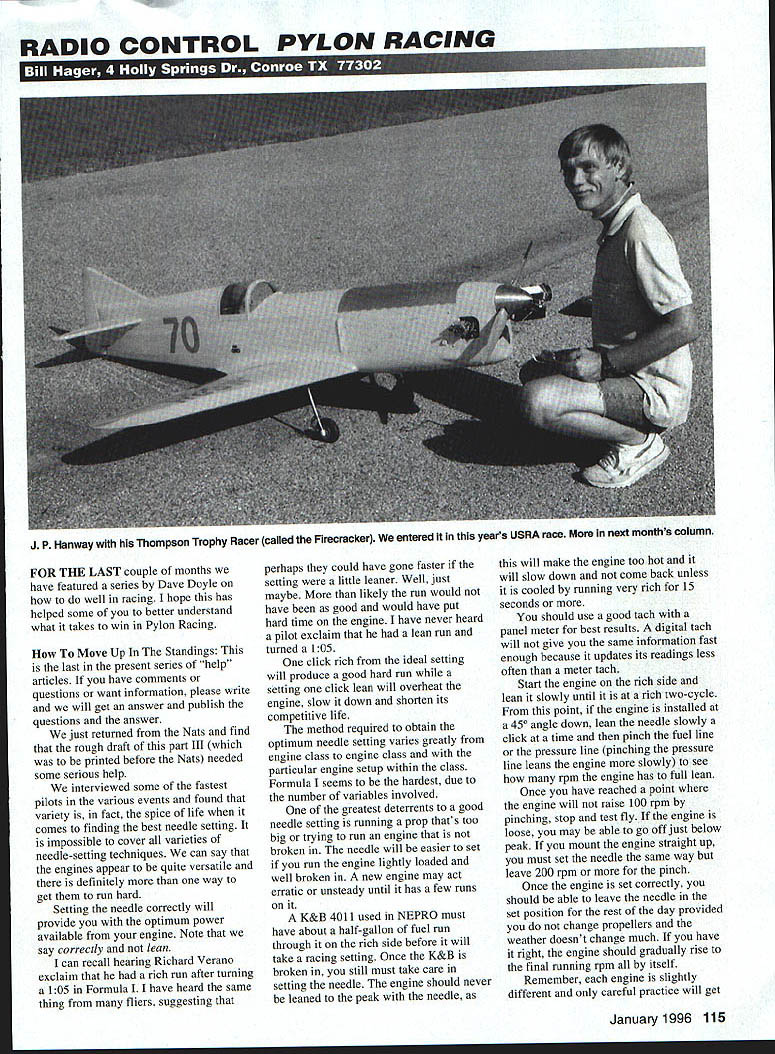
After the Nats I made a trip to Galveston, Texas where they were just finishing a week of racing by the bigger RC airplanes. In fact I had entered an airplane in the new Thompson Trophy Class. Due to a schedule change at this year's Nats, I was too late to fly, but not too late to see the finals. Wow! What a good job these folks did. I should have a complete rundown in the next issue.
Transcribed from original scans by AI. Minor OCR errors may remain.

