
RADIO CONTROL: PYLON RACING
Bill Hager, 4 Holly Springs Dr., Conroe, TX 77302
This report on the 20th Annual Atlanta Air Racing Championships was provided by Bob Brassell, who served as Contest Director (CD) for the event.
The 20th Annual Atlanta Air Racing Championships
Atlanta is known as the Crossroads of the South, and the 20th annual Atlanta Air Racing Championships proved this continues to be true. A total of 31 pilots from 9 different states gathered at the Atlanta R/C Club field the weekend of October 21–22 for some of the most competitive pylon racing of the season.
The racing schedule included AMA 428 Q-500 and QM40 (Quarter Midget 40) on Saturday, with SEMPRA Standard/Advanced/Expert Q-500 on Sunday. Below is a brief rundown of the action.
AMA Q-500
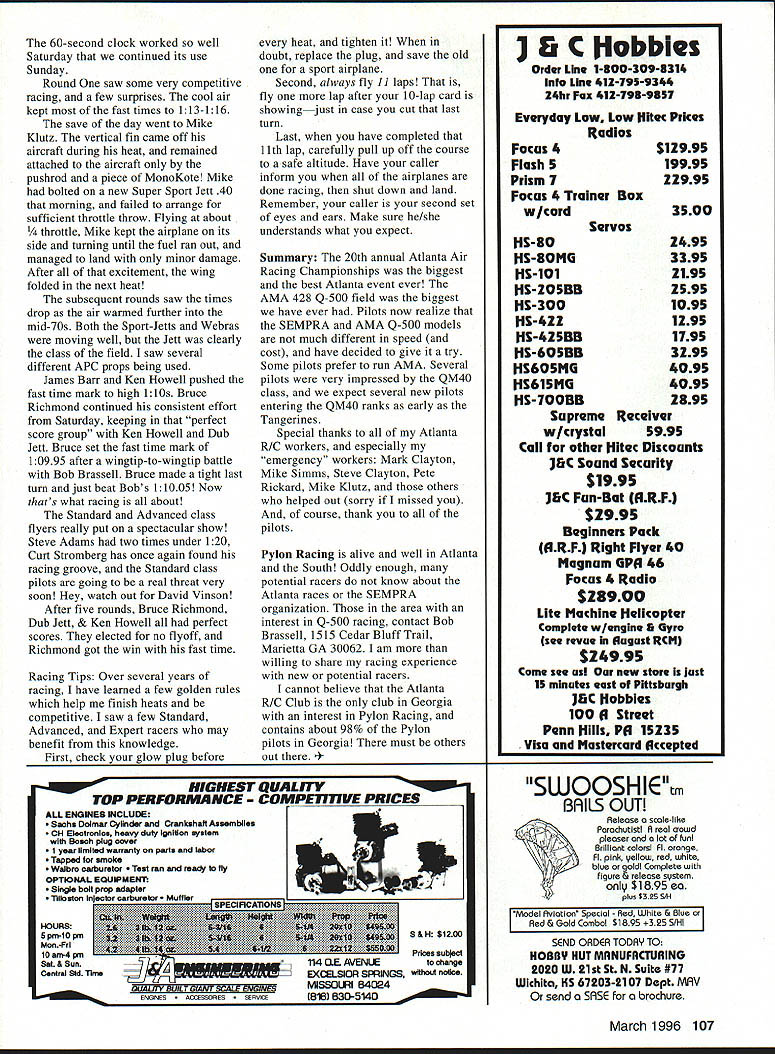
A chilly but crystal-clear Saturday morning greeted the 26 pilots entered in the AMA Q-500 event. The long course (2.5 miles) was set up and ready. The weatherman predicted 10–15 mph winds by late morning, and the wind began to blow around 10 a.m. for the start of the first heat.
Because of a light turnout of club workers (likely due to the cold and wind), the matrix was run in three-airplane heats. Thanks to cooperation from the pilots and a few borrowed workers, this worked well. The CD operated under a 60-second start clock. Every heat was fast and competitive—most AMA Q-500 pilots possess similar skills and engines, which makes for close racing.
Early standouts were Bruce Richmond, Dub Jett, Ken Howell, and Mike Stokes. Dave Bowman and James Barr also showed early speed. Although the cool and wind prevented record performance, times improved as the temperature warmed into the 60s. Aircraft generally fared well.
In the end, Bruce Richmond, flying a Jett/APC-powered Revolution, emerged with a perfect score. Mike Stokes and David Bowman, one point behind, flew off for second and third. During the flyoff, Stokes' airplane hit coming around Turn Three and struck the weeds; David completed 10 laps with a somewhat customized prop. Mike Stokes finished third. Fast time of the day: 11.406.
Quarter Midget 40 (QM40)
Following a brief pilots' meeting and awards ceremony, QM40 racing began about 3:30. The wind let up and it was almost 70°F. Ten QM40 pilots competed in a small-field format of four rounds with three-airplane heats. Racing was fast and competitive with a variety of airframe/engine combinations.
The first heat showed Dub Jett's Sweet Pea V-tail very fast, Sam Shimizu's Tsunami moving well, and Bruce Richmond's Miss RJ close behind. Attrition affected results: Carl Simms lost Pole Kitty (cause unknown), Steve Kovach lost his Larson Mustang that flew through the sun, Jerry Salisbury lost a Mustang between Turns Two and Three (CFIT), and Bruce Richmond withdrew.
Through it all, "Racer Rick" Landers was smooth and fast in his Napier Heston, posting a fast time of 1:11.04 and a perfect score for the win. Racing concluded after four rounds by consensus of the remaining pilots.
SEMPRA Q-500
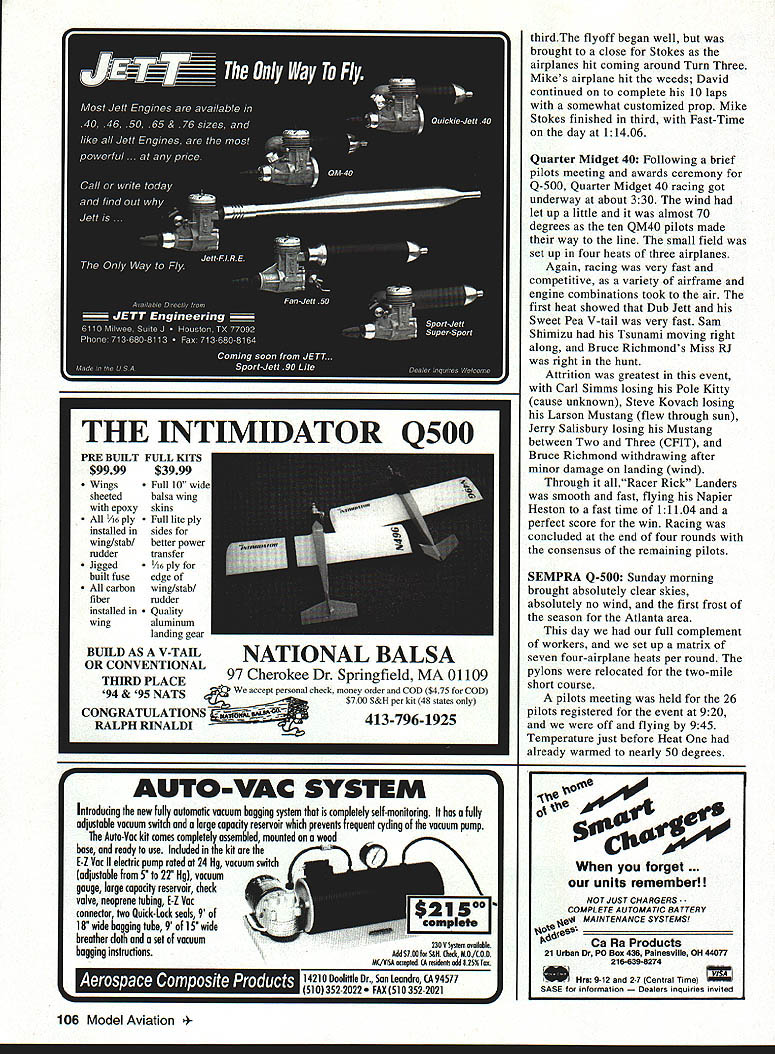
Sunday morning brought absolutely clear skies, no wind, and the first frost of the season for the Atlanta area. With a full complement of workers, the CD set up a matrix of seven four-airplane heats per round; the pylons were relocated for the two-mile course.
A pilots' meeting was held at 9:20 a.m. for the 26 registered pilots, and flying began by 9:45. Temperature before Heat One had warmed to nearly 50°F. The 60-second clock that worked well on Saturday continued in use.
Round One produced very competitive racing and some surprises. Cool air kept most fast times in the 1:13–1:16 range. The "save of the day" went to Mike Klutz: the vertical fin came off his aircraft during a heat and remained attached only by the pushrod and a piece of MonoKote. Mike had bolted on a new Super Sport Jett .40 that morning and had insufficient throttle throw; flying at about 1/4 throttle, he kept the airplane on its side and turning until the fuel ran out, managing to land with only minor damage. The wing folded in the next heat.
As the air warmed into the mid-70s, times dropped. Both Sport-Jetts and Webras performed well, but the Jett engine was clearly the class of the field; several different APC props were used. James Barr and Ken Howell pushed fast times into the high 1:10s. Bruce Richmond continued consistent performance, remaining in the "perfect score group" with Ken Howell and Dub Jett. Bruce set the fast time at 1:09.95 after a wingtip-to-wingtip battle with Bob Brassell—Bruce made a tight last turn and just beat Bob's 1:10.05.
Standard and Advanced class flyers also put on a great show. Steve Adams had two times under 1:20, Curt Stromberg regained his racing groove, and the Standard class pilots are becoming a real threat—watch out for David Vinson.
After five rounds, Bruce Richmond, Dub Jett, and Ken Howell all had perfect scores. They elected not to fly off; Richmond took the win based on his fast time.
Racing Tips
Over several years of racing, a few golden rules help finish heats and be competitive. These tips may benefit Standard, Advanced, and Expert racers:
- Check your glow plug before every heat, and tighten it. When in doubt, replace the plug and save the old one for a sport airplane.
- Always fly 11 laps—fly one more lap after your 10-lap card appears, just in case you cut that last turn.
- After completing the 11th lap, carefully pull off the course to a safe altitude. Have your caller inform you when all airplanes are done racing, then shut down and land. Your caller is your second set of eyes and ears—make sure he/she understands what you expect.
Summary and Thanks
The 20th annual Atlanta Air Racing Championships was the biggest and best Atlanta event ever. The AMA Q-500 field was the largest the club has seen. Pilots now realize that SEMPRA and AMA Q-500 models are not much different in speed (and cost), and many have decided to try both. Several pilots were very impressed by the QM40 class, and more entrants are expected.
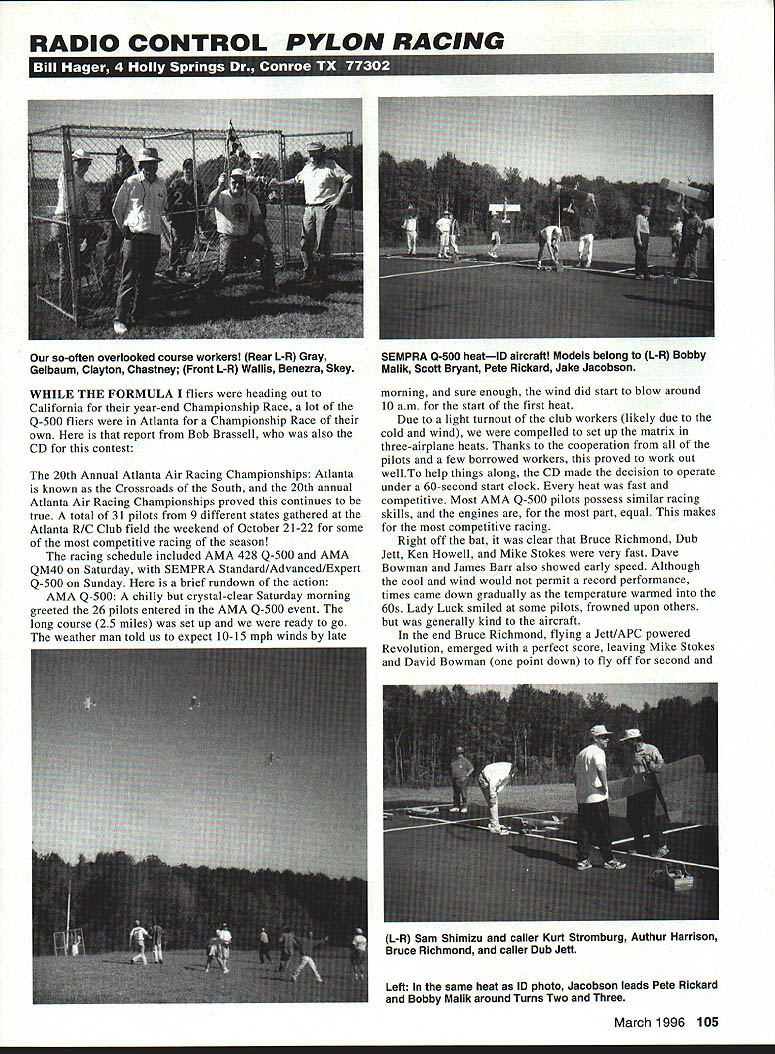
Special thanks to all Atlanta R/C workers, and especially the "emergency" workers: Mark Clayton, Mike Simms, Steve Clayton, Pete Rickard, Mike Klutz, and others who helped out (sorry if any names were missed). And, of course, thank you to all the pilots.
Pylon racing is alive and well in Atlanta and the South. Many potential racers do not know about the Atlanta races or SEMPRA. Those in the area interested in Q-500 racing may contact Bob Brassell at 1515 Cedar Bluff Trail, Marietta, GA 30062. He is willing to share his racing experience with novice pilots.
I cannot believe the Atlanta R/C Club is the only club in Georgia with an interest in pylon racing—it contains about 98% of the pylon pilots in Georgia. There must be others out there.
Transcribed from original scans by AI. Minor OCR errors may remain.

