
Radio Control: Pylon Racing
Dave Lane
EXPERT CLASS
- B. Brogden 1st 24 1:18.00
- T. Prather 2nd 24 1:16.10
- B. Smith 3rd 24 1:18.23
- E. Hotelling 4th 22 1:19.46
- T. Christopher 5th 22 1:21.34
It was truly an international affair, with entries from Japan, Mexico, and Canada. There were four entries in Expert from Japan and three from Mexico. Standard class had one from Japan, three from Mexico and 15 from Canada! The U.S. accounted for the rest of the 108 entries. There were nine states represented in Expert and four states in Standard.
This race is getting bigger every year. I hope the Barks, Inc., of Bakersfield are able to maintain their outstanding effort in the future. The Bakersfield race is to the world of modeling as the Cleveland Air Races were to the world of full-scale air racing.
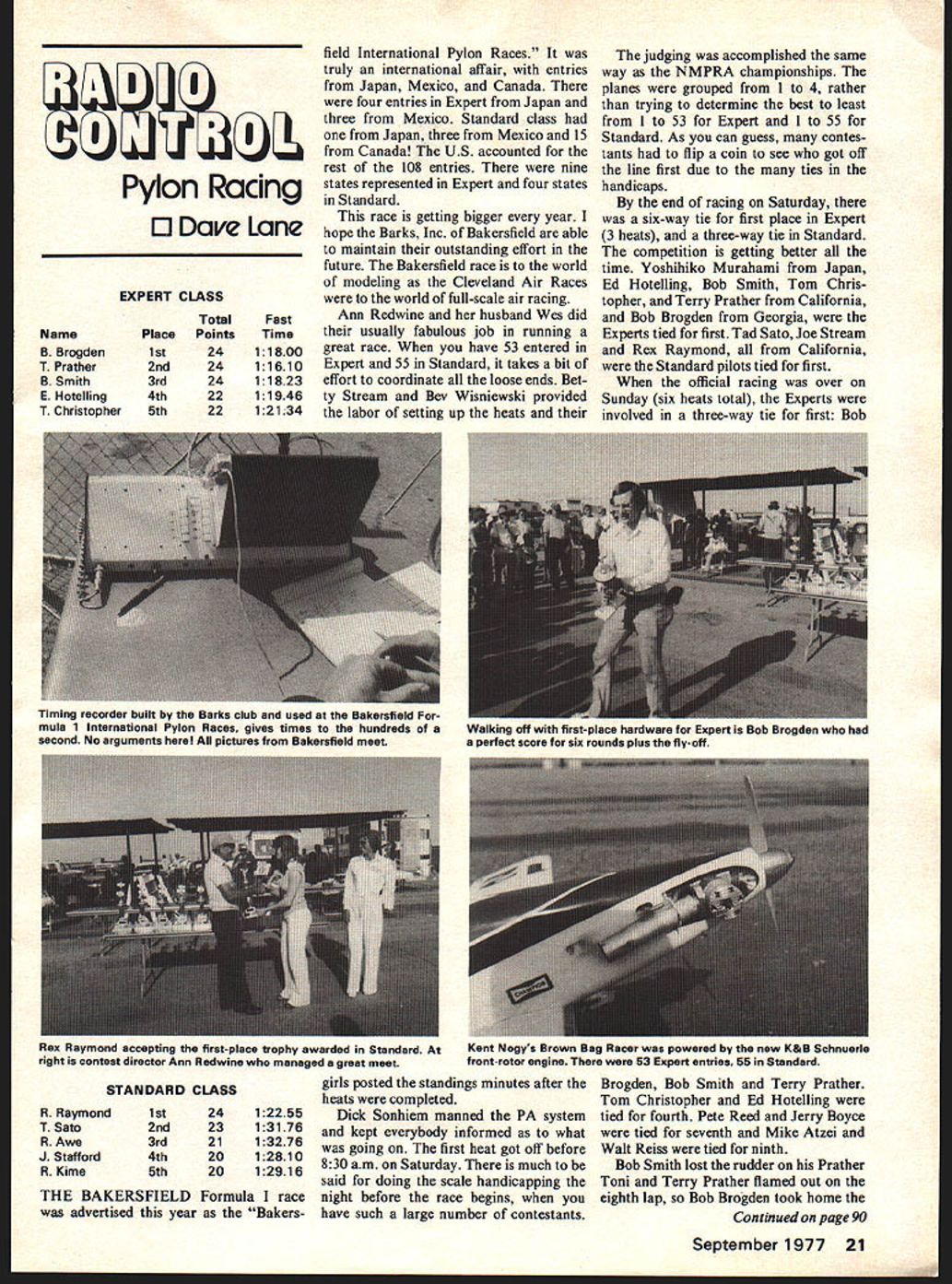
Ann Redwine and her husband Wes did their usually fabulous job in running a great race. When you have 53 entered in Expert and 55 in Standard, it takes a bit of effort to coordinate all the loose ends. Betty Stream and Bev Wisniewski provided the labor of setting up the heats and their girls posted the standings minutes after the heats were completed. Dick Sonhiem manned the PA system and kept everybody informed as to what was going on. The first heat got off before 8:30 a.m. on Saturday. There is much to be said for doing the scale handicapping the night before the race begins, when you have such a large number of contestants.
The judging was accomplished the same way as the NMPRA championships. The planes were grouped from 1 to 4, rather than trying to determine the best to least from 1 to 53 for Expert and 1 to 55 for Standard. As you can guess, many contestants had to flip a coin to see who got off the line first due to the many ties in the handicaps.
By the end of racing on Saturday, there was a six-way tie for first place in Expert (3 heats), and a three-way tie in the Standard. The competition is getting better all the time. Yoshihiko Murahami from Japan, Ed Hotelling, Bob Smith, Tom Christopher, and Terry Prather from California, and Bob Brogden from Georgia, were the Experts tied for first. Tad Sato, Joe Stream and Rex Raymond, all from California, were the Standard pilots tied for first.
When the official racing was over on Sunday (six heats total), the Experts were involved in a three-way tie for first: Bob Brogden, Bob Smith and Terry Prather. Tom Christopher and Ed Hotelling were tied for fourth. Pete Reed and Jerry Boyce were tied for seventh and Mike Atzei and Walt Reiss were tied for ninth. Bob Smith lost the rudder on his Prather Toni and Terry Prather flamed out on the eighth lap, so Bob Brogden took home the
STANDARD CLASS
- R. Raymond 1st 24 1:22.55
- T. Sato 2nd 23 1:31.76
- R. Awe 3rd 21 1:32.76
- J. Stafford 4th 20 1:28.10
- R. Kime 5th 20 1:29.16
first-place hardware. Bob was leading the race all the way when Terry flamed out.
Tom Christopher cut in his fly-off, so Ed Hotelling was able to cruise to most of the race for fourth. Boyce and Atzei won their heats handily for seventh and ninth, respectively.
Terry Prather won the fast time perpetual trophy for the third time, so he gets to keep it. Terry's fast time this year was 1:16.10.
Rex Raymond went on to win the Standard Class with a perfect score of 24 points for six heats. Rex is 71 years young! Rex had a fast time of 1:22.55. Not bad for Standard Class. I guess we will see Rex in the Expert Class from now on—his time was the fastest in Standard for the weekend.
Yoshihiko Murahami put his Prather Toni through the number-three pylon in the fourth round Sunday morning. Upon inspecting the pylon after the impact, Ron Schore and the Barks contest management decided that the pylons will have to be constructed of sturdier material. The Toni went through 3/8" plywood on one side of the pylon and through 1/8" plywood on the opposite side of the pylon. In the future the pylons will be constructed of 3/4" plywood on the impact side and 5/8" plywood on the other side with a canvas bag hung inside the pylon.
This incident brought to light the fact that the pylons do not afford the protection necessary for the pylon-cut judges. In addition to the stronger pylons, we are considering some sort of body protection for the pylon workers. This protection could either be a flak type vest used by the military or a baseball catcher's chest protector. All you NMPRA districts should check your equipment to be sure there is adequate protection for your workers.
All in all, everybody had a good time with plenty of excitement and racing this year at Bakersfield and we all hope to have another good one next year.
Dave Lane, 4477 136th, Hawthorne, CA 90250.
Transcribed from original scans by AI. Minor OCR errors may remain.

