
RADIO CONTROL PYLON RACING
Wayne Yeager, 15387 Forrister Rd., Clayton, MI 49235
Overview
In past years I’ve tried to describe the Nats Pylon competition with a single word; one year I called them the “fragmented” Nats. This year it was very difficult—the Pylon venue was turned over to the National Miniature Pylon Association (NMPRA) for the first time. How ’bout I just call it the “different” Nats?
For the first time the entire worker pool was selected from the contestants, with the exception of a few stalwarts, including Paul Page, Bob Campbell, Charlie Robinson, Brigette Brown, Jim and Bernie Allen.
Since workers have become an extinct group, Pylon needed a new plan. The details were developed during the Nats planning meeting last fall; the meeting was attended by the Nats management staff and the involved AMA Special Interest Groups (SIGs)—in Pylon’s case, NMPRA.
New staffing plan (matrices)
After the plan was developed a new problem was discovered by NMPRA President Pete Reed. The original plan involved flying one event in the morning and another in the afternoon—the morning event’s contestants would staff the afternoon event, and vice versa. It was a general conclusion that a contestant could not fly and work the same event, so any person flying multiple events would be excluded from working those events. At last year’s Nats approximately 12 contestants flew Quickie. If these people were to be excluded, those same 12 people would be the entire worker pool for the Nats, which would result in a shutdown; it takes at least 16 people to run an event.
Pete and his staff developed a new plan dividing the fliers into two matrices; fliers from one matrix would staff the other. Matrix A was scheduled to fly on Monday and Wednesday; Matrix B was scheduled to fly on Tuesday and Thursday. The top 14 competitors from each matrix would fly in a “final” on Friday.
This plan was followed and provided a sufficient worker pool. Although there were a few problems, I’m certain they will be worked out by next year.
Other than initial scheduling problems, Pylon racing went well, and there were many positive comments from the contestants. Processing was conducted on the same day at the same location, with tables set up at each venue. This resulted in nothing but positive comments toward the format, which will most certainly be continued.
Officials and contest directors
Although NMPRA was in charge of Pylon at the Nats, Pete Reed recognized certain officials would be needed—particularly Contest Directors to run the four events. He obtained the services of:
- Cliff Telford — FAI and Formula I
- Paul Geders — Quarter Midget
- Teri and John Dunham — Quickie 500
These people did a yeoman job and are to be commended.
Formula I
Formula I entries were down and Quarter Midget entries were higher than predicted; a half-day was taken from the Formula I schedule and added to Quarter Midget so the first day of racing would start and end Formula I.
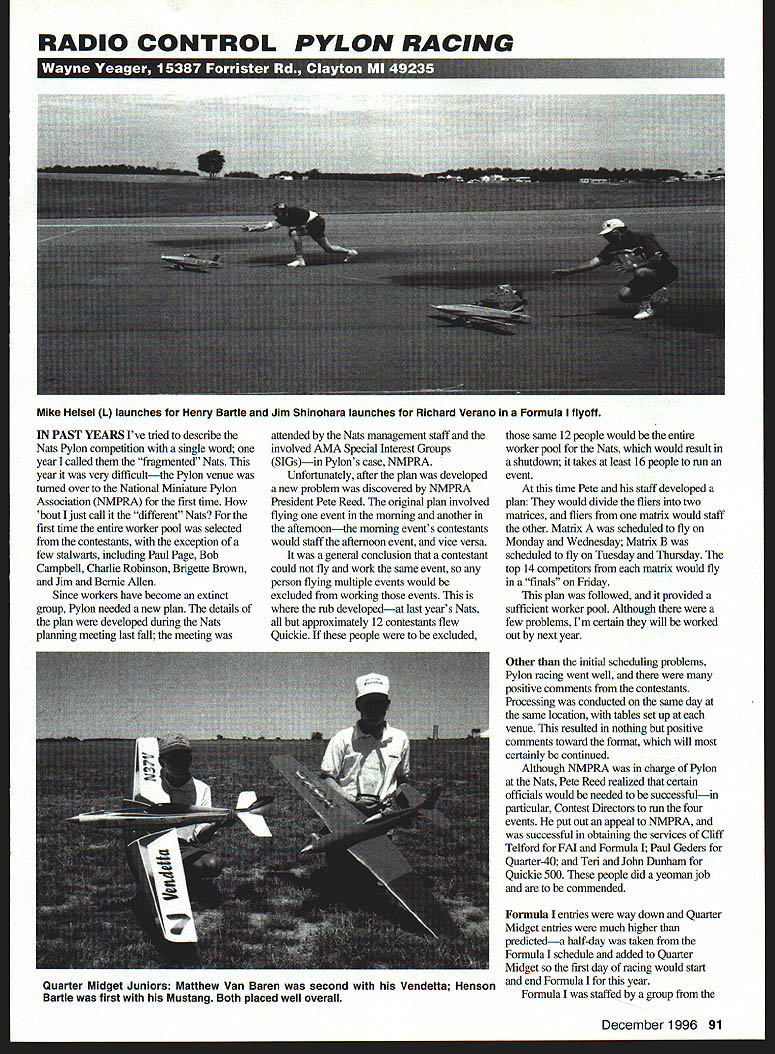
Formula I was staffed by a group from the Prince George County R/C Club, Maryland. They ran things professionally, completing six rounds and flyoffs just as the hour started Monday morning.
- Heat Round winner: Richard Verano, followed by Bob Brogdon, Jason Shulman, and Canada’s Eddie Smith.
- Round heat winners ranked by best times included: Dave Shadel, Richard Verano, Travis Flynn, Harold Sattler, Henry Bartle, and Darrol Cady.
- Dave Shadel posted a 1:11.64 at the end of Round Two, later lowering to 1:08.09—the meet’s best time at that point.
After the first three rounds, rounding out the top ten were Rusty Van Baren, Pete Reed, Mike Helsel, Henry Bartle, Lloyd Burnham, Roy Andrassy, and Matthew Van Baren. Rounds Three, Four and Five continued with Dave Shadel leading. Harold Sattler, Pete Reed and Matthew Van Baren fell out of the top ten and were replaced by Bob Brogdon, Jason Shulman and Richard Verano.
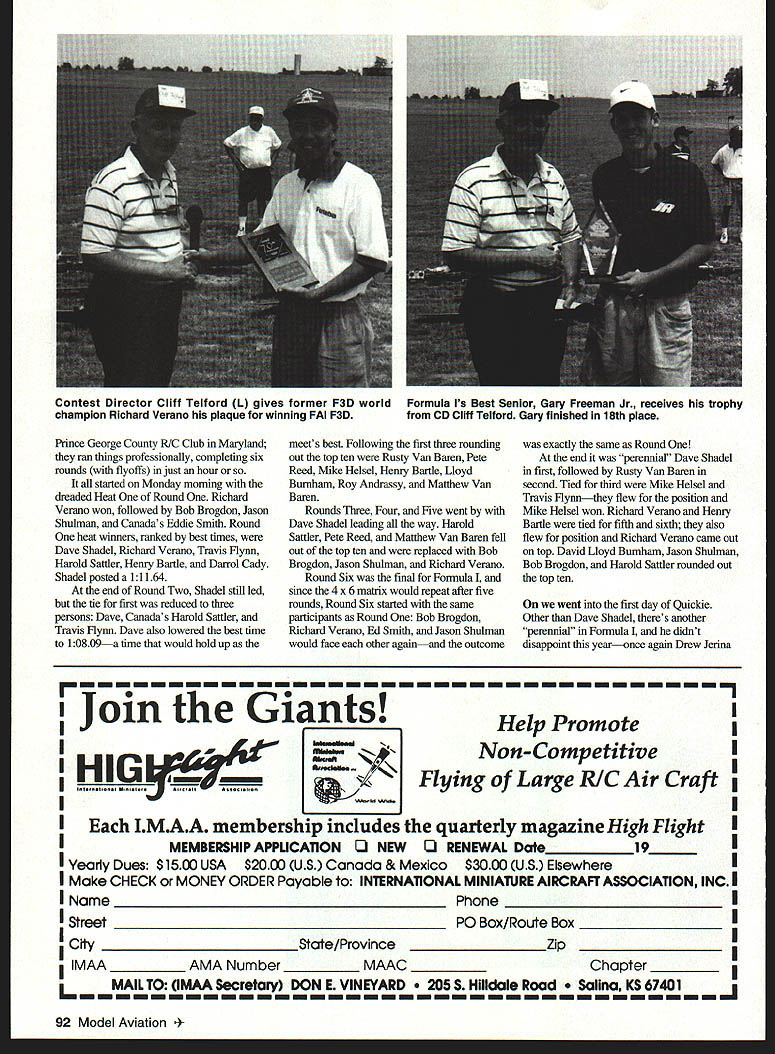
Round Six (the final Formula round since a 4 x 6 matrix would repeat after five rounds) ended with Dave Shadel first, Rusty Van Baren second. Tied for third were Mike Helsel and Travis Flynn; flyoff winner was Mike Helsel. Richard Verano and Henry Bartle tied for fifth and sixth; Richard Verano won the flyoff. David Lloyd, Lloyd Burnham, Jason Shulman, Bob Brogdon and Harold Sattler rounded out the top ten.
Other Formula I notes:
- Another “perennial” in Formula I, Drew Jerina, won the Best Finish award with his Shark. Drew’s paint system, patience, and skill produce consistently excellent results.
Quickie 500
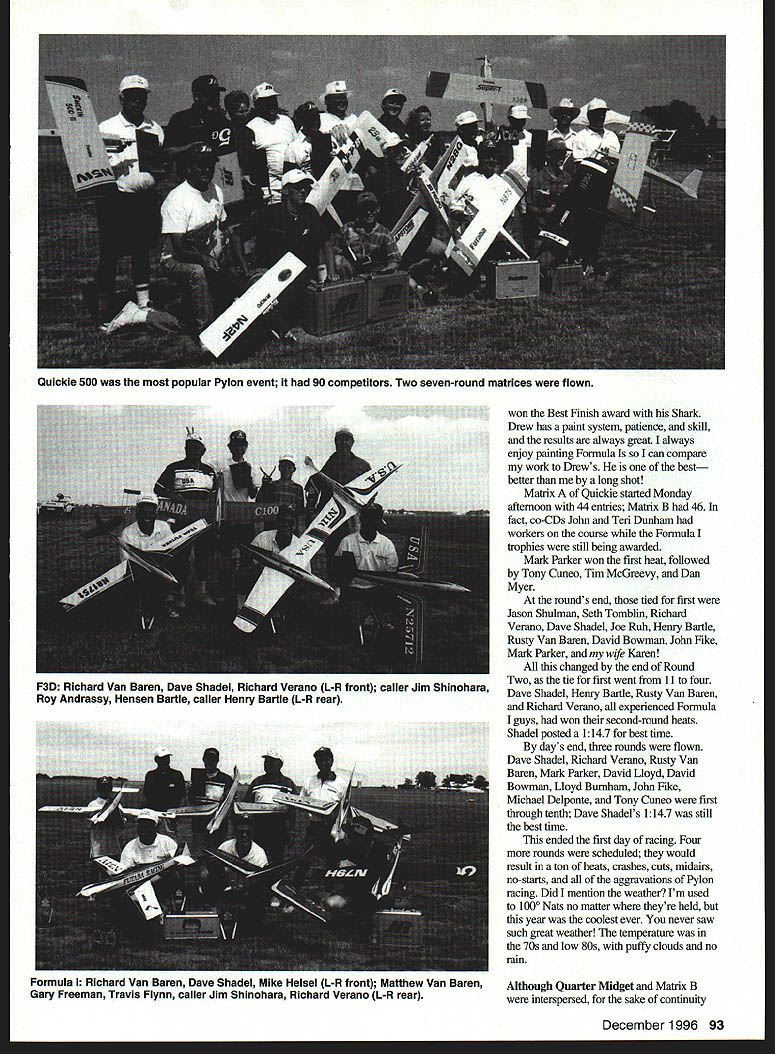
Matrix A of Quickie started Monday afternoon with 44 entries; Matrix B had 46. Co-CDs John and Teri Dunham had workers on the course while the Formula I trophies were still being awarded.
- Matrix A first heat: Mark Parker won, followed by Tony Cuneo, Tim McGreevy, and Dan Myer.
- At the end of Round One, those tied for first included Jason Shulman, Seth Tomblin, Richard Verano, Dave Shadel, Joe Ruh, Henry Bartle, Rusty Van Baren, David Bowman, John Fike, Mark Parker, and Karen Yeager.
After Round Two the tie for first was reduced to four: Dave Shadel, Henry Bartle, Rusty Van Baren, and Richard Verano. Shadel posted a best time of 1:14.7.
By the end of the first day (three rounds), the top ten in Matrix A were:
- Dave Shadel
- Richard Verano
- Rusty Van Baren
- Mark Parker
- David Lloyd
- David Bowman
- Lloyd Burnham
- John Fike
- Michael Delponte
- Tony Cuneo
The weather was unusually pleasant—temperatures in the 70s and low 80s with puffy clouds and no rain.
Matrix A continued with Rounds Four, Five, Six, and Seven. Dave Shadel led for the first six rounds; he zeroed in Round Seven and fell to fourth but remained safely in the top 14 for the finals. Richard Verano ended Matrix A with a perfect score and the best time of 1:11.32. The 13 other Matrix A qualifiers were:
- Rusty Van Baren
- Lloyd Burnham
- Mark Parker
- Tony Cuneo
- Dennis Sumner
- Michael Delponte
- David Lloyd
- Raymond Brown
- Darrol Cady
- John Gerhardt
- David Bowman
- Dan Kane Jr.
Matrix B highlights:
- Heat One winners: Roy Andrassy (1st), Paul Benezra (2nd), Don Luce (3rd).
- After early rounds, 12 fliers were tied for first: Gary Schmidt, Jim Allen, Craig Grunkemeyer, Terry Frazer, Joe Dodd, Roy Andrassy, Santiago Panzardi, Richard Tocci, Gary Freeman Jr., Drew Telford, Randy Etken, and Gary Gau.
- After four rounds, Jim Allen and Gary Schmidt were tied for first in points; Jim had the faster time by 0.51 seconds.
Matrix B completed Rounds Five, Six, and Seven; the 14 fliers who qualified for the finals were:
- Craig Grunkemeyer
- Richard Tocci
- Bruce Richmond
- Jim Allen
- Gary Schmidt
- Ken Howell
- Drew Telford
- Gary Gau
- Larry D. Stone
- Gary Freeman Jr.
- Dewey Davenport
- Raymond Hendriksma
- Thomas Scott
- Santiago Panzardi
Quickie finals:
- 28 finalists competed (top 14 from each matrix). The pilots agreed to fly a maximum of five rounds, so a perfect 4 x 7 matrix was posted with no frequency conflicts.
- Round One winners included Lloyd Burnham, Dewey Davenport, and John Gerhardt. Dennis Sumner double-cut for a zero.
- After Round One the leaders (tied) were Gary Schmidt, Richard Verano, Jim Allen, Telford, Lloyd Burnham, Mark Parker, and Dan Kane; Gary Schmidt had the best time at 1:11.50.
- Round Two reduced the tie to Gary Schmidt, Jim Allen, and Mark Parker.
- Round Three saw Jim Allen post a faster time and move into first.
- Some competitors dropped out when their chances diminished; this made it easier for the leaders and was a disappointing trend.
After Round Four there remained a three-way tie for first: Jim Allen, Gary Schmidt, and Mark Parker. Round Five decided the championship: Jim Allen and Gary Schmidt were tied after the round; a flyoff resulted and Jim Allen became the 1996 Nationals Champion. Craig Grunkemeyer posted the best time of the meet with 1:10.97.
Top ten Quickie finishers:
- Jim Allen (Champion)
- Gary Schmidt
- Mark Parker
- Darrol Cady
- Lloyd Burnham
- Craig Grunkemeyer
- Dan Kane
- Rusty Van Baren
- Santiago Panzardi
- Bruce Richmond
Note: Quickie had 90 entries; only 28 qualified for the finals, leaving many top fliers disappointed.
Quarter Midget
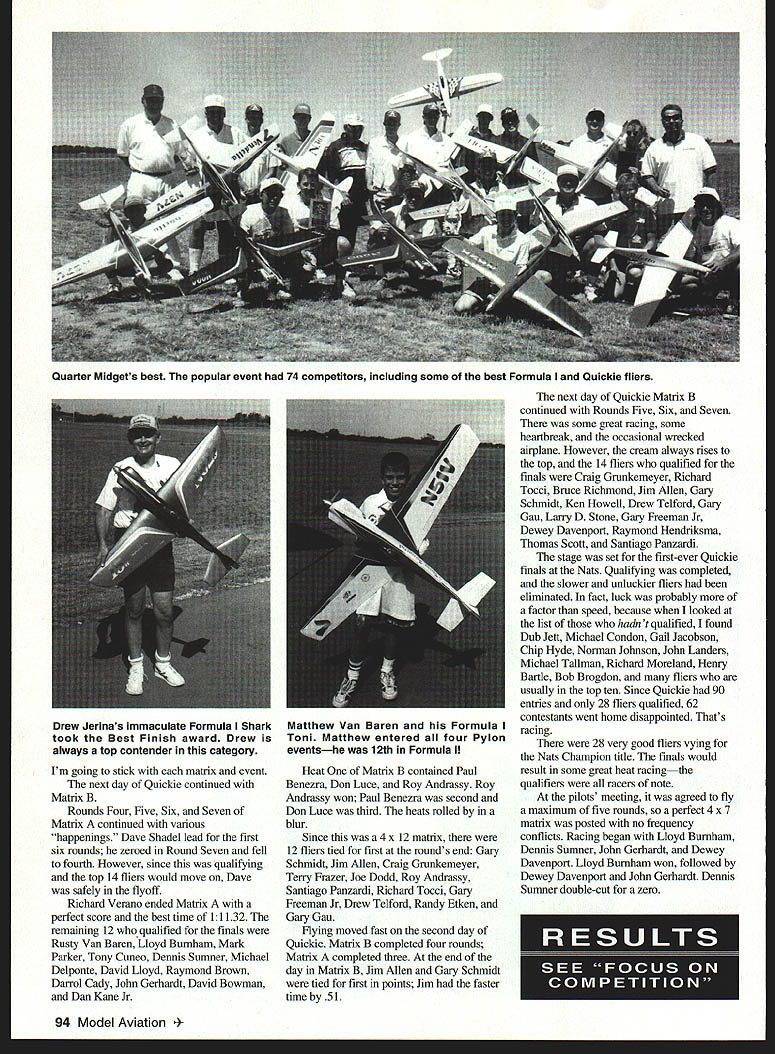
Quarter Midget had 74 entries—only 16 less than Quickie. The matrix was a 4 x 19, and the ranks included many top Formula I and Quickie fliers.
After two rounds the tie for first was reduced to seven: Henry Bartle, Rusty Van Baren, Mike Helsel, Harold Sattler, Gary Schmidt, Michael Condon, and Drew Jerina.
After three rounds six of those seven remained; Harold Sattler fell off the pace. By Round Four the tie for first was reduced to Michael Condon, Rusty Van Baren, and Henry Bartle.
Rounds Four, Five, and Six went by with Henry Bartle alone in first place with a perfect score. He was followed (tied one point back) by Dave Shadel, Rusty Van Baren, Michael Condon, and Ray Brown.
Henry Bartle won his last heat and became the 1996 Nationals Quarter Midget champion—a repeat of 1995.
Top Quarter Midget finishers included (in order listed by event summary):
- Henry Bartle (Champion)
- Rusty Van Baren
- Dave Shadel
- Richard Verano
- Jim Allen
- Chip Hyde
- Michael Condon
- Dan Kane
- Mike Helsel
- David Lloyd
FAI F3D
The last event, FAI F3D, usually has a low number of entrants. This year the Canadian team-selection race was held at the AMA Nationals; three Canadians attended and the selection was easily settled. Roy Andrassy, Ed Smith, and Harold Sattler will represent Canada at the World Championships in the Czech Republic. There were eight fliers in F3D this year.
Formula I CD Cliff Telford ran the event with five rounds. Notable results:
- After Round One the order included Richard Verano, Dave Shadel, Roy Andrassy, Gary Gau, Harold Sattler, and Ed Smith. Rusty Van Baren and Henry Bartle posted zeros.
- Richard Verano turned the best time early at 1:09.77; Dave Shadel also posted competitive times (1:14.47 with a cut).
- The final result was very close: Richard Verano finished with 276.27 points; Dave Shadel with 278.96. They were followed by Rusty Van Baren, Roy Andrassy, Gary Gau, Ed Smith, Harold Sattler, and Henry Bartle.
Racing at the ’96 Nats was finished!
Fuel and logistics
Jon Bartoshek of JBK Products deserves thanks for coming to our rescue when we needed fuel badly. Bev Wisniewski has obtained the fuel for Nats events for years. Because flying was increased this year, we agreed to raise the fuel amounts to 64 gallons for the various events.
Around the third day, chief fueler Jim Allen noted that at the current rate of consumption we would run out of fuel before flying was completed—short by about nine gallons. AMA’s headquarters hobby shop had only about three gallons of Sig fuel. Horizon’s Mike Stokes called around and discovered no one within 200 miles had enough fuel.
JBK Products was in the exhibitor tent. Nats Manager Ron Morgan, AMA Competitions Director Steve Kaluf, and I visited Jon Bartoshek and asked for 12 gallons; he had eight on hand. Jon had one gallon of 30% and three gallons of 10%. He poured it all into a five-gallon can, shook it, and poured four gallons back into the 15% bottles. The mixed fuel was used immediately and worked fine. Jon gave the fuel at a greatly reduced price—many thanks to JBK Products.
Safety and equipment
The competition included the usual mishaps, midairs, over-rolls, and radio problems. One pilot, Gary Freeman Jr., tested the brand-new AMA #6 wire cages. The airplane was lost, but pit worker Paul Benezra was fully protected. Paul said the accident woke him up, but nothing penetrated the cage—providing assurance that this type of cage will be required in the future.
Clubs around the country should consider upgrading their equipment to #6 wire. Most current cages are built with #8 or #11 wire and can be upgraded by welding #6 wire over the older wire.
Pylon CDs should note that the Competition Regulations now show the pylon in the middle of the cage. This moves the judge away from the cage wall—a very important safety feature.
Transcribed from original scans by AI. Minor OCR errors may remain.

