
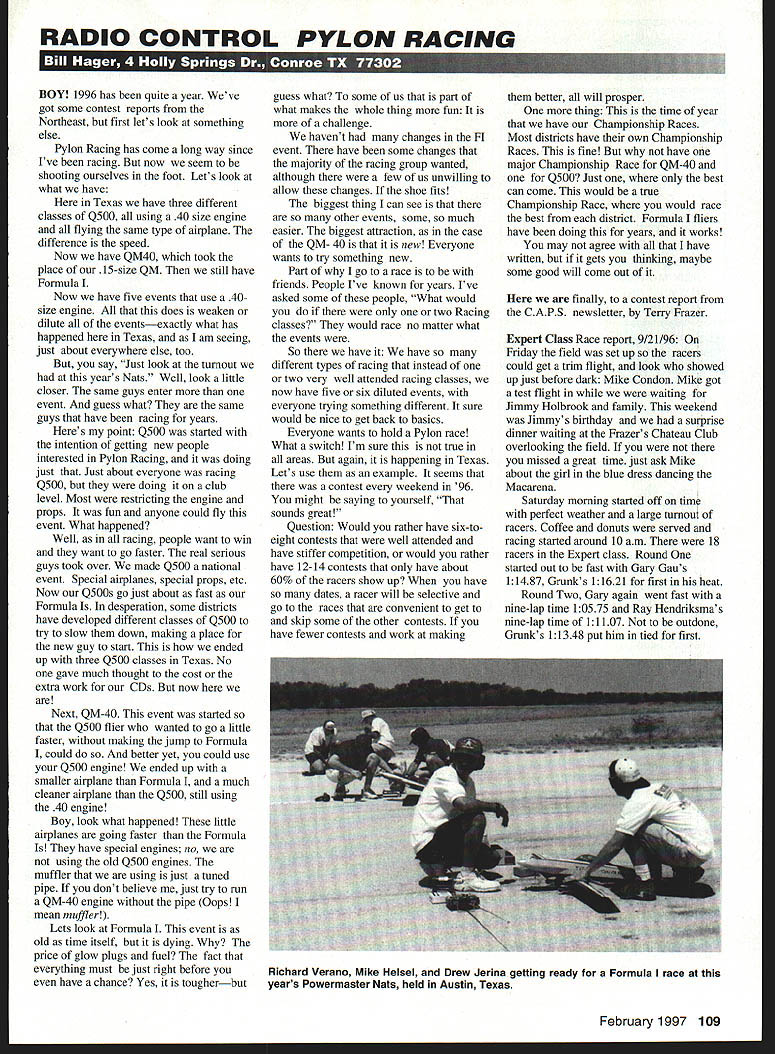
RADIO CONTROL PYLON RACING
By Bill Hager
4 Holly Springs Dr., Conroe TX 77302
Boy — 1996 has been quite a year. We've got some contest reports from the Northeast, but first let's look at something else.
Pylon racing has come a long way since I started. Lately, though, it seems we're shooting ourselves in the foot. Here in Texas we have three different classes of Q500, all using a .40-size engine and all flying the same type of airplane. The difference is the speed.
Now we have QM-40, which took the place of our .15-size QM. Then we still have Formula I. Now we have five events that use a .40-size engine. All that this does is weaken or dilute all of the events—exactly what has happened here in Texas, and, as I am seeing, just about everywhere else, too.
You might say, "Just look at the turnout we had at this year's Nats." But look a little closer: the same guys enter more than one event. And guess what? They are the same guys that have been racing for years.
Here's my point. Q500 was started with the intention of getting new people interested in pylon racing, and it was doing just that. Just about everyone was racing Q500, but they were doing it on a club level. Most were restricting the engine and props. It was fun and anyone could fly this event. What happened?
As in all racing, people want to win and they want to go faster. The real serious guys took over. We made Q500 a national event. Special airplanes, special props, etc. Now our Q500s go just about as fast as our Formula I's. In desperation, some districts have developed different classes of Q500 to try to slow them down, making a place for the new guy to start. This is how we ended up with three Q500 classes in Texas. No one gave much thought to the cost or the extra work for our Contest Directors. But now here we are!
Next, QM-40. This event was started so that the Q500 flier who wanted to go a little faster, without making the jump to Formula I, could do so. Better yet, you could use your Q500 engine! We ended up with a smaller airplane than Formula I and a much cleaner airplane than the Q500, still using the .40 engine.
Look what happened: these little airplanes are going faster than the Formula I's! They have special engines; no, we are not using the old Q500 engines. The muffler that we are using is just a tuned pipe. If you don't believe me, just try to run a QM-40 engine without the pipe (oops—I mean muffler).
Let's look at Formula I. This event is as old as time itself, but it is dying. Why? The price of glow plugs and fuel? The fact that everything must be just right before you even have a chance? Yes, it is tougher—but to some of us that is part of what makes the whole thing more fun: it is more of a challenge.
We haven't had many changes in the FI event. There have been some changes that the majority of the racing group wanted, although there were a few of us unwilling to allow these changes. If the shoe fits...
The biggest thing I can see is that there are so many other events, some so much easier. The biggest attraction, as in the case of the QM-40, is that it is new! Everyone wants to try something new.
Part of why I go to a race is to be with friends — people I've known for years. I've asked some of these people, "What would you do if there were only one or two racing classes?" They would race no matter what the events were.
So there we have it: we have so many different types of racing that instead of one or two very well-attended racing classes, we now have five or six diluted events, with everyone trying something different. It sure would be nice to get back to basics.
Everyone wants to hold a pylon race! What a switch. I'm sure this is not true in all areas, but again, it is happening in Texas. Let's use Texas as an example: it seems there was a contest every weekend in '96. That might sound great, but ask yourself:
- Would you rather have six to eight contests that were well attended and have stiffer competition, or
- Would you rather have 12–14 contests that only have about 60% of the racers show up?
When you have so many dates, a racer will be selective and go to the races that are convenient to get to and skip some of the other contests. If you have fewer contests and work at making them better, all will prosper.
One more thing: this is the time of year that we have our championship races. Most districts have their own championship races. This is fine! But why not have one major championship race for QM-40 and one for Q500? Just one, where only the best can come. This would be a true championship race, where you would race the best from each district. Formula I fliers have been doing this for years, and it works!
You may not agree with all that I have written, but if it gets you thinking, maybe some good will come of it.
CONTEST REPORT — C.A.P.S. (Terry Frazer)
Expert Class Race — 9/21/96
On Friday the field was set up so the racers could get a trim flight, and look who showed up just before dark: Mike Condon. Mike got a test flight in while we were waiting for Jimmy Holbrook and family. This weekend was Jimmy's birthday and we had a surprise dinner waiting at the Frazer's chateau club overlooking the field. If you were not there you missed a great time. Just ask Mike about the girl in the blue dress dancing the Macarena.
Saturday morning started off on time with perfect weather and a large turnout of racers. Coffee and donuts were served and racing started around 10 a.m. There were 18 racers in the Expert class.
Round One:
- Gary Gaus: 1:14.87 (fast)
- Grunk: 1:16.21 — first in his heat
Round Two:
- Gary Gaus: nine-lap time 1:05.75 (fast)
- Ray Hendriks: nine-lap time 1:11.07
- Grunk: 1:13.48 — tied for first in his heat
Round Three:
- Gary Gaus: 1:14.24 — put him in first as Grunk dropped two points
- Ray Hendriks tied for second with Pete Bergstrom
Round Four:
- Pete and Ray won their heats to stay in second
- Gary: 1:15.31 — stayed in first place
Round Five:
- Gary won his heat to clinch first place by posting all wins
- Pete dropped two points and fell out of trophy contention
- Tim Crookham surprised everybody, winning his last heat
- Ray won his heat to put him in a tie with Tim, forcing a flyoff for second
Flyoff for second:
- Ray Hendriks won the flyoff and took second
- Tim Crookham third
- Grunk fourth
- Pete Bergstrom fifth
Fast Time was awarded to Grunk since Gary and Ray each had nine laps.
Standard Class — 9/21/96
There were 4 racers: J. Holbrook, J. Schweitzer, D. Carpenter, and B. Safriet.
Round One:
- Schweitzer and Carpenter won their heats
- Carpenter set his heat time with a 1:36.44
Round Two:
- Holbrook and Carpenter won their heats
- Carpenter set a faster time of 1:34.17
Round Three:
- Holbrook, Schweitzer, and Carpenter were tied for first after this round
Round Four:
- Holbrook and Carpenter won their heats and were tied for first
- Carpenter set a fast time of 1:31.22; Schweitzer had 1:31.92
Round Five:
- Carpenter got a zero in his heat
- Holbrook took first in his heat and won the event
Final standings:
- Holbrook
- Schweitzer
- Carpenter
- Safriet
Carpenter took Fast Time with his 1:31.44.
Saturday night all the racers got together at Sarah's restaurant in Portsmouth, Ohio, just down from the flying field. Thirty-eight people were there for dinner. Jimmy Holbrook was honored for his birthday and given presents; Karen Yeager even sent him something.
Expert Class — 9/22/96
Sunday morning: rain had stopped, warm weather with a light breeze.
Round One:
- Gary Gaus: 1:14.43 — first
- Grunk: 1:18.87 — won his heat
Round Two:
- Pete Bergstrom: fast time 1:19.15
- Wind was getting bad
Round Three:
- Gary: 1:16.87 — still perfect
- Grunk also won his heat
- Mike Condon and Grunk hit coming around Pylon Two
- Terry Frazer and Rex Knepper hit going around Pylon One; Rex came out ahead and Terry hit the ground
Round Four:
- Gary: 1:18.34 — another fast time, tied with Grunk for first
Round Five:
- Gary: 1:12.22
- Grunk: 1:16.50 — forced a flyoff
Flyoffs:
- Rex Knepper, Joe Dodd, and Ed Spiker had a flyoff for third, fourth, and fifth
- Rex won, capturing third
- Ed came in fourth
- Joe finished fifth
- Flyoff for first and second:
- Gary did not even get off the ground; Grunk flew ten laps to take first
Standard Class — 9/22/96
There were five pilots: Ken Points, Jim Holbrook, Bruce Safriet, Joe Schweitzer, and Terry Frazer.
Round One:
- Schweitzer won his heat with a 1:37.22
- Frazer and Points did not get off the ground
Round Two:
- Holbrook and Points won their heats
Round Three:
- Holbrook and Safriet won their heats
Round Four:
- Safriet and Frazer finally got off the ground and won their heats
Round Five:
- Jimmy and Kenny won their heats, which put Jimmy in first place by himself
Final standings:
- Jim Holbrook
- Joe Schweitzer
- Bruce Safriet
- Ken Points
- Terry Frazer
Acknowledgments:
- Thanks to all who helped. We all had a good time.
- Special thanks to Sam Frazer for calling the race and putting up with so much beforehand.
Note: Sarah Behnam flew her first Expert class heats and did very well — finishing 12th on Saturday and 13th on Sunday. Congratulations!
Transcribed from original scans by AI. Minor OCR errors may remain.

