
RADIO CONTROL: PYLON RACING
By Wayne Yeager — 15387 Forrister Rd., Clayton, MI 49235
Worker issues and the NMPRA plan
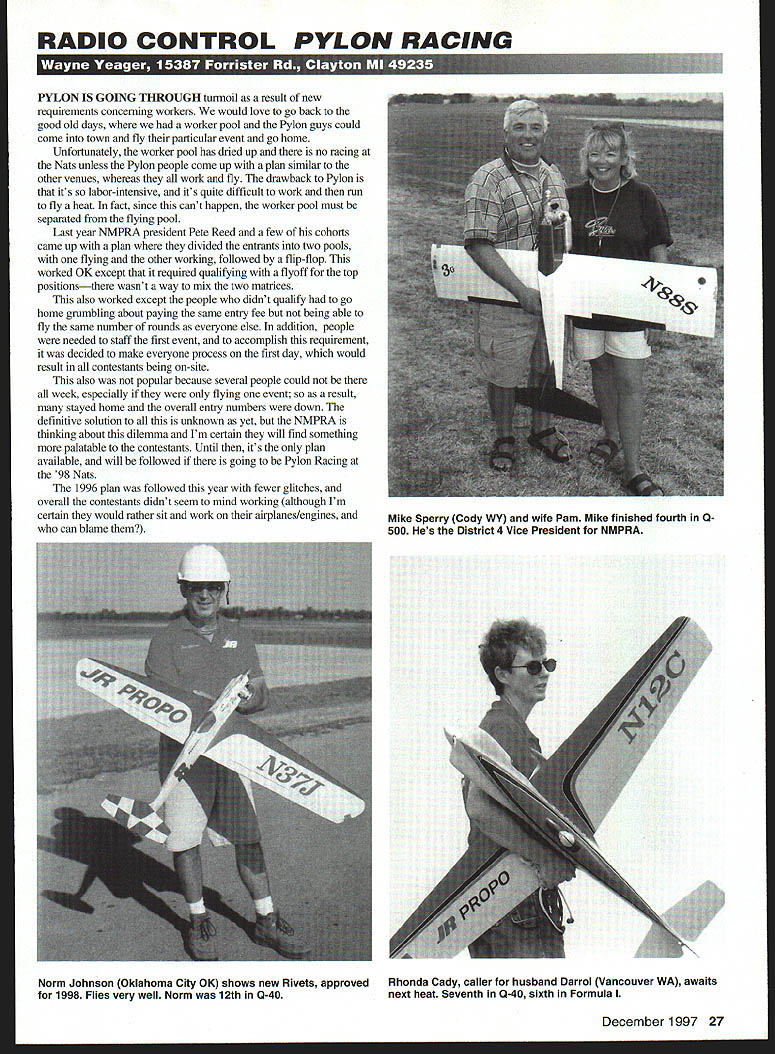
Pylon is going through turmoil because of new requirements concerning workers. Many would like to return to the old days when a worker pool existed and pilots could come into town, fly their event, and go home. Unfortunately, that pool has largely dried up. There will be no racing at the Nats unless pylon organizers adopt a plan similar to other venues, where pilots also work.
Pylon events are labor-intensive, and it’s difficult to both work and run back to fly a heat. Because that arrangement is impractical, the worker pool must be separated from the flying pool. Last year NMPRA president Pete Reed and several others devised a plan: divide entrants into two matrices — one flying while the other works — then swap. That worked reasonably well but required qualifying flyoffs for top positions because the two matrices could not be mixed.
The split-matrix system also left some pilots unhappy: those who didn’t qualify complained about paying the same entry fee but not flying the same number of rounds. To ensure enough workers on the first day, everyone was required to process that day so contestants would be on-site. That proved unpopular with pilots who could not attend the whole week, and overall entry numbers fell. The definitive solution is not yet known; the NMPRA is considering alternatives. Until a better plan is adopted, the split-matrix system will be used if there is to be pylon racing at the Nats.
1997 Nats overview
The 1996 plan was followed again in 1997 with fewer glitches, and overall contestants didn’t seem to mind working (although most would rather be tuning airplanes and engines). Attendance and manpower issues aside, the racing itself produced remarkable performances.
Richard Verano — dominant performer
Richard Verano was a dominant force at the Nats, winning four pylon events — a feat not seen since the mid-1970s when only two events were held. His performance was commanding and effective; he seemed to clean up like a western sheriff. Verano’s four-event sweep set him apart as the standout of the meet.
Formula
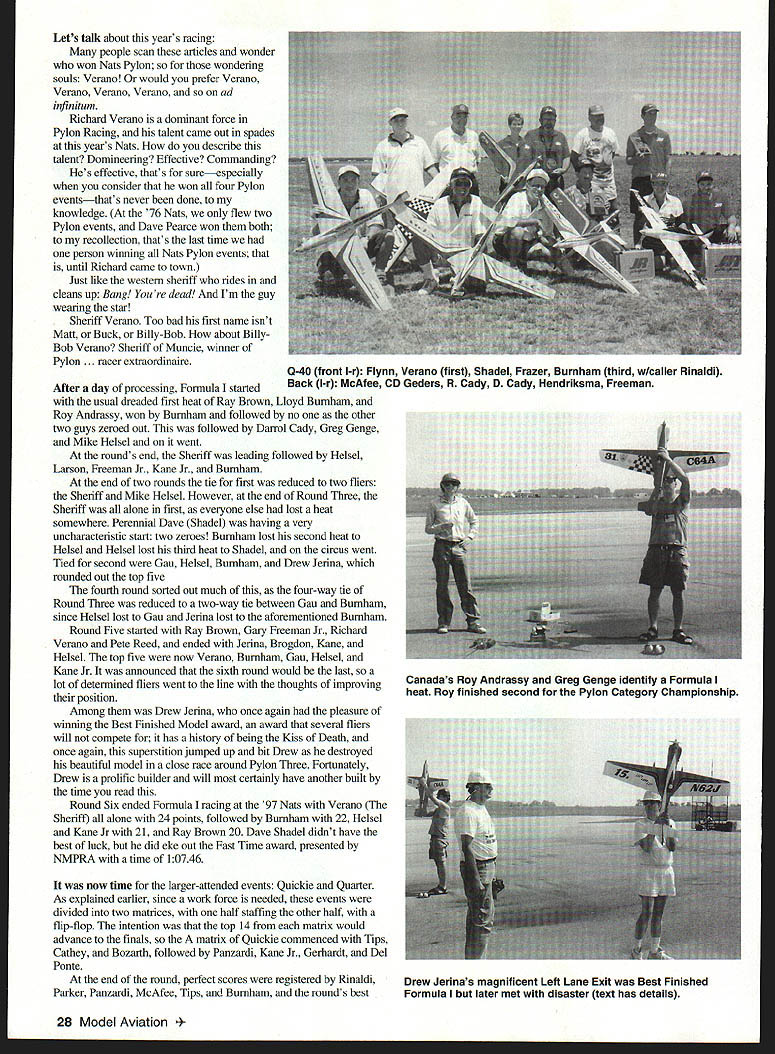
After day processing, Formula competition began with the customary difficult first heat. Early qualifiers included Ray Brown, Lloyd Burnham, and Roy Andrassy. Darrol Cady, Greg Genge, and Mike Helsel also went rounds. After two rounds, Verano led with Helsel close behind, followed by Larson, Gary Freeman Jr., Kane Jr., and Burnham. A two-way tie for first between Verano and Helsel developed, but by the end of Round Three Verano stood alone in first as others dropped heats. Veteran Dave Shadel had an uncharacteristic start with two zeros.
Standings shuffled through Rounds Four and Five as heats sorted ties and eliminated hopes. Drew Jerina won the Best Finished Model award but suffered a dramatic crash during the meet; fortunately he is a prolific builder and will recover.
Round Six concluded Formula at the ’97 Nats. Final top positions:
- 1st: Richard Verano — 24 points
- 2nd: Lloyd Burnham — 22 points
- Tied 3rd: Mike Helsel and Kane Jr. — 21 points
- 5th: Ray Brown — 20 points
Dave Shadel did manage to take the Fast Time award presented by the NMPRA.
Quickie and Quarter (split matrices)
Because a workforce is required, Quickie and Quarter events were split into A and B matrices, with one half staffing while the other flew, then flipping. The plan intended that the top 14 from each matrix advance to the finals.
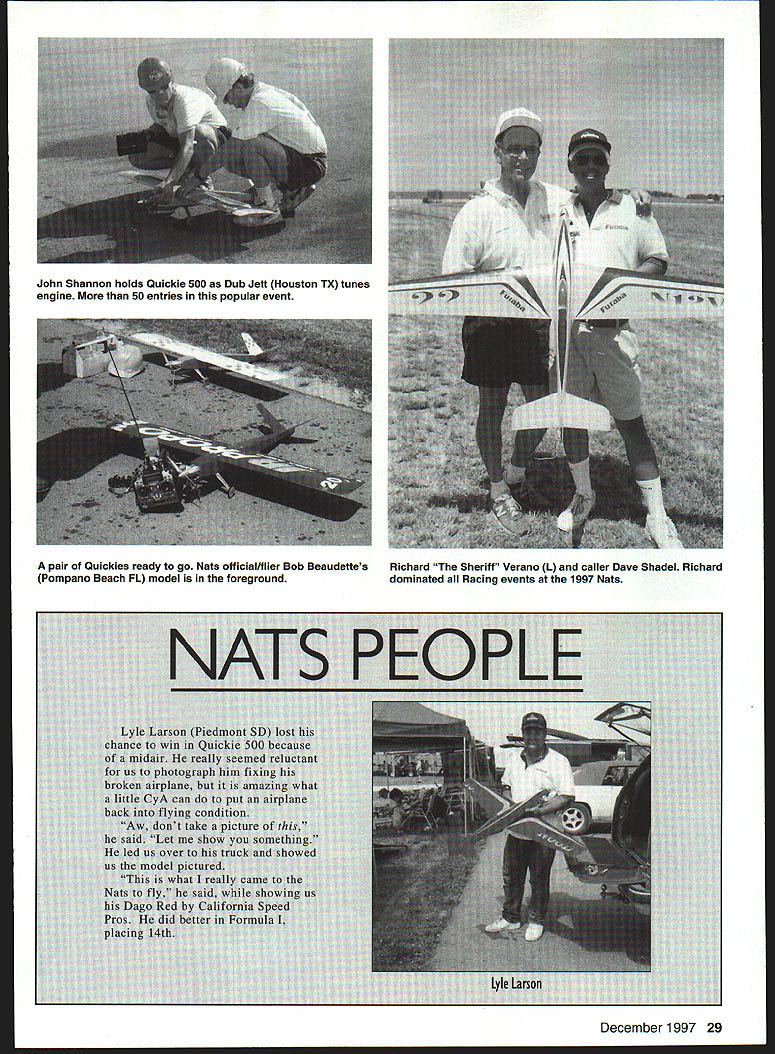
Quickie A opened with entries such as Tips, Cathey, Bozarth, Panzardi, Kane Jr., Gerhardt, and Del Ponte. In Round One perfect scores were registered by Rinaldi, Mark Parker, Panzardi, McAfee, Tips, and Burnham. The round’s best time was identical for Rinaldi and Parker at 1:17.40.
Round Two reduced the early tie: Rinaldi crashed his only airplane and was out, Panzardi cut a pylon and finished third in his heat, Tips lost his heat, and Burnham registered a zero but continued with a backup plane. A and B matrices flew on different days; for clarity this report treats the action as continuous.
Through Rounds Three, Four, and Five Parker ran with a perfect score, Kane Jr. trailed by one point, then Webb, Gerhardt, and Tallman followed. Round Six showed little change. After Rounds Seven through Nine (the last round), the top 14 advancing to the finals from that matrix were:
- Mark Parker
- Lloyd Burnham
- Farran
- McAfee
- Kane Jr.
- Darrol Cady
- Gerhardt
- Webb
- Edsall
- Stone
- Panzardi
- Tips
- Bertrand
- Tallman
A downside of the system: many pilots who worked hard to qualify — for example, Mark Parker finishing on top in qualifying — had to discard that result and start over in the finals, which were a short five rounds.
F3D (FAI)
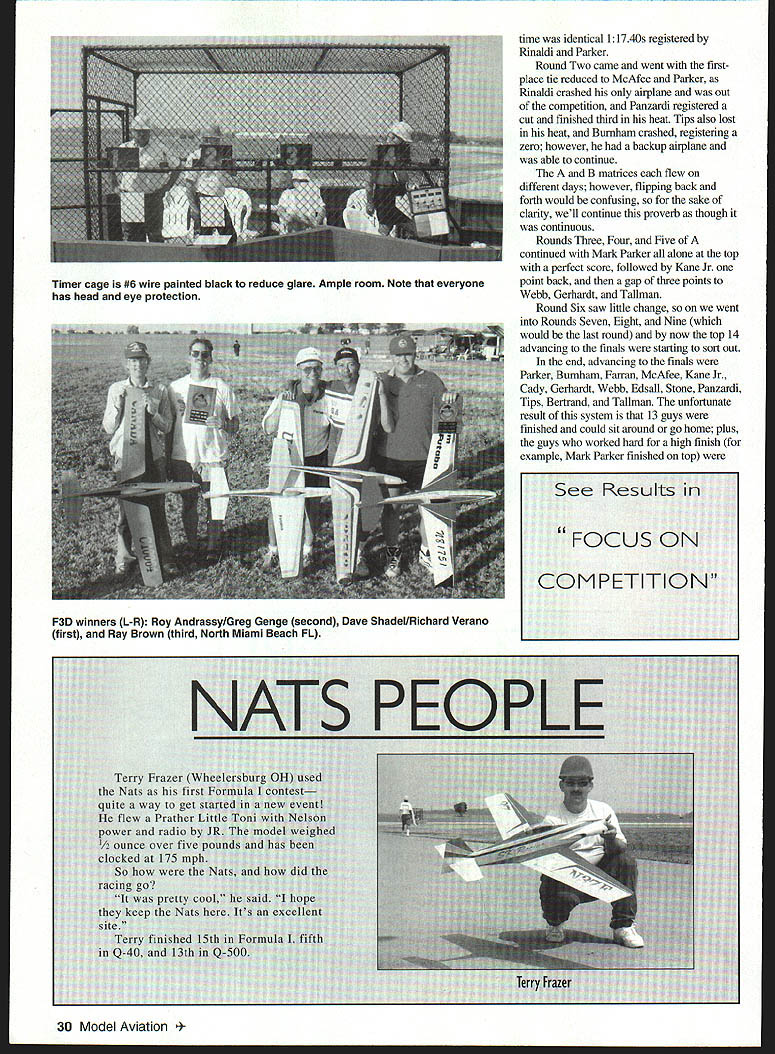
F3D had 10 entries at the ’97 Nats. To speed the event, contestants were moved to the ready-area tent to cut walking time to the pits; five rounds were scheduled and the event was run in about three hours.
FAI was run with three three-airplane heats and two two-airplane heats; pilots race the clock in this format. Round One ended with Dave Shadel in front by 0.75 seconds over Verano, followed by Ray Brown, Roy Andrassy (Canada), John Gerhardt, Cory Paine, Gary Gau, Travis Flynn, and Canadians Ed Smith and Greg Genge. The Canadians had come to get practice before the F3D World Championships.
Round Two saw little change at the top, but Round Three brought upheaval when a perennial contender registered a no-start and incurred a 200-point penalty (the F3D equivalent of a zero). After rounds shuffled, Rinaldi led for a time, with Brown, Paine, Shadel, and Andrassy close behind. Round Four had several swings: Ray Brown double-cut for a zero, and Shadel barely made a late start but recorded a slow time.
In F3D scoring, a contestant’s worst time is dropped after four rounds. Verano had four solid times and elected not to fly the fifth round to preserve equipment for the World Championship. After five rounds, F3D final results were:
- 1st: Richard Verano
- 2nd: Roy Andrassy
- 3rd: Ray Brown
- 4th: Dave Shadel
- 5th: Ed Smith
Verano posted the Best Time with 1:04.84. The Canadian team was pleased with two pilots finishing in the top five.
Quickie/Quarter finals and the final heat
The larger-attended Quickie and Quarter finals followed qualifying. In one of the final events, after five rounds of tight racing, Verano was again at the top and the question was whether anyone could beat him or go clean without a loss. The answer was no — Verano remained unbeatable.
Among the decisive final races, a flyoff was required to decide second through fourth. The flyoff featured Lloyd Burnham and Dave Shadel (veterans) and Travis Flynn (a talented young Californian). The heat was extremely close — the lead shifted multiple times between Burnham and Flynn, with Shadel pushing hard. Around lap eight Flynn took the lead and held it to win the heat.
Final results for that event:
- 1st: Richard Verano
- 2nd: Travis Flynn
- 3rd: Lloyd Burnham
- 4th: Dave Shadel
- 5th: Frazier
Richard Verano’s sweep of four events made him the standout at the ’97 AMA Nats.
Quickie B
Quickie B mirrored A with a large entry (28). The elimination process began with pilots such as Jeff Darnell... (reporting continues beyond the scanned page.)
Notes
- The split-matrix staffing system solved immediate worker shortages but created qualifying and fairness issues that organizers continue to address.
- Equipment preservation (sitting out unnecessary rounds) and strategic flying played notable roles, especially with international events on the horizon.
Transcribed from original scans by AI. Minor OCR errors may remain.

