
RADIO CONTROL PYLON RACING
Byline
Bill Hager, 4 Holly Springs Dr., Conroe TX 77302
Boy, this season went by fast for me. I lost some good friends this year—Hubert Wills (from Texas), Matt Smith, Monty Moncrief, and John Brodbeck (of K&B). I remember John helping me get my K&B engine running at the Oshkosh Nationals. He was always around with the orange K&B truck to help out the racers.
The latest loss was a friend of mine and a friend to Pylon Racing—Jim Shinohara. Following is a write-up by Dave Shadel presented in High Performance, the NMPRA (National Miniature Pylon Racing Association) newsletter that pretty well covers it:
“Pylon Racing's greatest advocate and supporter is gone. He passed away on October 6 in Sumperk, Czech Republic nearly two months after a very serious heart attack while participating at the F3D World Championships. Jimmie was the guy whom we never expected to leave us. He was always the eternal teenager, full of mischief and blessed with a great sense of humor. We always expected that he would be around forever, outliving us all.
“Jimmie's contributions to Pylon racing were quite well known. His kindness and generosity afforded many people the chance to race who otherwise would not have been able to. He built over 500 racing aircraft in the twenty plus years of our friendship, many of which were gladly given to racing enthusiasts worldwide with only the wish that the recipients go out and win races.
“Winning was what Jimmie liked to do best, and though we had some races which were absolute disasters, he took it as only a challenge to do better next time. Win or lose, Jimmie always had fun. But the winning was the icing on the cake.
“If you had the pleasure of knowing him, you were indeed fortunate. He was about as unique as could possibly be described, one whom you only meet once in a lifetime.
“Although Jimmie is no longer with us in person, as long as Pylon Racing is flown, his spirit will never die.
“Until we meet again, my friend, we miss you more than you can know.”
Thanks, Dave—these people will be missed.
In the first part of 1997 I talked with Rob Kurek at Model Aviation about finding someone else to do this column. I have been writing it for more than 18 years, but with my growing machine shop business there is just not enough time to continue to do a good job. So we decided to start looking for someone else.
I was to continue the column until my replacement was found—that has not changed—but I have missed a few articles and I'm sorry! I didn't know that I would be missed, but through e-mail, letters, phone calls, and people at contests asking me, “What happened?,” I realize, and so does the AMA, that the Pylon column is an important part of Model Aviation.
I thought it might be good to ask for guest columns from those who are interested until we find someone who we think will do the job. That person should be open-minded in all aspects of racing. I know that I've been slanted toward Formula One, but I think I've been fair to all of the other events. I think this person should be a member of the NMPRA; since it's the Special Interest Group that has a large say in what happens in Pylon Racing, that's where it all happens.
The columnist must have writing skills; it wouldn't hurt to know how to use a camera, and the person needs to be an avid competitor. We hope that whoever we get will have some new ideas that will help out. I try to include building, painting, flying, and engine tips, most of which come out of the NMPRA newsletter, as do items that people like to know about what is going on around the country. The column is not just for Pylon racers; there are probably about 125,000 other people out there who read the magazine—people I think we need to reach.
Some of you have expressed concerns that the AMA is not interested in Pylon Racing and doesn't care if there is a column or not. That is not true. Racing is such an important part of modeling that there will always be a Pylon Racing column.
Quarter 40 is really taking off, so expect to see more about the event in future issues.
Q-40 Needling Tip (from Darrol Cady, NMPRA newsletter)
A different pinching/start procedure is used with the Q-40s than is used for the Quickie 500s. The following consolidates the recommended method:
- Needle setup and establishing the "spot":
- Needle the engine up until it just comes on the pipe; at this point it may still be about 1,500+ rpm below peak.
- Pinch the needle quickly so the engine goes to peak, then immediately let it drop back 500–1,000 rpm without touching anything. That drop-back point is your running position, or "spot."
- While setting, turn the needle in 1/8-turn increments until you find the spot. If the engine does not drop back after pinching, open the needle 1/4-turn and carefully cover part of the venturi with a finger or thumb to cool the engine; repeat until the spot is established.
- After a flight, decide whether the engine is a little fat, just right, or a little lean and move the needle 1/4-turn in the direction needed. If you have established the spot, leave it.
- Restarting on the line:
- If time allows and you need to restart, get the line in the race and open the needle one full turn.
- Choke the engine by putting a finger over the exhaust and spin the prop until you see fuel coming out of the venturi. Remove your finger just before you stop spinning to draw some fuel in.
- When you are comfortable with the time left, start the engine. Leave the glow plug connected until the engine warms enough to run on its own.
- Disconnect the glow and immediately turn the needle halfway so it's still 1/2-turn from your spot.
- Watch the clock and start moving the needle to your spot so that, when it reaches the spot, you have at least 15 seconds to get back to your flying area.
- As a guideline, I (an older, slower operator) start with about 45 seconds left on the clock and have plenty of time for the whole routine. Many consistent racers use this system.
If the engine overheats on the line and the rpm goes flat, put it back on the established spot and go back to fly. If nothing else is wrong, once it cools it will run as it did on the last run.
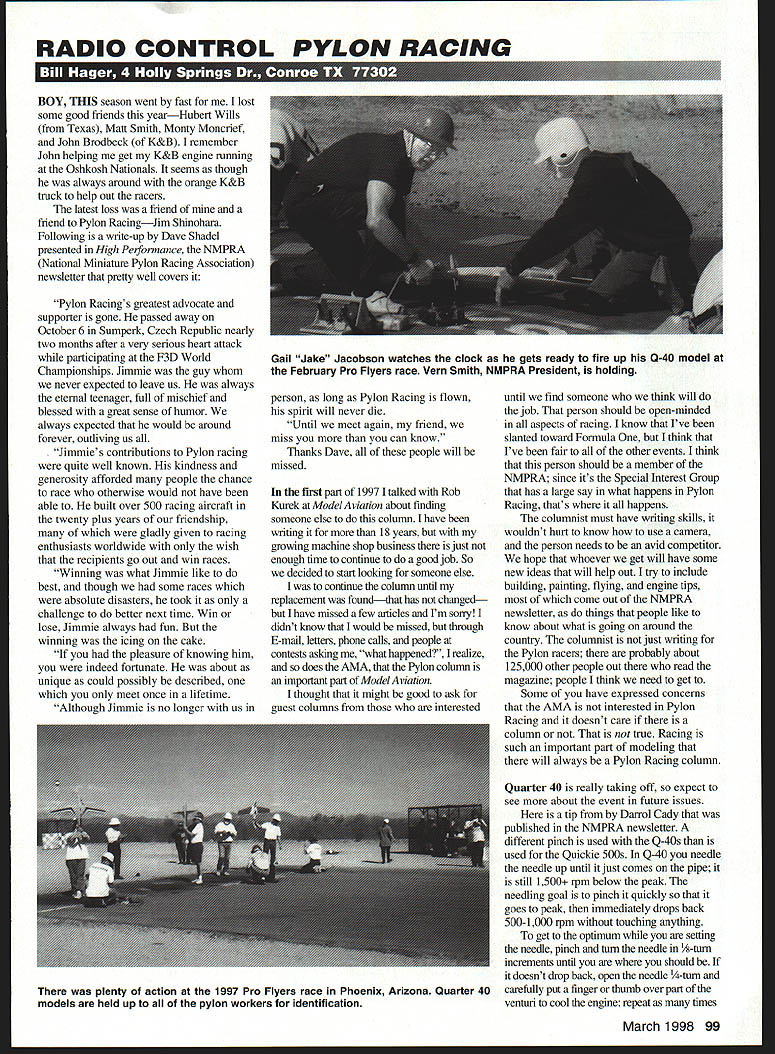
Wow! I went to the Pro Flyers race in February—the event that starts off the season for most Formula One and Q-40 fliers. While most of the U.S. is still in the deep freeze, the weather in Phoenix, Arizona is usually very good, with 1997 being no exception. Results:
Formula 1
- Richard Verano
- Jim Allen
- Scott McAfee
- Darrol Cady
Quarter 40
- Travis Flynn
- Richard Verano
- Chip Hyde
- Jim Allen
Many are looking forward to the 1998 race. The next column should be about the NMPRA Championship race held in Irving, Texas, October 10–12.
See you next month.
Transcribed from original scans by AI. Minor OCR errors may remain.

