
Radio Control: Pylon Racing
Dave Lane
AS MOST of you know by now, the 1/4-scale racing event is beginning to take hold here in California. The Southern California Scale Squadron established a racing event for the AT-6 Class. Their provisional rules, as of now, are as follows:
I. Static Judging — AMA Sport Scale Rules.
II. Sport Scale Flying 1) Unassisted ROG, 2) Figure Eight, 3) Fly Past, 4) Option, 5) Option, 6) Option, 7) Option, 8) Option, 9) Traffic Pattern, 10) Landing Perfection.
III. Pylon Heats 1) First starting positions will be determined by the highest static points. 2) Winners of the Pylon Heats will be awarded: 1st Place — 100 points, 2nd Place — 90 points, 3rd Place — 80 points, 4th Place — 70 points, 5th Place — 60 points. 3) Race Course will be the Quarter Midget Course. 4) First through fifth place overall will be determined by the highest combined points from the three events.
IV. Airplane General: 1) Bridi AT-6 (stock) 2) K & B 61 (non-Schnuerle), no pump or Perry porting 3) Senaco muffler (where db limits must be met), Slimline (where no db limits) 4) Landing Gear (retracts at builder's option) 5) Minimum weight of 8.25 lbs., maximum of 10 lbs. 6) Propellers and fuel to be furnished by sponsoring group (fuel not to exceed 15% nitro).
I attended one of the Scale Squadron Meetings when they proposed the above rules. They asked for my comments and the following is what I suggested.
I feel there is too much emphasis on the scale flying part of the event. That is because I am pro-racing first and scale, second. I think the scale portion should be no more than the requirement for the full scale AT-6 event. To qualify as a pilot for the AT-6 Races, you must demonstrate your ability to fly around the pylon course for four laps at pylon height and do a horizontal roll without falling out of the sky. That should be all that is required for the RC event.
The section on the Airplane probably was where I really stuck my foot in it! I was adamant about the fact that this should not be a one-manufacturer kit event. Joe Bridi agreed with me. I feel that any manufacturer that wants to build a T-6 for the event should be able to do so. As long as all the kits meet the specs for the event, they should be allowed.
The same thing goes for the engine. Any non-Schnuerle .61 should be allowed. I believe that the rules are being changed as stated above.
Another point that I do not agree with is the propeller being furnished by the hosting club. I think the props should be stock, as are the full scale T-6's, but I think you should be able to run whatever brand of prop you want as long as it is 11 inches (minimum) in diameter.
I believe the specs on Bridi's T-6 are a 72-in. wing (800 sq. in.) and the fuselage is about 10–11 in. deep at the cockpit. Joe's kits will be available by the time you read this article.
Another jumbo class of racing starting out here in California is 1/4-scale Formula One.
This class is being pushed by C B Associates of Hayward, Calif. The rules proposed for this class are as follows:
(These are the same basic rules as .40-powered F-1 with some controls built in to ensure that a full-blown speed event does not evolve as it did in F-1. These airplanes will fly at roughly pattern speeds. A fast lap time will be about two minutes.)
Engines — Front rotor, 10 cc/.61 cu. in. maximum displacement. Any make or homemade.
Fuel — Supplied by contest sponsor. Can be low or high nitro.
Carburetor — Any.
Aircraft — One-quarter-scale Formula 1 aircraft only.
Pressure — Any.
Spinner — 3.500" minimum.
Weight — 7 lb. minimum, 12 lb. maximum.
Wheels — 4.000" diameter, 1.000" wide at tire, minimum.
Wing Thickness — 2.000" at center section, minimum.
Wing Area — 800 square inches.
Idle Rule — No idle rule as such, except that the race must begin from a standing start. No holding of aircraft is permitted. Any type of wheel brake is permissible.
Course — Standard Formula 1 with cut judges at each pylon. No flagmen. No. 1 pylon, cut judge only.
Aircraft Specifications — Width at pilot's position 6.000". Height 11.000" bottom of fuselage to top of canopy. Length 48.000" from front of airplane (not spinner) to rudder post. Width across cheek cowls 9.500". Cheek cowls must be same size. Mufflers will be mandatory and, ideally, should not be visible. A db rating of not over 90 should be enforced.
Suggested Contest — Stand-off scale. Judging. Awards given for this category. One round of Aerobatics. Separate awards given. Awards given to the top winner of all three events, combined scores. Scale round and Aerobatic flight occurs at the same time. Contestant may enter any one or all events.
Name of Event — F-1/10 cc, Kong Racing, 1/4-Scale Racing, Whatever.
A 1/4-size Little Tony is available from C B Associates, Inc. now, and a Shoestring and Rivets will be available later on this year. A Little Mike will follow. If interested, call Bob Scigelkoff, 21658 Cloud Way, Hayward, CA 94545; phone 415-783-4868.
I watched a demonstration flight at the Bakersfield contest of one of C B's Minnows. It is a very stable flier but this one weighed over 11 lbs., so it was not very fast. If you keep these planes down in the 7- to 8-lb. range, they should move right along. I am not trying to say they should go as fast as Formula 1, but they have to go fast enough to make them easy to handle and make it interesting.
Now that these two new classes are getting off the ground, I would like to propose a third class of 1/4-scale racing aircraft. I am not sure "1/4-scale" is the right phrase, I think it should be the Formula "800" class because of the 800 sq. in. wing rule in both the AT-6 and Formula 1 Classes. Anyway, getting back to my third class of racing, how about the Golden Age of Air Racing?
I would really like to see the Browns, Lairds, Ike's, Mike's, Schoenfelt's, etc., in the 800 sq. in. category. These aircraft lend themselves very well to this style of model. They would probably be a little faster than the AT-6's and Formula 1 jobs due to the cleaner front-end design of the in-line engines. If you like the round engines, there were plenty to choose from in the thirties.
I would like to hear from those of you who would be interested in the "thirties" type of aircraft racing in the "800" sq. in. size. If I can get enough interest, I can probably get Jack Stafford Models to produce the Brown B-3 in this larger size. I am going to build and test a prototype.
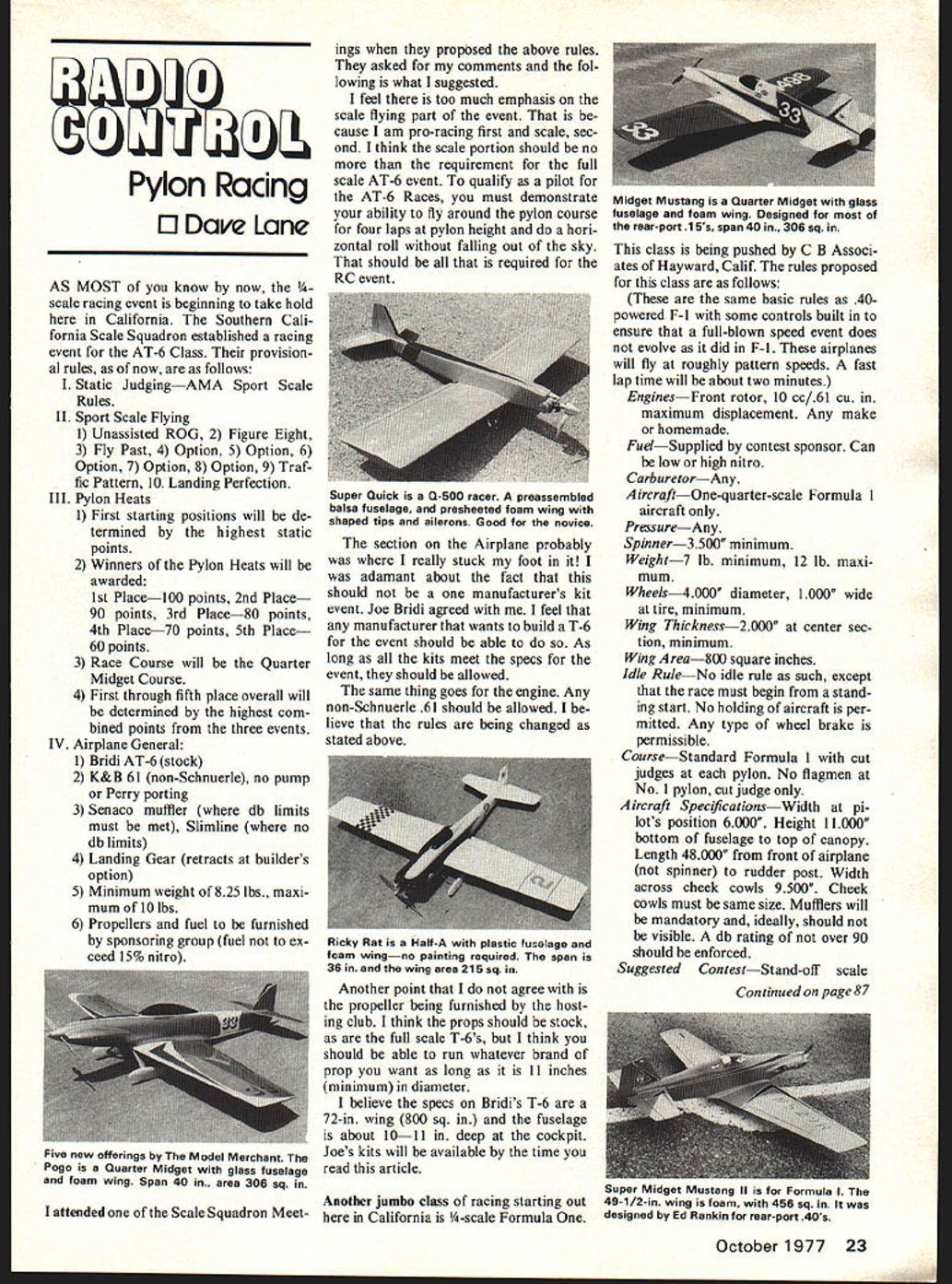
A new pylon racing manufacturer has come up with some nice aircraft for you glass-and-foam buffs. The Model Merchant (2405 Fairview, Plano, TX 75075) has available the following 1/4, 1/4 Midget and Formula aircraft: 1/4 Ricky Rat, $24.95; 1/4 Midget Pogo, $59.95; 1/4 Midget Mustang, $59.95; Q-500 Super Quick, $59.95 (preassembled balsa fuselage); F-1 Super Midget Mustang II, $99.95.
That's all for this month. Go fast and turn left!
Dave Lane, 4477 W. 136th St., Hawthorne, CA 90250.
Transcribed from original scans by AI. Minor OCR errors may remain.

