
RADIO CONTROL: PYLON RACING
Duane Gall, 1267 S. Beeler Ct, Denver CO 80231
Welcome
Welcome, Pylon Racing fans! Many thanks to the editorial board of MA for providing me with this "bully pulpit" (as Teddy Roosevelt once called the presidency), and again, thanks to retiring columnist Bill Hager for leaving some mighty big shoes to fill. I'll do my best.
You're part of it. Send me race reports, hints and kinks, and photos of your racing buddies. It'll be tough to fill this column otherwise. Until I can build up a little backlog of mail, I'll have to resort to giving away my speed secrets—and Lord knows there aren't many of those. Please include a SASE with any requests for info.
Stability in the rules
According to my watch, we're approaching January 1999. The new rule book will be coming out soon—the first one published under the new three-year rule cycle. Except for Emergency and "Urgent" proposals (of which we can always hope there won't be too many), this edition ought to provide one-stop shopping for answers to rule questions from now until January 1, 2002.
There's been a lot of stewing in the pot for the last couple of years—particularly in Q-40, where some of the lingering loopholes from the 1994–96 rule cycle had to be addressed. Look for more stability this time around.
To the extent that there may be interim revisions, I am hopeful that AMA will be able to continue working with the National Miniature Pylon Racing Association (NMPRA) to review suggested language, conduct member polls, and maintain an updated, unofficial version of the rules as amended. If you're reading this and you plan to attend more than one race next year, please join NMPRA. The AMA Contest Board takes NMPRA polls and recommendations seriously, and follows them about 90% of the time.
The Great Barrier Relief
By the time you receive this, we should have final results from the barrier-cage tests that have been going on for the past year or so under the auspices of AMA and NMPRA. I am hopeful that these results will confirm the safety of the chain-link barriers now in use at most sites.
Racing as we know it depends on the presence of race course officials (timers, flaggers, and cut judges) stationed right under the flight path. These are volunteers; it is reasonable for them to insist, as a condition of their agreeing to take on this task, that they can expect to leave the field under their own power at the end of the day. The barrier tests ought to give us a very important selling point the next time we stand up at a club meeting and ask for help at a race. "Yes," we can say, "you will be safe in the cages."
The AMA Executive Council has been criticized for singling out RC Pylon when we worry about safety. After all, Pylon is an event in which we have to sign a waiver form acknowledging that model airplanes are capable of going out of control occasionally, and in which we agree not to sue AMA if it happens.
On the other hand, consider the EC's point of view. Pylon is the only event where we routinely fly high-powered models around our heads, heat after heat, all day long. It looks scary to the uninitiated. Maybe it's more dangerous than flying a jet turbine or Giant Scale model back and forth all day in front of a crowd of judges and spectators, maybe less. We haven't had enough accidents to prove the point either way, and I hope we never do.
Actually, when you think about it, the curious thing isn't that the EC makes us sign a waiver. The curious thing is that they don't make everybody else sign a waiver, too. After all, you have to sign a waiver when you rent a pair of skis, attend a car race, or play in the office softball league. They're everywhere.
Editor's note
The AMA Membership Application contains a "Safety Code compliance and waiver and release of liability statement" that applies to all members.
There's even a waiver on the back of this Rockies ticket I'm holding in my hand, stating that the minute I walk into the ballpark I implicitly assume "all risks inherent in the game of baseball." I guess that means if I get beaned by a foul ball, I have to call Blue Cross; I can't plan on taking early retirement courtesy of [Rockies owner] Jerry McMorris. Well, gosh darn it, that's tough, but then I didn't win the lottery either. Pity, pity.
So let's not pout about it. Instead, let's add the fact of the waiver to the preflight inspections and the barrier cages and the helmets as evidence that we take safety issues seriously and that we RC Pylon types are the most responsible, most well-regulated group in all of modeldom. And hey, hey, hey, let's be careful out there.
Speed limits on the Autobahn?
We often hear speed and safety discussed as though they were the same issue, but they are not. There are valid reasons other than safety for considering limits on speed. One of these is the perceived lack of a true "entry level" RC Pylon event on the national scene.
In RC Sailplane, there are the Two-Meter and Hand-Launch events. In Control Line, there are 2.1 Sport Speed, Slow Combat, and Profile Carrier. Free Flight features P-30 Rubber and Easy B Indoor for the first-time competitor. In all of these, the best performance achievable under the rules formula—even by experts competing at a national level—is distinctly lower than the performance achievable under the more advanced rules formulas.
Some even go so far as to legislate the materials that may be used in the airframe. In Easy B, for example, all major components must be wood. Carbon fiber, boron fiber, Kevlar, and microfilm are specifically disallowed.
In contrast, all three of the AMA Pylon events (Formula 1, Quarter 40, and Quickie 500) are producing times less than 1:10 on the 2½-mile course. There are slight differences in straightaway speed, but not much.
At the '98 Nats, the top places in Quickie were taken by big-name contestants using prebuilt, all-composite airframes costing around $450. Is this a problem? Pro and con:
- Pro:
- Racing needs a "farm team" circuit where new pilots can learn the skills and strategies of racing without going "scary fast." Quickie used to fulfill that function, but doesn't any more. While horsepower has tripled, airframe size and weight haven't changed since the '70s. We're losing new people because not even a reasonably proficient sport flier can build or fly one of these models without expert help.
- Con:
- "Entry level" events are a pipe dream. The average sport flier won't last long in racing, no matter how you try to water down the rules. Going fast is the name of the game, and those who care to learn how to do it will do it.
- Quickie provides a way to go fast without putting a lot of time into building a pretty airplane. If a person wants to spend $450 on a pre-built, so what? They still have to fly it, and flying skill is what Quickie is all about.
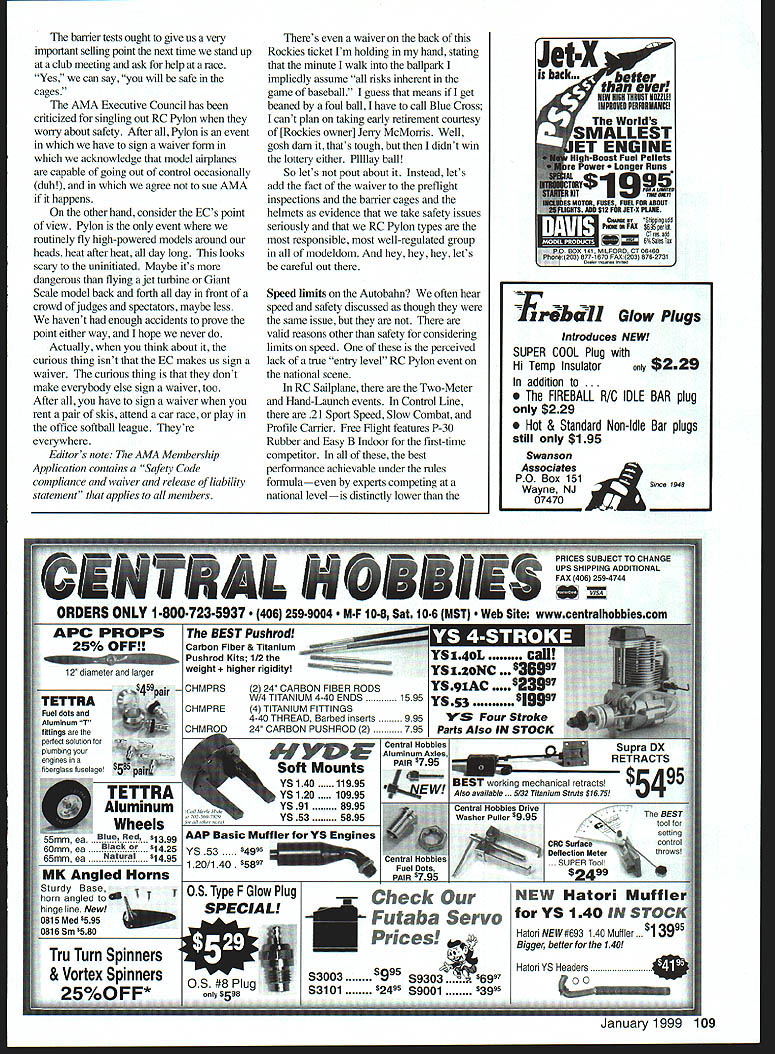
Those are the arguments in a nutshell. It has been suggested that by simply increasing the size of the firewall from 2¼ inches square to 2¾ inches square, the Quickies would be slowed down by five seconds or so—still heart-pounding for all but the most jaded competitor, but perhaps providing one extra tick of the clock for those who need it to recover from an over-roll or whatever. This would also reduce stress on the wing during turns, reducing the need for carbon-fiber reinforcement.
The next rule cycle will be upon us soon. What's your opinion?
Color war
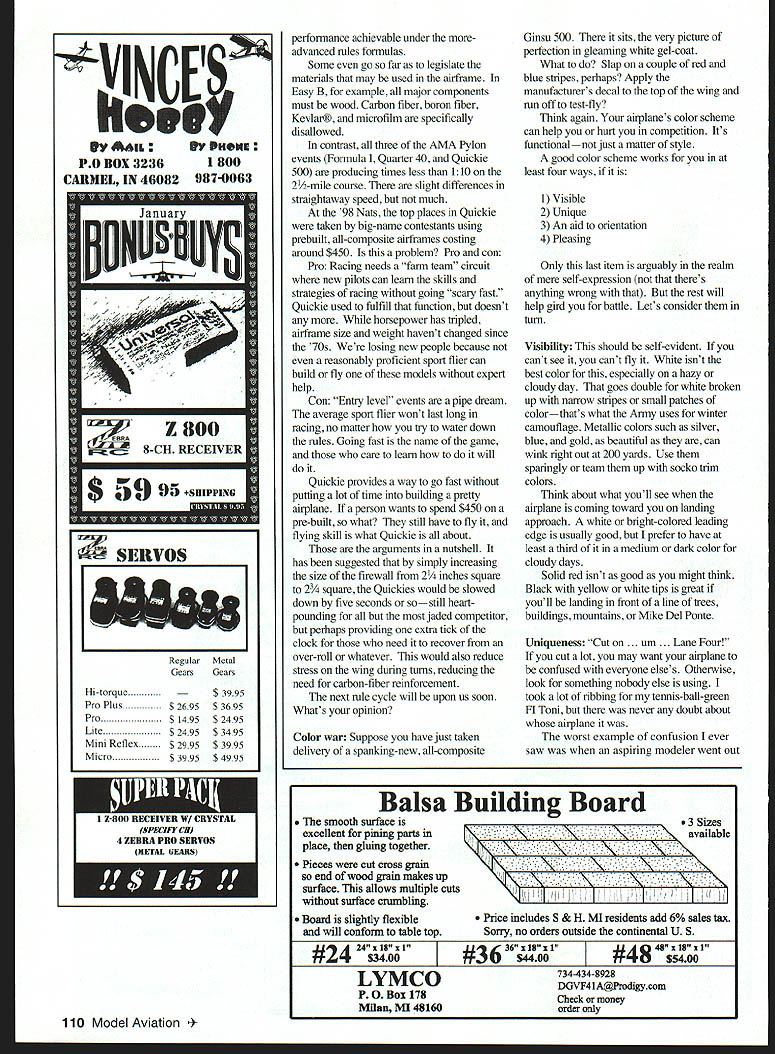
Suppose you have just taken delivery of a spanking-new, all-composite Ginsu 500. There it sits, the very picture of perfection in gleaming white gel-coat. What to do? Slap on a couple of red and blue stripes, perhaps? Apply the manufacturer's decal to the top of the wing and run off to test-fly?
Think again. Your airplane's color scheme can help you or hurt you in competition. It's functional—not just a matter of style.
A good color scheme works for you in at least four ways, if it is:
- Visible
- Unique
- An aid to orientation
- Pleasing
Only this last item is arguably in the realm of mere self-expression (not that there's anything wrong with that). But the rest will help gird you for battle. Let's consider them in turn.
Visibility
This should be self-evident. If you can't see it, you can't fly it. White isn't the best color for this, especially on a hazy or cloudy day. That goes double for white broken up with narrow stripes or small patches of color—that's what the Army uses for winter camouflage. Metallic colors such as silver, blue, and gold, as beautiful as they are, can wink right out at 200 yards. Use them sparingly or team them with socko trim colors.
Think about what you'll see when the airplane is coming toward you on landing approach. A white or bright-colored leading edge is usually good, but I prefer to have at least a third of it in a medium or dark color for cloudy days.
Solid red isn't as good as you might think. Black with yellow or white tips is great if you'll be landing in front of a line of trees, buildings, mountains, or Mike Del Ponte.
Uniqueness
"Cut on ... um ... Lane Four!" If you cut a lot, you may want your airplane to be confused with everyone else's. Otherwise, look for something nobody else is using. I took a lot of ribbing for my tennis-ball-green FT Toni, but there was never any doubt about whose airplane it was.
The worst example of confusion I ever saw was when an aspiring modeler went out and bought an FAI racer just like the World Champion's airplane—even painted it in identical colors. At the Nats, both airplanes ended up in the same heat. On takeoff one of the pilots got confused and started watching the wrong airplane. Of course, they were both applying the same control inputs at the same time, so the one airplane they were both watching seemed to be under perfect control ... and the airplane that neither of them was watching proceeded merrily on its way as a Free Flight. Scratch one world-beater airplane.
Orientation
Notice how Aerobatic models have different markings on the top and bottom? That's so the pilot knows when the airplane is inverted, knows how many rotations it made in a spin, etc. The same principles apply to Racing models—up to a point.
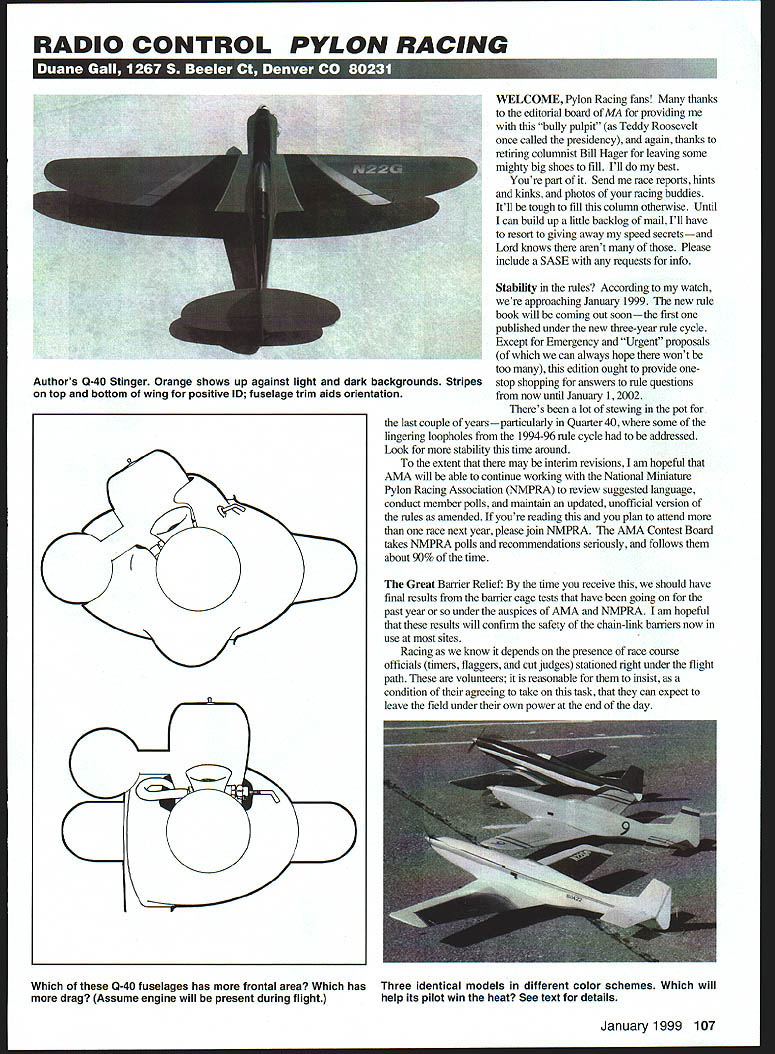
Some Racing pilots actually use completely different colors on the bottom, which may be going too far. Remember what the cut judges and timers are looking for: a positive ID of your airplane, all the way around the course. Sometimes they'll see the top of the airplane, sometimes the bottom. At today's speeds, it's hard enough for them to keep track of four color schemes, let alone eight.
If you rely on the color scheme to know whether you're inverted or not, you need to slow down your control throws, your airplane, or both. On the other hand, contrasting tips and tail feathers can be a big help in dialing in the right bank angle and gauging how hard to bang the elevator at Pylon One.
Pleasing
No mystery here; everybody wants their new whiz-bang to look cool. There are a few tricks, though.
You can reduce the gangly, "powered glider" look of some Q40s with chordwise stripes. Spanwise stripes have the opposite effect, increasing the elegance of a Quickie by visually stretching out its Hershey-bar wing.
A sunburst on the vertical fin draws attention to that feature. Jagged, curved, or S-shaped borders on color areas are "slow to the eye," adding interest to an otherwise ho-hum pattern. Those who care about the scalelike aspect of F1 and Q40 (and there are a few) will want to use colors and color schemes reminiscent of their full-scale prototypes.
Mike Helsel consistently uses the red-and-cream scale paint job from the original Little Toni, which has become his unofficial trademark in F1.
Bill Northcutt has done a beautiful job with his Lyle Larson Dago Red, decking it out in military camouflage with invasion stripes—not a scale paint scheme for the real Dago Red racer, but unmistakably P-51 and less gliderlike than most of the other Dagos.
Next month
Race reports, fiberglass how-tos, and more. Stay tuned!
Transcribed from original scans by AI. Minor OCR errors may remain.

