


RADIO CONTROL PYLON RACING
Duane Gall, 1267 S. Beeler Court, Denver CO 80231
BARRIER CAGE UPDATE
In the January column I alluded to the fact that AMA would soon be receiving the final, and hopefully definitive, results from the barrier cage testing undertaken by Lee Webster, with input from Al Watson, representatives of the NMPRA (National Miniature Pylon Racing Association). I expressed optimism that the results would confirm the adequacy of our existing barrier cages.
Mr. Webster presented his report on Friday, October 23, 1998, at the AMA Safety Committee in Muncie. I was there, as were Mr. Watson; NMPRA president Vern Smith; current AMA president Dave Brown; former AMA president Don Lowe, chairman of the Safety Committee; and various other luminaries.
Mr. Webster's initial tests were performed using "dynamic similitude" projectiles — solid, airplane-shaped darts with stub wings, fired along a cable using a rocket-powered sled. The results of those tests were rather gloomy. However, at the urging of a number of racing enthusiasts, myself included, AMA asked Mr. Webster to run a new series of tests using actual models.
NMPRA arranged for the donation of about a dozen Formula I's, complete with engines. The procedure this time appeared to be a fair test. The results held both good and bad news for clubs that have invested in barrier cages for racing.
Good news:
- Cages properly built using ordinary #9 chain-link fence material will withstand a full-on impact from a Formula I.
Bad news:
- Even a significantly lesser impact pushes the mesh in quite a bit. Most existing cages aren't big enough to provide the necessary "crush zone" on all sides.
- We cannot be sure that any of the other materials now in use have the properties necessary to absorb such impact and stay together. Nylon netting doesn't, even when hung loosely; 1/8" Lexan doesn't.
On Saturday, October 24, the Safety Committee made its recommendations to the AMA Executive Council (EC). Those recommendations included passage of an Emergency Proposal adopting specific design specifications in place of the various suggested methods of barrier construction now listed in the Competition Regulations. These specs include, but are not limited to:
- Use of #9 wire mesh
- Overall size of the cages
- Type of frame material
- Method of attachment of the mesh fabric to the frame (welding preferred)
The EC endorsed that proposal, and voted to finance the immediate construction of up to ten (10) sets of complying barrier cages, complete with trailers, to be distributed nationally under the auspices of NMPRA. They also arranged to ship the Nats cages from Muncie to some of the big meets already scheduled, where the local equipment may not measure up. This was done in lieu of canceling existing sanctions. They could have shut down racing entirely, but they didn't. Instead, they helped us out, big-time.
Racing has a good friend in Dave Brown, and in Don Lowe. Also Steve Kaluf, AMA's Technical Director, will be saddled with the unpleasant task of getting these cages built by the coming flying season.
Now it's true that 10 cages aren't enough for all of the clubs in the country. There will be some pain. Most clubs that do a lot of racing will probably want to go ahead and build new or retrofitted cages as soon as they can, rather than take a chance on getting one of the shared sets. By the time you read this, the construction drawings should be completed. Steve and Vern are going to try to have them available ASAP for any club that wants to use them.
Timers and lap counters will finally be able to say they have confidence the cages are adequate, as long as they're built to the specs. That should help when it comes time to ask for volunteers to work the next race.
OFF-COURSE CORRECTION
In my neck of the woods, three-pole racing has been dormant for a couple of years. We have cages, but they're not up to the new specs, and they've been stored outdoors, so they're a bit ratty. Furthermore, the trailer we've been using to transport them is right at its load limit. If we make the cages heftier, we'll need a new trailer. What to do?
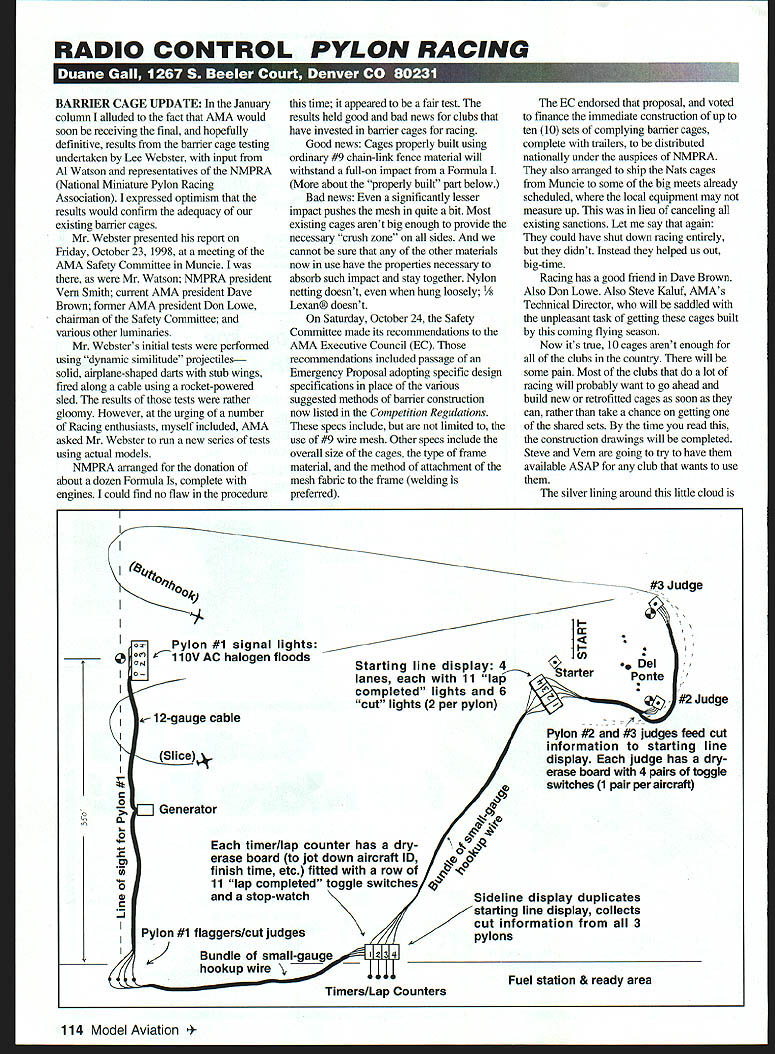
After much pondering and chin-scratching, we decided to take a cue from the two-pole folks and try handling all the Pylon #1 flagging and cut-judging from the sidelines. That avoids the necessity of building and lugging around the #1 cage — the biggest, heaviest one on the course.
In fact, with enough light bulbs and wire, we determined that we could also do without the timers' cage — the second-biggest pain in the whole operation. That leaves us only the #2 and #3 cages to contend with, plus one shelter for the starter to duck into after the airplanes take off.
The signal lights at #1 are halogen floodlights ($10 each, choice of five colors). They're fed by 110 VAC from a generator located on the course. This should provide the "instant-on" feature missing from many 12-volt systems.
The remainder of the system consists of:
- Simple toggle switches
- Small, standardized 12-volt bulbs and sockets
- Several rolls of small-gauge speaker wire
- A 12-volt battery recharged as necessary from the main generator
The on-course display panel provides instant feedback to the pilots and callers regarding the number of laps completed and the number of cuts at each pylon. A duplicate panel on the sidelines provides cut information to the timers/lap counters in "real time" — no longer will they have to rely on auditory signals transmitted via walkie-talkie, airhorn, or shouts from the starter.
Under this system, the starter has it easy. All he or she has to do is flag the takeoff for each heat and keep track of who's in the lead. Arguments over the order of finish, points, elapsed time, etc., will generally take place at the timer's station, not the starting line.
Of course, there are trade-offs. For one thing, 300 feet of heavy cable isn't cheap. We'll have to build boxes for all the displays so the lights are visible in daylight and also waterproof. We'll have to carry extra bulbs. Finally, and probably most controversial, we won't be able to call cuts because of "slices" and "buttonhooks."
Arguably, the ability to fly past #1 on the right and come back on the left is an important skill element in the game of pylon. However, any pilot who strays far from this ideal will:
- End up flying a longer course, which is slower;
- Induce his/her caller to search the heavens for the airplane instead of focusing on the task at hand; and
- Risk destroying the airplane in a head-on collision.
Such behavior tends to be self-limiting. Getting rid of the slice/buttonhook penalty removes the source of 90% of the arguments out on the race course. We've even considered outfitting the #1 crew with lockout switches that will physically prevent them from signaling a turn and calling a cut on the same airplane during the same lap.
We're still in the design stage as this goes to press. I'll provide updates as available. If you have experience with anything similar or if you have any helpful hints, source and price information, etc., that you'd like to share, please send them in!
Course layout / Equipment (summary)
- Pylon #1 signal lights: 110 VAC halogen floods
- Starting-line display: 4 LED lanes, 1 lap timer per lane, completed lights, 6 cut lights (2 per pylon), 12-gauge cable
- Pylon #2/#3 judges: feed cut information to starting-line display; judge has dry-erase board, 4 pairs of toggle switches (1 pair per aircraft)
- Generator/timer/lap counter: dry-erase board to jot down aircraft ID, finish time, etc.; filled row = 1 lap completed
- Sideline display: duplicates starting-line display and collects cut information
- Crew/stations: 3 Pylon #1 flaggers/cut judges; pylons; fuel station & ready area; timers/lap counters
HOW TO KEEP YOUR TIGER PURRING
In many areas of the country, the APRA (Arizona Pylon Racing Association) engine list governs which engines contestants may run in entry-level Quickie racing.
Lee Von der Hey (Las Vegas, NV) has taken the time to scope out the most-popular engine on the APRA list: the Thunder Tiger Pro .40 ABC. Here's his take on how to "blueprint" the engine for maximum longevity:
"Because of the way the engine rules are written, you can make some very slight changes to the engines that improve consistency, durability, and performance."
Transcribed from original scans by AI. Minor OCR errors may remain.

