
RADIO CONTROL PYLON RACING
Duane Gall, 1267 S. Beeler Court, Denver, CO 80231
QUICKIE, QUICKER, Quickest
Wow, the mail is really pouring in from the January column, in which I had the audacity to suggest that AMA Quickie (Event No. 428) could stand to be slowed down a little. Right now, the record is 1:06 — a couple of seconds away from Formula I and Quarter 40 on the same course.
Quickie never used to be that fast, nor was it ever meant to be. Most of the increase occurred in 1991, when Henry Nelson one-upped Rossi in the tuned-muffler department. Rossi's tuned muffler wasn't much better than the "common expansion chamber muffler" required by the rules, and it wasn't easy to see anything different about it from the outside.
As a result, Contest Directors let it slide, and a precedent was established for allowing the Rossis to compete. They quickly became the engine of choice.
One or two prescient souls alerted the Contest Board that a rule interpretation was needed since a tuned muffler—also known as a "magic muffler" or "folded tuned pipe"—had the potential to boost horsepower nearly as much as the classic double-cone tuned pipe.
Tuned pipes have always been illegal in Quickie. However, when the original rules were written, magic mufflers were only a twinkle in some engine-designer's eye, so the words "tuned muffler" never emerged.
Now, in the U.S., the gravest sin is being right too soon. These annoying critics were told to "leave it alone," to "quit making trouble." "It isn't a problem yet, so don't worry about it."
Shortly after that, Henry introduced his Rossi-killer, and average heat times dropped by 10–15 seconds overnight. Tails fluttered. Wings folded. Carbon fiber became an essential construction material for any airplane with a Nelson on it.
By 1994, times on the short (2-mile) course were down to less than a minute, and Nationals event director Wayne Yeager declared that Event No. 428 would be flown on the long (2½-mile) course for safety reasons. No one argued, and no one has looked back.
In 1999, the rule book still refers to Event No. 428 as "an entry level event for pilots who are new to racing and ... a fun event for experienced pilots." Many experienced pilots are having fun turning F1 times with stock airplanes.
What's not so clear is whether the "entry level" portion is still being served, or if it even belongs there anymore. "Entry level" doesn't have to mean slow—slower, perhaps. The Rossi-powered airplanes weren't slow, except compared to what we have now. There were many close and exciting races.
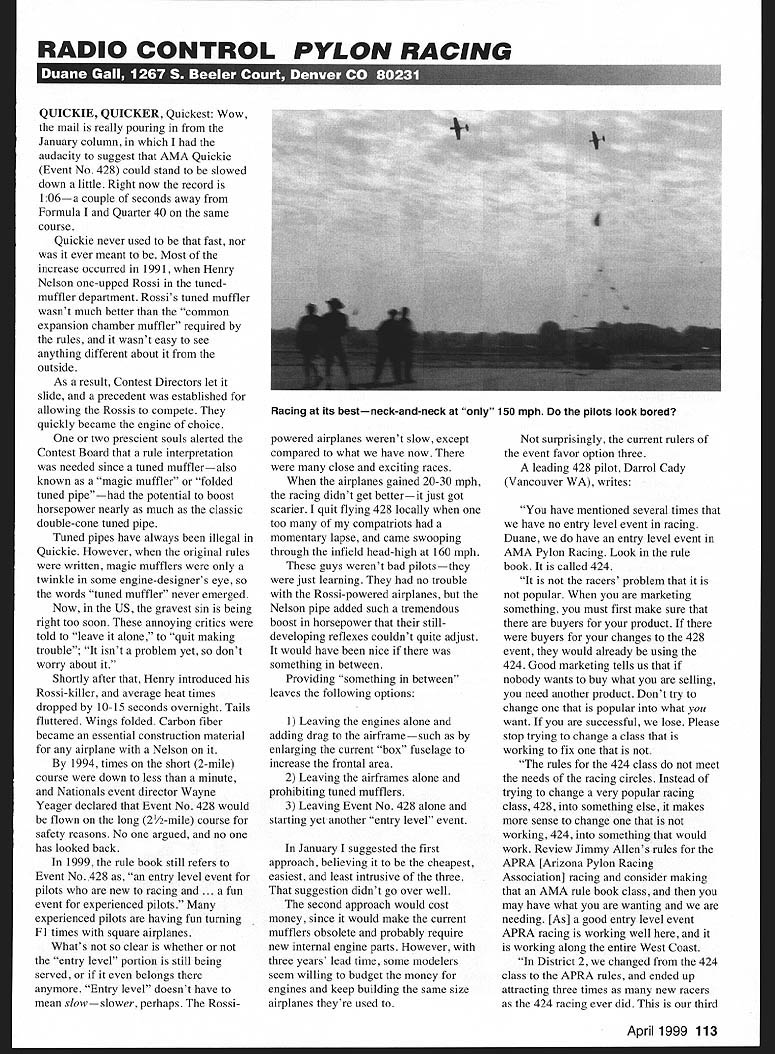
When the airplanes gained 20–30 mph, the racing didn't get better—it just got scarier. I quit flying 428 locally when one too many of my compatriots had a momentary lapse, and came swooping through the infield head-high at 160 mph.
These guys weren't bad pilots—they were just learning. They had no trouble with the Rossi-powered airplanes, but the Nelson pipe added such a tremendous boost in horsepower that their still-developing reflexes couldn't quite adjust. It would have been nice if there was something in between.
Providing "something in between" leaves the following options:
- Leaving the engines alone and adding drag to the airframe—such as by enlarging the current "box" fuselage to increase the frontal area.
- Leaving the airframes alone and prohibiting tuned mufflers.
- Leaving Event No. 428 alone and starting yet another "entry level" event.
In January I suggested the first approach, believing it to be the cheapest, easiest, and least intrusive of the three. That suggestion didn't go over well.
The second approach would cost money, since it would make the current mufflers obsolete and probably require new internal engine parts. However, with three years' lead time, some modelers seem willing to budget the money for engines and keep building the same size airplanes they're used to.
Surprisingly, the current rulers of the event favor option three. A leading 428 pilot, Darrol Cady (Vancouver, WA), writes:
"You have mentioned several times that we have no entry level event in racing. Duane, we do have an entry level event in AMA Pylon Racing. Look in the rule book. It is called 424.
"It is not the racers' problem that it is not popular. When you are marketing something, you must first make sure that there are buyers for your product. If there were buyers for your changes to the 428 event, they would already be using the 424. Good marketing tells us that if nobody wants to buy what you are selling, you need another product. Don't try to change something that is popular into what you want—if they are successful, we lose. Please stop trying to change a class that is working to fix one that is not.
"The rules for the 424 class do not meet the needs of the racing circles. Instead of trying to change a very popular racing class, 428, into something else, it makes more sense to change one that is not working, 424, into something that would work. Review Jimmy Allen's rules for the APRA (Arizona Pylon Racing Association) racing and consider making that an AMA rule book class, and then you may have what you are wanting and we are needing. As a good entry level event APRA racing is working well here, and it is working along the entire West Coast.
"In District 2, we changed from the 424 class to the APRA rules, and ended up attracting three times as many new racers as the 424 racing ever did. This is our third APRA season coming up, and we are still drawing 10 to 15 at every race. We have had five to six of the APRA guys move up to the 428 class and still have the same number of racers in the APRA class.
"This is the intent of the entry level—a place for the newbie to try it and see if it is to his liking. It is a place that he can stay, if it fulfills his need for speed. Once you find the course, and learn to fly it, the speed difference is easy. If the new racer wants to go faster, he can change [engines] and go fast, with the same airplanes."
Darrol makes a good point, although he overlooks the fact that there's still a huge gap between APRA speeds and AMA 428 speeds.
Local clubs try to fill that gap with different classes for Rossi, Webra, MVVS, and the so-called "sport" versions of the Nelson and Jett 428 engines, and the result is a mess. If you want to travel to a contest outside your local bean patch, you have to call ahead, then buy or borrow an engine to meet the local rules. In fairness to Darrol, this hodgepodge may have less to do with airspeed than with penny-wise modelers who think it makes more sense to buy two or three $150 engines and mix and match parts than to plunk down $250–300 for one thoroughbred racing engine that runs right out of the box.
Slowing down 428 might do nothing but cramp the style of expert pilots, such as Darrol, who use 428 as a warm-up and practice event for Quarter 40 and Formula 1, or who just like to go insanely fast with rectangular airplanes.
Is this a valid concern? Would anyone actually abandon the hodgepodge system in favor of 428 if it was 5–10 seconds slower, or would such a change represent all pain and no gain? Should 428 just be surrendered to the experts and energies directed toward reinventing 424 as an "entry level" event, as Darrol suggests?
If so, the next question is whether to run it at the Nationals, and whether to limit entries to those who aren't entered in 428 or the other expert-level events—that is done in Pattern to keep the newbies from getting trounced by the big names.
If you have an opinion, write to your district Contest Board representative at the address listed in the "Focus on Competition" section of this magazine. Then join the NPMRA (National Miniature Pylon Racing Association) while you're at it. September 30, 1999 is the deadline for submission of any rule changes you want to see considered for inclusion in the 2002–2005 rule book.
Double Trouble
In addition to writing this column, I'm chairman of the RC Racing Contest Board, filling the spot left by Wayne Yeager when he retired last year. I applied for both jobs in hopes of getting one or the other, but I got both.
I suspect it's a sinister plot by everybody I managed to edge out in heat races last year, who are hoping to tie my hands with all of this wordsmithing so I won't be able to build airplanes or practice. So far, it's working.
Until I burn out, I will try to do both jobs to the best of my ability. This means being careful to avoid misusing one post in furtherance of the other. You would have had to suffer through listening to my opinions in any case, so forget about me keeping my mouth shut. I will, however, give equal time to responsible opposing views.
I won't be submitting any big, controversial rule proposals of my own for this cycle. The Contest Board chairman's job description includes "refining" the wording of proposals submitted by others, and working with the Technical Director to resolve conflicts in wording, placement in the rule book, etc. I'm going to let my role end there.
The rules don't prohibit the chairman from signing proposals, but considering my dual role, I think it's more appropriate that I defer to others when it comes to putting ideas in front of the Contest Board for action.
The AMA rules process is supposed to be a democratic, bottom-up thing, not a top-down thing. Ideas with merit will have more than just one proponent. Therefore, if anything I write here prompts you to say, "Right on, there oughta be a law!", call AMA for a Forms by Fax, get a rule proposal form, sign it, and send it in. Or make darn sure someone else you know has already done it.
Feed the Hand That Bites You
In spite of what he wrote, I'll inform you of some merchandise that Darrol Cady sells: hollow carbon-fiber rods suitable for pushrods, but adaptable for a variety of other purposes. (One that immediately comes to mind is wing spars for insanely fast rectangular airplanes.)
These rods are similar to what you may have seen advertised, but without the titanium tips. They're 29½ inches long, almost indestructible. Sizes are:
- 5/32" O.D. with an I.D. that's a slip fit for #4 x 40 threaded rod.
- 1/8" O.D. with an I.D. that's a slip fit for #2 x 56 threaded rod.
Both sizes are $4 per rod, plus $6 postage per order. Detailed instructions for proper assembly are included. Write to Darrol at 10711 NE 37th Ct., Vancouver, WA 98686; Tel.: (360) 573-0987; E-mail: dcady@pacifier.com.
Light and Variable
Design drawings and a full parts list, complete with Radio Shack part numbers and prices, are available for the electric light signaling and scorekeeping system outlined in last month's column.
With this system, all you need are the #2 and #3 cages, no #1 cage or timer's cage, since most of the workers are off the race course. Send me a SASE if you'd like copies.
That's it for this month. Spring's coming!
Transcribed from original scans by AI. Minor OCR errors may remain.

