
RADIO CONTROL PYLON RACING
Duane Gall, 1267 S. Beeler Court, Denver CO 80231
BLASTS FROM THE PAST The numbers I gave you in the May column for Quarter .40 propeller diameter and peak static RPM have been superseded. I recommended a 7.2-inch diameter and a peak static RPM of 24,500; the new numbers are a 7.4- to 7.5-inch diameter and a peak of 22,500–23,500 RPM.
It won't hurt your engine to run the smaller propeller at the faster RPM, but there's a slight loss in efficiency from all of that thrashing.
For the electric signaling system outlined in the March issue, Randy Ling (Kent WA) suggests replacing the 110V AC portion of the circuit with 24V DC to run the Pylon #1 signal lights. Two car batteries in series will do it. This eliminates the need for a generator on the racecourse, and makes for a safer setup overall.
This arrangement has been used in the Pacific Northwest for many years, and it's working fine. Low-power (12V) halogen bulbs light up quickly on 24V, and the line losses between the batteries and the bulbs prevent overloading of the bulbs; that is, they don't actually "see" 24 volts.
Randy relates another advantage to this setup: it's possible to wire in ordinary telephones as part of the circuit, so the racecourse workers can talk to each other without the interference and other problems associated with walkie-talkies.
I'm told that the ideal connectors for this, or any similar system, are ordinary, cheap two-wire extension cords. Clip off the plugs and a few inches of the cord, then strip the insulation off the ends of the wires and use wire nuts to attach them to the main cable.
Randy has offered to answer any detailed questions firsthand. Call him at (253) 854-2786, or write to him at 11033 SE 214th St., Kent WA 98031. Remember to enclose an SASE.
I still have diagrams and parts lists for the system as published. Send me an SASE for that.
Go For the Gold Cup!
Perhaps it's premature to describe the 1999 JR Gold Cup series for Quarter .40 racing as "historic," "turning point," or "salvation." The NMPRA, in conjunction with major sponsors JR and Powermaster Fuels, has put together a season's worth of premier events that may give Radio Control (RC) Pylon Racing the "shot in the arm" it needs.
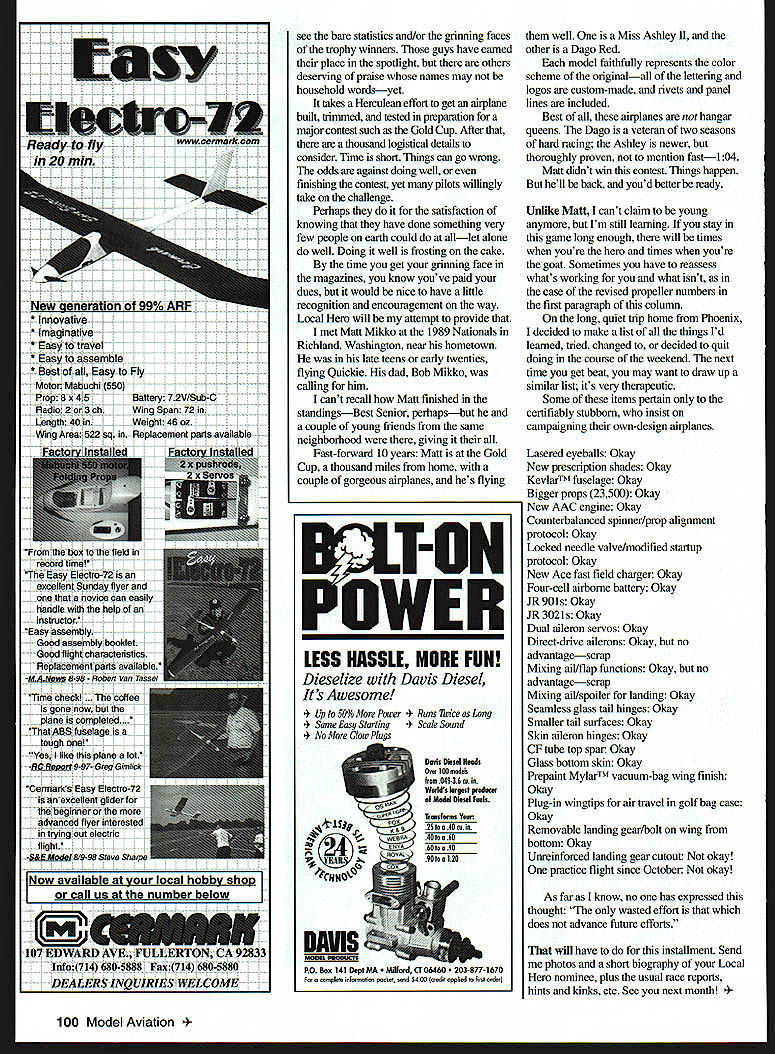
I attended the inaugural event at Phoenix in late February. By the time you read this, the Merced CA and Bowie MD contests will have been held, and the remainder of this year's series consists of events at Dayton OH (September 11–12) and Orlando FL (December 11–12).
The concept is to encourage clubs to put on high-quality two-day events by guaranteeing the workers (yes, you read that right) and the hosting clubs up to $2,000 per event in sponsor merchandise.
Sponsors include:
- JR
- Powermaster Fuels
- ACE Hobby Distributors
- Carl Goldberg Models
- Dave Brown Products
- Du-Bro Products
- Futaba Corporation
- K&B Manufacturing
- Performance Specialties
- Sullivan Products
- ZAP Products
Perhaps as word gets around, other companies will step forward to help keep the effort going.
As for the race itself, "spectacular" is not too strong a word. I've been to seven or eight Nationals, a few NMPRA championships, occasional FAI team trials, and I have never been beaten by so many competitors at one contest.
The air was nearly perfect; my engine over-revved, not many of my propellers. Every heat was like a flyoff at the Nationals. The qualifying time for the Calcutta on Sunday was 1:05 — that's a dozen pilots faster than 1:05.
Rather than list all 56 entrants and their finish positions, an accompanying photo includes the top finishers, and you can check out the Web sites of Drew Telford (http://home.san.rr.com/thedrewpages) and "Mabo" (http://www.superminnow.com).
Drew and Mabo attend as many races as they can, and report on them as soon as they get home. Drew manages to compete and take pictures; Mabo assists the Canadian team, takes pictures, and writes funny articles for his Web page. My hat is off to both of them.
Local Hero
I'm starting an occasional feature in this column called Local Hero. When the race reports are printed in the magazines, you often see the bare statistics and/or the grinning faces of the trophy winners. Those guys have earned their place in the spotlight, but there are others deserving of praise whose names may not be household words—yet.
It takes a Herculean effort to get an airplane built, trimmed, and tested in preparation for a major contest such as the Gold Cup. After that, there are a thousand logistical details to consider. Time is short. Things can go wrong. The odds are against doing well, or even finishing the contest, yet many pilots willingly take on the challenge.
Perhaps they do it for the satisfaction of knowing that they have done something very few people on earth could do at all—let alone do well. Doing it well is frosting on the cake.
By the time you get your grinning face in the magazines, you know you've paid your dues, but it would be nice to have a little recognition and encouragement on the way. Local Hero will be my attempt to provide that.
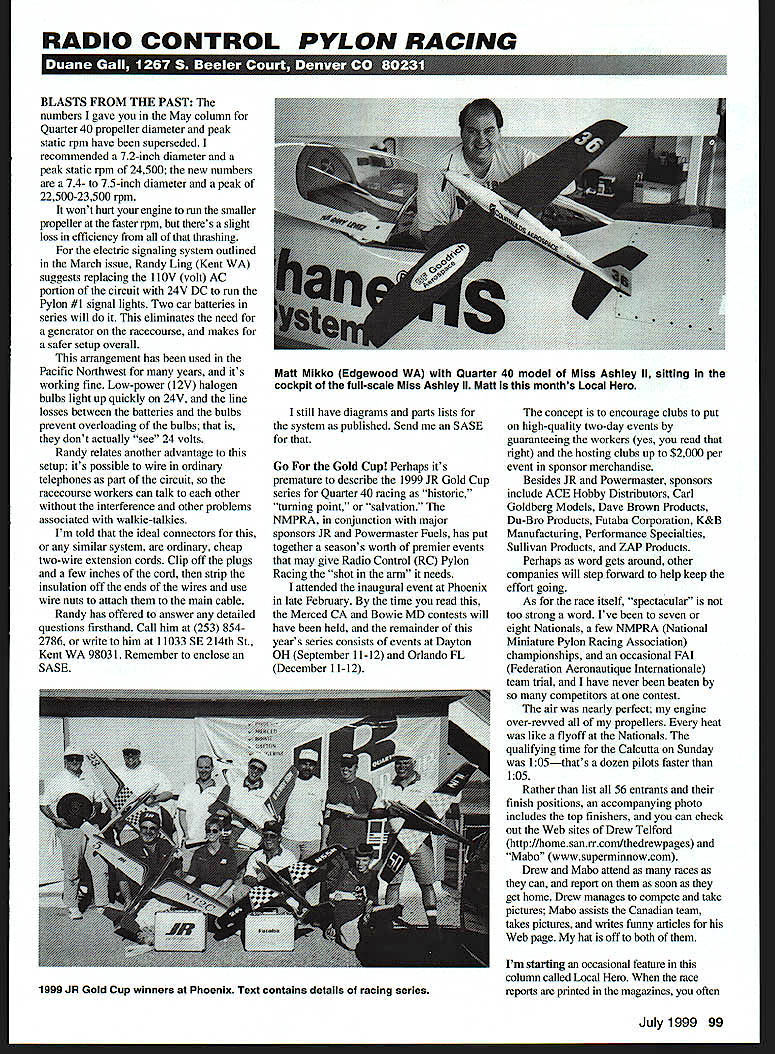
I met Matt Mikko at the 1989 Nationals in Richland, Washington, near his hometown. He was in his late teens or early twenties, flying Quickie. His dad, Bob Mikko, was calling for him.
I can't recall how Matt finished in the standings—Best Senior, perhaps—but he and a couple of young friends from the same neighborhood were there, giving it their all.
Fast-forward 10 years: Matt is at the Gold Cup, a thousand miles from home, with a couple of gorgeous airplanes, and he's flying them well. One is a Miss Ashley II, and the other is a Dago Red.
Each model faithfully represents the color scheme of the original—all of the lettering and logos are custom-made, and rivets and panel lines are included.
Best of all, these airplanes are not hangar queens. The Dago is a veteran of two seasons of hard racing; the Ashley is newer, but thoroughly proven, not to mention fast—1:04.
Matt didn't win this contest. Things happen. But he'll be back, and you'd better be ready.
Unlike Matt, I can't claim to be young anymore, but I'm still learning. If you stay in this game long enough, there will be times when you're the hero and times when you're the goat. Sometimes you have to reassess what's working for you and what isn't, as in the case of the revised propeller numbers in the first paragraph of this column.
On the long, quiet trip home from Phoenix, I decided to make a list of all the things I'd learned, tried, changed to, or decided to quit doing in the course of the weekend. The next time you get beat, you may want to draw up a similar list; it's very therapeutic.
Some of these items pertain only to the certifiably stubborn, who insist on campaigning their own-design airplanes:
- Lasered eyeballs: Okay
- New prescription shades: Okay
- Kevlar fuselage: Okay
- Bigger props (23,500 RPM): Okay
- New AAC engine: Okay
- Counterbalanced spinner/prop alignment protocol: Okay
- Locked needle-valve/modified startup protocol: Okay
- New fast-field charger: Okay
- Four-cell airborne battery: Okay
- JR 901S: Okay
- JR 3021S: Okay
- Dual aileron servos: Okay
- Direct-drive ailerons: Okay, but no advantage — scrap
- Mixing aileron/flap functions: Okay, but no advantage — scrap
- Mixing aileron/spoiler for landing: Okay
- Seamless glass tail hinges: Okay
- Smaller tail surfaces: Okay
- CF-tube top spar: Okay
- Glass bottom skin: Okay
- Prepaint Mylar vacuum-bag wing finish: Okay
- Plug-in wingtips for air travel in golf-bag case: Okay
- Removable landing gear/bolt-on wing from bottom: Okay
- Unreinforced landing-gear cutout: Not okay!
- One practice flight since October: Not okay!
As far as I know, no one has expressed this thought: "The only wasted effort is that which does not advance future efforts." That will have to do for this installment. Send me photos and a short biography of your Local Hero nominee, plus the usual race reports, hints and kinks, etc. See you next month!
Transcribed from original scans by AI. Minor OCR errors may remain.

