
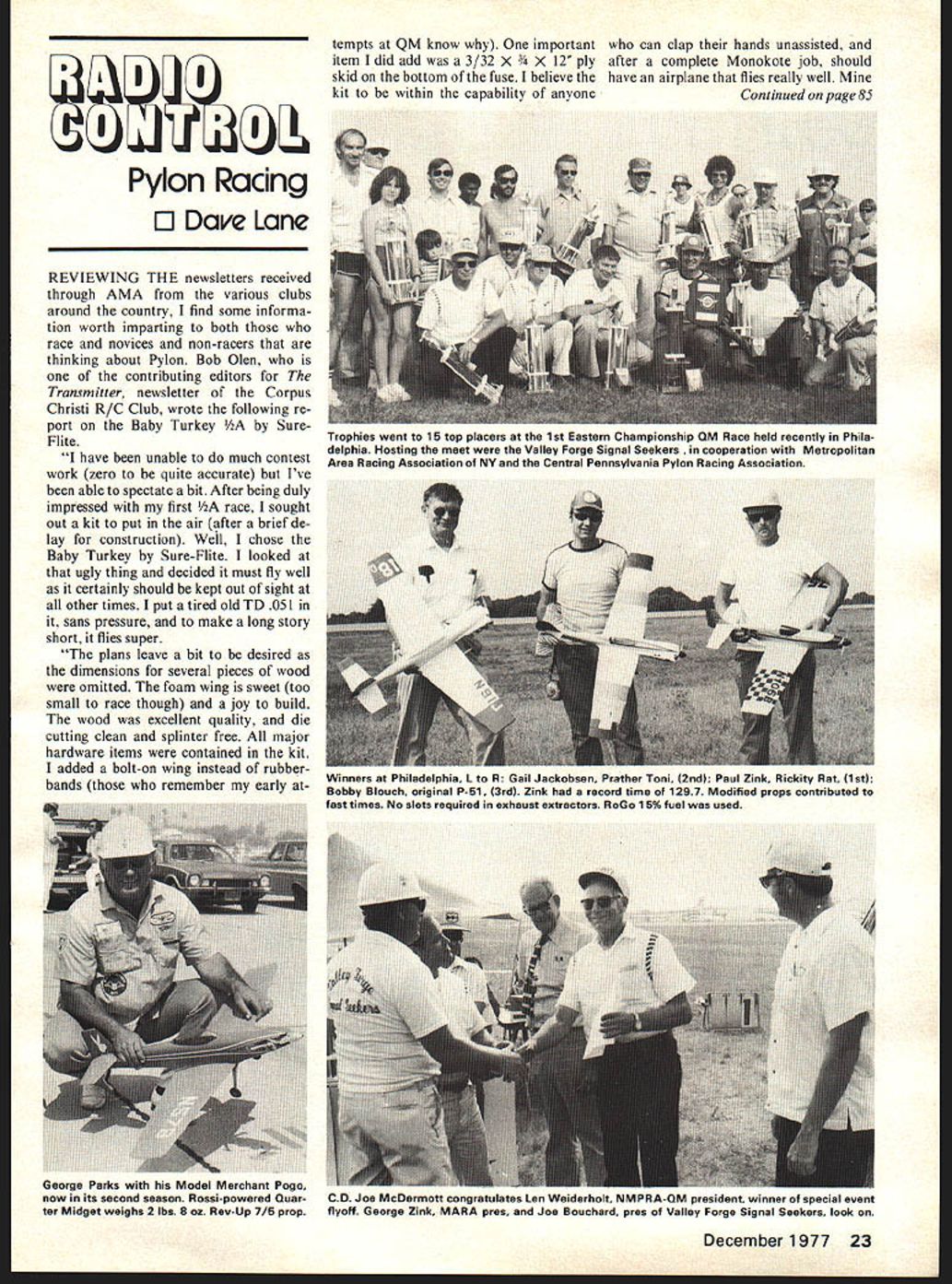
Radio Control: Pylon Racing
Dave Lane
REVIEWING THE newsletters received through AMA from the various clubs around the country, I find some information worth imparting to both those who race and novices and non-racers that are thinking about Pylon. Bob Olen, who is one of the contributing editors for The Transmitter, newsletter of the Corpus Christi R/C Club, wrote the following report on the Baby Turkey 1/2A by Sure-Flite.
"I have been unable to do much contest work (zero to be quite accurate) but I've been able to spectate a bit. After being duly impressed with my first 1/2A race, I sought out a kit to put in the air (after a brief delay for construction). Well, I chose the Baby Turkey by Sure-Flite. I looked at that ugly thing and decided it must fly well as it certainly should be kept out of sight at all other times. I put a tired old TD .051 in it, sans pressure, and to make a long story short, it flies super.
"The plans leave a bit to be desired as the dimensions for several pieces of wood were omitted. The foam wing is sweet (too small to race though) and a joy to build. The wood was excellent quality, and die cutting clean and splinter free. All major hardware items were contained in the kit. I added a bolt-on wing instead of rubber-bands (those who remember my early attempts at QM know why). One important item I did add was a 3/32 X 3/4 X 12" ply skid on the bottom of the fuse. I believe the kit to be within the capability of anyone who can clap their hands unassisted, and after a complete Monokote job, should have an airplane that flies really well. Mine took less than one week from purchase to test flight.
"A two-ounce tank, an EK Super Pro receiver, two servos and a 225-mA pack were installed for a flying weight of 19 ounces (dry). Test flight day came with unusually high winds for this area (20 mph). Being an intrepid veteran of S. Texas, I felt undaunted by the winds that kept my contemporaries at home or in their cars. I jauntily unloaded my equipment, put my airplane on the ground and returned to the van for my radio. With a wry smile of confidence and defiance I returned to the vacant pit area, vowing to 'show those guys.' Conspicuous by its absence, I noted no place to put the fuel in my just-filled bulb. My airplane had taken leave of the situation. My immediate reaction was one of concern. If my airplane didn't feel any better about the forthcoming test flight than that, how would the rest go? Well, I found it hiding in the bushes about 100 feet downwind and except for a dent or two seemed okay.
"I fueled the turkey up and let it warm up (really I didn't have a shutoff and did not want to test with a full bag of fuel). In days gone by I flew a single channel for five minutes worth lazy rolls (aileron only). Finally, launch time. I whipped it out of my hands like a small arrow and after a few moments seemed oblivious to the wind. A thoroughly enjoyable little craft capable of all maneuvers not requiring rudder. Incidentally, it penetrates very well as I did my best to land short and had no difficulty stretching to the runway. If you're hesitating in 1/4A, get a Baby Turkey for $14.95 and you'll have more airplane than you paid for. A very positive, stable airplane within the capability of all but the newest novice. I recommend it."
Bob Root has made some interesting observations about the Cox .15 for QM. The faster Cox's run the non-finned high-compression head with no copper head gasket. Several paper crankcase gaskets are needed to get proper head clearance. Add gaskets until maximum rpm is achieved. This usually occurs with a head clearance between 9 and 12 thousandths. The best prop seems to be a Rev-up 7-5N cut down to between 6½ and 6¾ diameter, and thinned to give a ground rpm of 21,500 to 22,500. (Unless the QM rule is changed, you will be illegal if you do anything to the props other than balancing; there is movement to eliminate the stock prop rule in QM.)
Joe Klause submitted the following observations on the problem of "stock" engines in QM.
Under QMRC rules, competitors are required to use stock engines. In other words, so-called custom-tuned engines are a big no, no. Fine, except that there may just be some room for some honest and serious questions about when an engine ceases to be stock. Why say that? "Stock is stock, isn't it?" "Everybody knows that," so the sayings go.
Well, as a simple matter of fact, by far the major percentage of custom tuning involves nothing more than ensuring a good fit between the parts of an engine (less friction = more horsepower). Now, if nothing else is done other than properly fitting the engine, is it still stock? For one reason or another, some guys will say no. Their intent is unquestionably honest. However, a few questions come to mind.
If we put gaskets between the two parts of the Cox .15 case, as suggested by Bob Root, aren't we really changing the exhaust and bypass timing as well as head spacing? Next, someone might ask if that's any different than putting a gasket under a Rossi .15 sleeve? Someone then may say that gaskets are a part of the Cox but not of a Rossi. But what is the purpose of a Cox crankcase gasket? One answer is that it is a seal. If we say that it's also to change timing, etc., then we have said that we can tune the engine rather than let it be stock out of the box.
Is it illegal to properly align bearings? Everybody would probably agree it's okay to replace a bad bearing. Is it illegal to ensure its proper alignment? Similarly, is it illegal to change sleeves and pistons? They too wear out, and unquestionably some combinations are a lot better than others. If you have a combination that fits together well, you'll probably have a really good engine.
These seem to be straightforward, valid questions. Unfortunately, they tend to shoot holes through the so-called stock engine bit. Why? Because the problem is one of definition. This all too often triggers off petty insinuations and acrimony among competitors. Give it a little thought, and most importantly, remember that any rule that is not easily and practically enforceable is really useless.
Next month I will have a report on the happenings at Reno. I will be judging on the pylons again this year. That's all for now. Go fast and turn left.
Dave Lane, 4477 W. 136th St., Hawthorne, CA 90250.
Transcribed from original scans by AI. Minor OCR errors may remain.

