
RADIO CONTROL: PYLON RACING
Duane Gall 1267 S. Beeler Court, Denver CO 80231
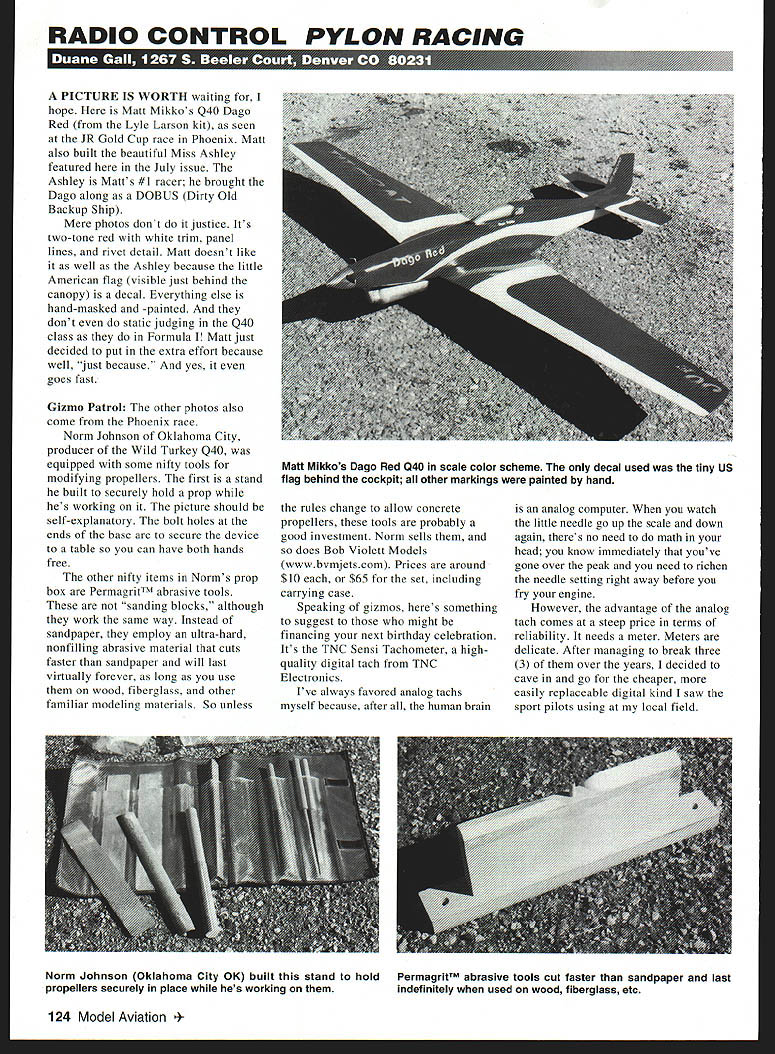
Matt Mikko's Q40 "Dago Red"
A picture is worth waiting for, I hope. Here is Matt Mikko's Q40 Dago Red (from the Lyle Larson kit), as seen at the JR Gold Cup race in Phoenix. Matt also built the beautiful Miss Ashley featured in the July issue. The Ashley is Matt's #1 racer; he brought the Dago along as a DOBUS (Dirty Old Backup Ship).
Mere photos don't do it justice. It's two-tone red with white trim, panel lines, and rivet detail. Matt doesn't like it as well as the Ashley because the little American flag (visible just behind the canopy) is a decal. Everything else is hand-masked and -painted. And they don't even do static judging in the Q40 class as they do in Formula I! Matt just decided to put in the extra effort because, well, "just because." And yes, it even goes fast.
Gizmo Patrol
The other photos also come from the Phoenix race.
Norm Johnson of Oklahoma City, producer of the Wild Turkey Q40, was equipped with some nifty tools for modifying propellers. The first is a stand he built to securely hold a prop while he's working on it. The picture should be self-explanatory. The bolt holes at the ends of the base are to secure the device to a table so you can have both hands free.
The other items in Norm's prop box are Permagrit abrasive tools. These are not "sanding blocks," although they work the same way. Instead of sandpaper, they employ an ultra-hard, non-filling abrasive material that cuts faster than sandpaper and will last virtually forever, as long as you use them on wood, fiberglass, and other familiar modeling materials. So unless the rules change to allow concrete propellers, these tools are probably a good investment. Norm sells them, and so does Bob Violett Models (www.bvmjets.com). Prices are around $10 each, or $65 for the set, including a carrying case.
TNC Sensi Tachometer
Here's something to suggest to those who might be financing your next birthday celebration: the TNC Sensi Tachometer, a high-quality digital tach from TNC Electronics.
I've always favored analog tachs myself because, after all, the human brain is an analog computer. When you watch the little needle go up the scale and down again, there's no need to do math in your head; you know immediately that you've gone over the peak and you need to richen the needle setting right away before you fry your engine.
However, the advantage of the analog tach comes at a steep price in terms of reliability. It needs a meter. Meters are delicate. After managing to break three of them over the years, I decided to cave in and go for the cheaper, more easily replaceable digital kind I saw the sport pilots using at my local field.
The first one I got was a $40 Brand X. It worked, but I found the three-digit readout wasn't precise enough — within 100 rpm it became an annoying situation. The last digit flutters and shifts because the device is reading somewhere between two values and can't decide which to show. It also required perfect light conditions to work consistently. Changing the battery didn't help much.
Encouraged by finding a little better quality, I decided to gamble $80 on the three-digit Model PT offered by TNC. It's worth it. The tach reads in low-light conditions and I persuaded the proprietor, Tony Criscimagna, to install a timeout switch for a small additional fee. So now I'm at the starting line, can just pick it up, press the button, confirm rpm, set it down, and it'll turn itself off. Other custom features are available. Visit TNC's web site: http://www.ulsternet/~tnc/tncweb.html or call 914-679-8549. More sophisticated Sensi Tach models will read to 10 rpm resolution (at greater cost). The factory can supply a unit that reads to a standard 99,990 rpm (and some models go up to 150,000 rpm).
Nationals and a Proposal for Class-Based Flyoffs
As I read, the 1999 Nats have wrapped up. The winners' circle probably includes the usual suspects. Perennial champ Dave Shadel has always gone out of his way to encourage new pilots; anything that can whet the appetite of new pilots — help overcome early disappointments inevitable in competition — will work to everyone's benefit. It doesn't mean giving people something for nothing; it may mean taking a fresh look at the way competition is structured and the way trophies are handed out.
Dave Shadel has a suggestion about changing the way we conduct races. He believes we've lost a sizable number of racing participants over the last ten years because many got tired of putting forth substantial effort with little reward. Racing has become a dead end for some. Virtually every competitive sport has a class/category system that allows participants to pit skills against others of similar ability. People naturally want to compete against others of similar ability.
Dave's proposal:
- Fly five or more rounds for those who are chasing national points. (Note: this refers to the NMPRA national point system, which requires a minimum of five rounds for results to be counted.) This determines your place in the contest, but only for national points. There are no awards other than your accrued points.
- Take the best times for every contestant and group them by top three (or four, depending on how big the race is), second three (or four), and so on down the list.
- Set up a flyoff in each category using those grouped best times.
- Award a first-place trophy for each group in the fly-offs.
This gives every contestant a shot at an award against others of similar ability and promises exciting, closely matched flyoffs. If you're worried about sandbaggers, that's easy to deal with: anyone who beats their previous best time by more than five seconds in the flyoff is disqualified.
The beauty of this system is that not everyone has to have the most up-to-date combination of aircraft, engine, etc., in order to compete. Their ability to operate at any given level is all that's necessary.
I have spoken to numerous racers about this proposal in the past few months and have yet to find any solid argument against it. The discussion is now open — let's hear your side of it.
— Thanks, Dave
Rule-Change Cycle
As mentioned, the Nats are over and we are in a rule-change cycle. Rule proposals will be accepted at AMA Headquarters until September 30, 1999. Any changes adopted by the Contest Board will govern for three years, until the next rule cycle begins in 2002.
Proposals may be submitted by any three Open-class AMA members. Forms are available from HQ — Tel.: (765) 287-1256 or Fax: (765) 289-4248.
Transcribed from original scans by AI. Minor OCR errors may remain.

