
RADIO CONTROL: PYLON RACING
Duane Gall, 1267 S. Beeler Court, Denver CO 80231
The 1999 NATS blossomed under a mellow summer sun, blending vestiges of the past with portents of the future.
This was the year the Formula I's gathered for the last time, announcing their impending hibernation with a raucous call that echoed through the rolling Indiana hills like the late-afternoon buzz of cicadas.
It was the year when four of the top places were left open by America's FAI team, who stayed in touch from half a world away.
And it was the year in which the world champion came from the United States, while the US champion came from Mexico.
There were plenty of contestants—75 in Quickie, 69 in Quarter 40—and almost enough workers to keep things going without interruption for five full days. Many thanks to the members of the Munsee SkyChiefs, who were willing and able to devote weekdays to this effort.
Thanks also to the pilots who stepped up when extra help was needed. Interestingly, these included Lloyd Burnham, winner of Quickie. Could this be karma? Is it possible that working a race makes you a better pilot? All you up-and-coming racers, take note!
Other supporters included:
- JR
- Futaba
- Powermaster Fuel (which supplied plenty of clean, reliable "go" juice for the event)
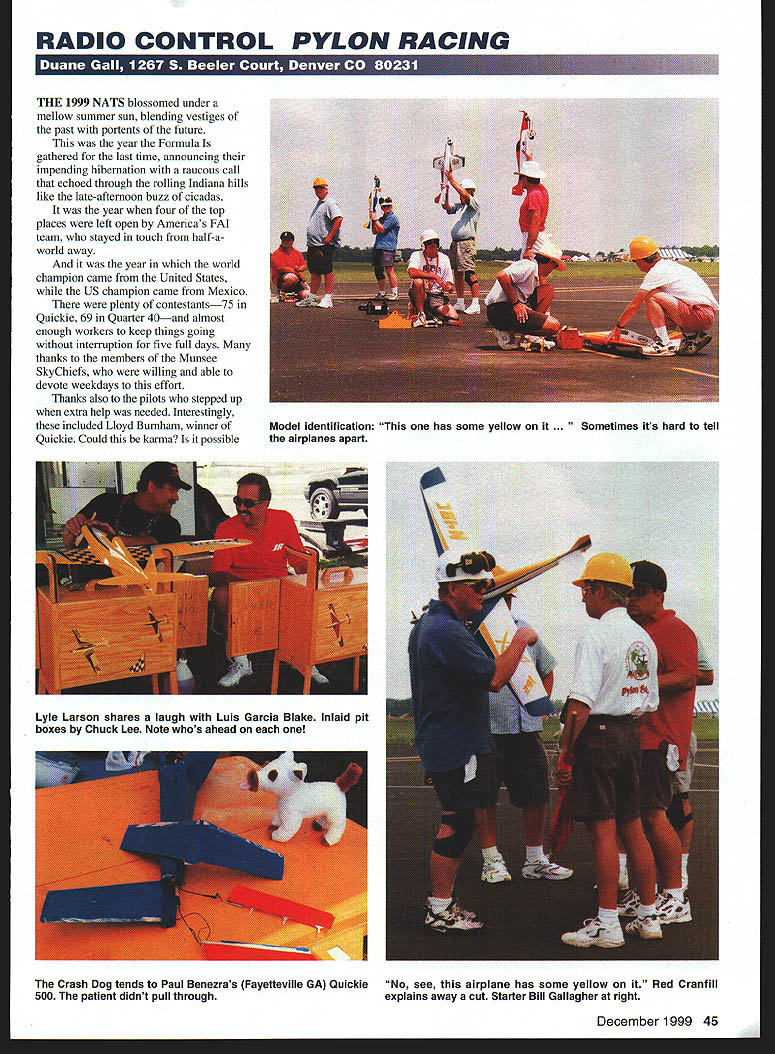
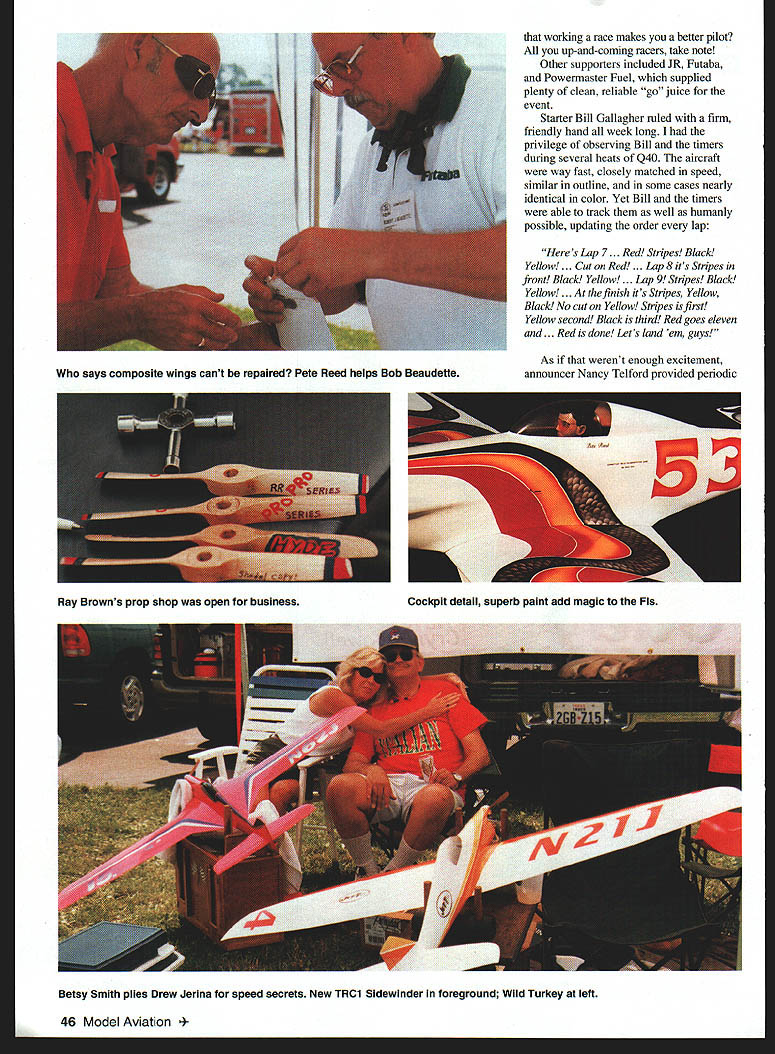
Starter Bill Gallagher ruled with a firm, friendly hand all week long. I had the privilege of observing Bill and the timers during several heats of Q40. The aircraft were way fast, closely matched in speed, similar in outline, and in some cases nearly identical in color. Yet Bill and the timers were able to track them as well as humanly possible, updating the order every lap:
"Here's Lap 7... Red! Stripes! Black! Yellow!... Cut on Red!... Lap 8 it's Stripes in front! Black! Yellow!... Lap 9! Stripes! Black! Yellow!... At the finish it's Stripes, Yellow, Black! No cut on Yellow! Stripes is first! Yellow second! Black is third! Red goes eleven and... Red is done! Let's land 'em, guys!"
As if that weren't enough excitement, announcer Nancy Telford provided periodic updates.
Muncie's summer heat and humidity precluded any records at the Nats. Marcus Blanchard's 1:04 in Q40 and Travis Flynn's 1:09 in Quickie set the pace—about three seconds away from the existing records. To those one tick behind, that was fast enough.
Thankfully absent from this year's Nats was any sort of controversy over rules. The pilots just brought their good stuff and got down to racing.
Quickie 500
Quickie has come into its own as the most popular and widespread pylon racing event, for experts at the Nats and for beginners at the local level. In the latter case, local rule variations limiting the cost and horsepower of the engines make the event more accessible to new pilots.
Airframes are pretty much the same: all very light, rugged, and easy to fly. That's not to say the airplanes are identical. Although designers have generally settled on the high-wing, V-tail configuration, there are a thousand subtle variations on this theme. All-molded designs such as the V-Max and Bird of Prey offer great performance. They provide precision prefabrication and glossy, perfectly straight flying surfaces right out of the box. Even the stabilizer has an accurate, carefully selected airfoil on these models. The price of such precision, of course, is cash.
On the other hand, conventional wood-and-foam-core construction allows more flexibility in selecting the airfoil du jour—these days usually a close relative of the Selig-Donovan 8052. The Quik-Vs and Rev-Lutions are known for up-to-the-minute upgrades in this department.
And then there are the Intimidators and Conspirators, relatively straightforward wood-and-foam designs that, in practiced hands, can still go fast enough to win. Lloyd Burnham won this Nats with an Intimidator, and he says that his backup model, a Quik-V Mark III, goes equally well.
So although there's no question that money and high-tech can be helpful, they are not essential as long as you are willing to put in an equivalent amount of time and practice.
As for the other half of the airspeed equation (i.e., horsepower), the engines of choice continue to be the Nelsons and Jetts. No secret there. The most-popular propeller is the APC 8.8 x 8.75, which a healthy engine will turn at about 19,000 rpm.
Put all this data together, stir vigorously, and you get two days of extremely close racing. The top 24 places had best times less than 1:20. Consistency made the difference, with cuts and mishaps winnowing out many of the "fast guys."
Results highlights:
- Winner: Lloyd Burnham (only pilot with a perfect score)
- Flyoffs:
- Second place: Tim Lime and Gary Freeman Jr.
- Fourth through seventh: Craig Gunkemeyer, Randy Ritch, Trey Farran, Lyle Larson
- Eighth through tenth: Joe Dodd, Ray Brown, Mark Parker
Quarter 40
What if you took Formula I, made the engines run as consistently as in Quickie, then made the airplanes a pound lighter? That's Q40. Intense competition and outrageous speeds are the hallmarks of this event.
All-molded airplanes may be helpful in Quickie, but they are virtually essential here. The flight loads imposed on a 56-inch wing (the longest span allowed by the rules; therefore, the only one ever used) require perfect construction out of the spar and top skin. Fortunately, the kitmakers seem to have it figured out; there was not a single folded wing this year.
The dominant designs remain the Miss Ashley II by Rusty Van Baren and the Dago Red by Lyle Larson. First place went to an Ashley and a fast time went to a Dago, so you can pretty much take your pick. However, new designs continue to challenge the status quo. Jerry Small's TRC1 Sidewinder and Lyle Larson's updated (56-inch-span) Napier-Heston racer showed great promise.
Higher speeds demand an adjustment in flying styles. The traditional "bank-and-yank" technique is all but gone from Q40. These airplanes bank once immediately after takeoff, and after that it's just yank, yank, yank. The flight path is basically a knife-edge circle, punctuated by pulses of up-elevator timed to coincide with the pylons. Tiny adjustments in the bank angle before each turn control the altitude.
Corrections toward the outside of the circle are made using down-elevator. This is hard for some of us to get used to. Nevertheless, humans are a very adaptable species. And racing pilots are very goal-oriented as well.
Demonstrating both of these qualities in spades was the eventual winner, Jaime de la Vega. After a disappointing showing at the first JR Gold Cup contest in February, Jaime decided to pull out all the stops. With the help of a dedicated core group at Club Pegaso in Mexico City, Jaime reportedly put in two practice sessions a week for four months.
The improvement was obvious. Every time Jaime went out to race, the comments in the pits were about how solid and precise his flying was. He and the other Club Pegaso contestants were well-liked to begin with—they are among the nicest guys you'll ever meet—so when Jaime emerged as the high point leader in the 7th and final round, a spontaneous cheer went up. It was a well-earned, long-awaited victory.
Not that there weren't others who worked equally hard and came almost as far. The top finishers included:
- Jaime de la Vega (winner)
- Dan Kane Jr.
- Travis Flynn
- Trey Farran
- Craig Gunkemeyer
- Bob Miller
- Lloyd Burnham
- Mike Helsel
- Bill Johanson
- Santiago ("Chago") Panzardi
Flyoffs determined second, third, fifth through eighth, and ninth through eleventh places. Mike Tallman was "on the bubble," ending up in 11th after a tough battle with Chago and Johanson that went right down to the checkered flag.
Formula I
Finally it was time for the grand lions of F1 to roar their last. Past champion and Contest Board member Mike Helsel organized a Last Blast commemoration with donations from a veritable Who's Who of the most prestigious, longest-loved RC racing event in history.
The end of F1 did not result from any rule change or other official action; it was simply the passage of time and changes in the world around it that made the event more and more of an anachronism. One could cite contributing factors—the number of those open-stack .40s, the expense of high nitro, the "fiddle factor" of dealing with rear intakes and full cowls, the time and effort required for cockpit detail and mirror finishes—but it's impossible to say whether changing any one or more of those things would have saved it.
This contest brought out the best of the old and new. Gary Freeman Jr. campaigned an airplane built for Dave Shadel by the late, great Jim Shinohara. Pete Reed flew The Snake, a familiar single-seater from the East Coast during the '80s. And a figure from the first race report I ever drooled over during junior-high study hall, Irwin Funderburk, entered his '70s-era El Bandito.
The pictures will have to tell the rest of this story. As always, the Nats featured the best of the best, as well as another change of seasons. Put it on your calendar for 2000!
Transcribed from original scans by AI. Minor OCR errors may remain.

