
Radio Control: Pylon Racing
Dave Lane
BY THE TIME you read this month's column, you will be aware of the rule change in Quarter Midget that allows modified props. I am sure the dedicated pylon racer is in seventh heaven because of this rule change. For those of us who did not want to see this change, it is just one more headache that we have to endure if we want to race.
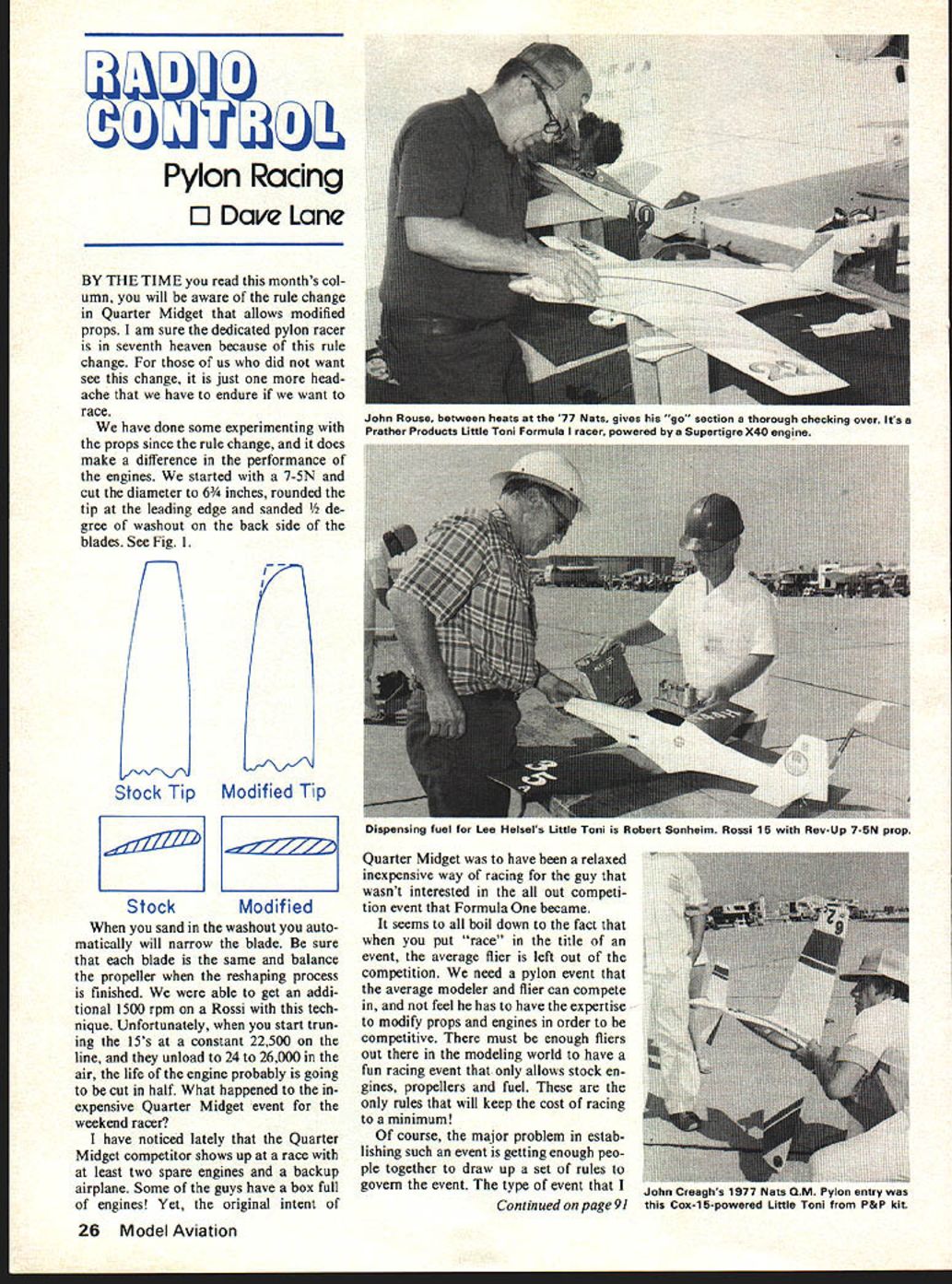
We have done some experimenting with the props since the rule change, and it does make a difference in the performance of the engines. We started with a 7-5N and cut the diameter to 6 3/4 inches, rounded the tip at the leading edge and sanded 1/2 degree of washout on the back side of the blades. See Fig. 1.
Stock Tip Modified Tip
Stock Modified
When you sand in the washout you automatically will narrow the blade. Be sure that each blade is the same and balance the propeller when the reshaping process is finished. We were able to get an additional 1500 rpm on a Rossi with this technique. Unfortunately, when you start turning the 15's at a constant 22,500 on the line, and they unload to 24 to 26,000 in the air, the life of the engine probably is going to be cut in half. What happened to the inexpensive Quarter Midget event for the weekend racer?
I have noticed lately that the Quarter Midget competitor shows up at a race with at least two spare engines and a backup airplane. Some of the guys have a box full of engines! Yet, the original intent of Quarter Midget was to have been a relaxed inexpensive way of racing for the guy that wasn't interested in the all out competition event that Formula One became.
It seems to all boil down to the fact that when you put "race" in the title of an event, the average flier is left out of the competition. We need a pylon event that the average modeler and flier can compete in, and not feel he has to have the expertise to modify props and engines in order to be competitive. There must be enough fliers out there in the modeling world to have a fun racing event that only allows stock engines, propellers and fuel. These are the only rules that will keep the cost of racing to a minimum!
Of course, the major problem in establishing such an event is getting enough people together to draw up a set of rules to govern the event. The type of event that I
Radio Control: Pylon Racing
had in mind would allow any airplane of 600 sq. in. wing area, and a minimum of five pounds in weight. The fuselage should have a canopy or cockpit and a pilot. The airplane should have at least three wheels, one of which is steerable for ground control. All three wheels would be fixed (no retracts).
There should be a minimum fuselage cross section measurement to eliminate super speed ships, similar to those that are appearing now in 1/2A racing.
I would leave the wing alone, except to require the center section to be one inch thick at the high point and a minimum 600 sq. in. total area, including that part which passes through the fuselage but not that part which constitutes a filet.
The airplane may be scale if the modeler so desires, but it is not mandatory. Safety would be a major factor, in that all models would have to pass a technical inspection to ensure proper radio, engine, and components. Component installations.
The engine would have to be a stock (out of the box) unit of any non-Schnuerle, front-rotor design of not more than .45 cubic inch. The propellers would be of a non-racing configuration, probably supplied by the hosting or sponsoring organization holding the contest. Fuel would also fall into this category.
As you can see, I am trying to promote an event that would be for the guy who would like to race, but not necessarily want to get so specialized that he can't fly the plane for fun or any other non-racing event he might like to compete in.
I picked the 600 sq. in. size only for the reason that this size of airplane is reasonably easy to transport to and from the flying field. The non-Schnuerle front-rotor engines are not so expensive as to be prohibitive in price, and with mild fuel and stock props, should last a season or more if you don't crash. That sure beats launching an engine every race or even every heat!
As I stated before, Jack Stafford Models is considering an 800 sq. in. Brown B-3! This would be for a .60 class of racing, similar to the Class C. B. Enterprises has started with the 800 sq. in. Formula One type of aircraft. The aircraft will be designed so that, if you want an AMA scale bird, you can put all of the detail on to your heart's content. The basic outline will be full scale. Jack will probably offer the kit in the same manner he offers the Quarter Midget; foam wing or build-up wing, whichever turns you on.
Kick around my suggestion on the above mentioned "fun type racing class" and let me know what you think of it. I am sure there are plenty of modelers and fliers out there that have some good ideas on this class of racing event.
Remember, we need an event that will bring new blood into the racing fraternity!
Dave Lane, 447 W. 136th St., Hawthorne, CA 90250.
Transcribed from original scans by AI. Minor OCR errors may remain.

