
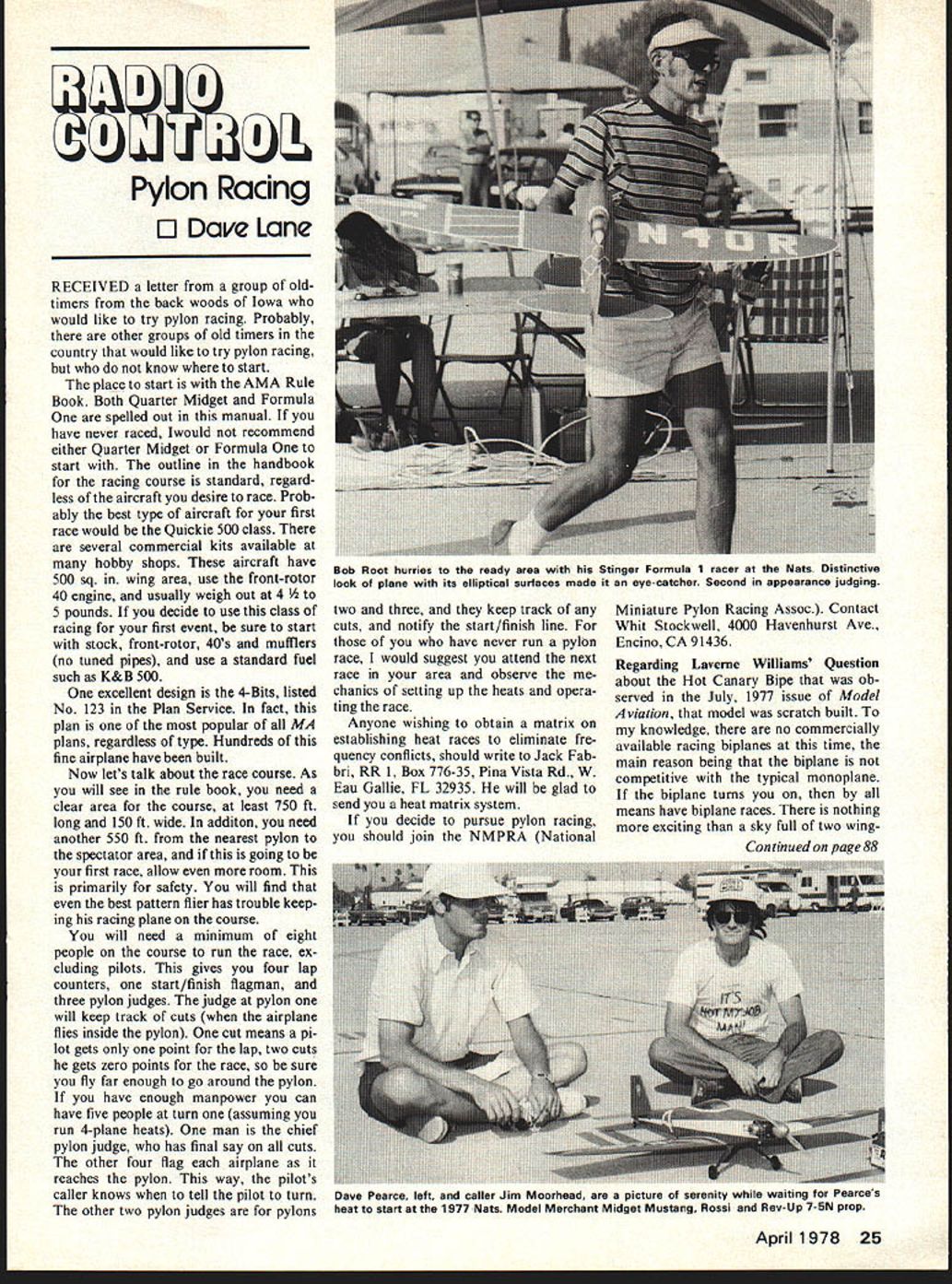
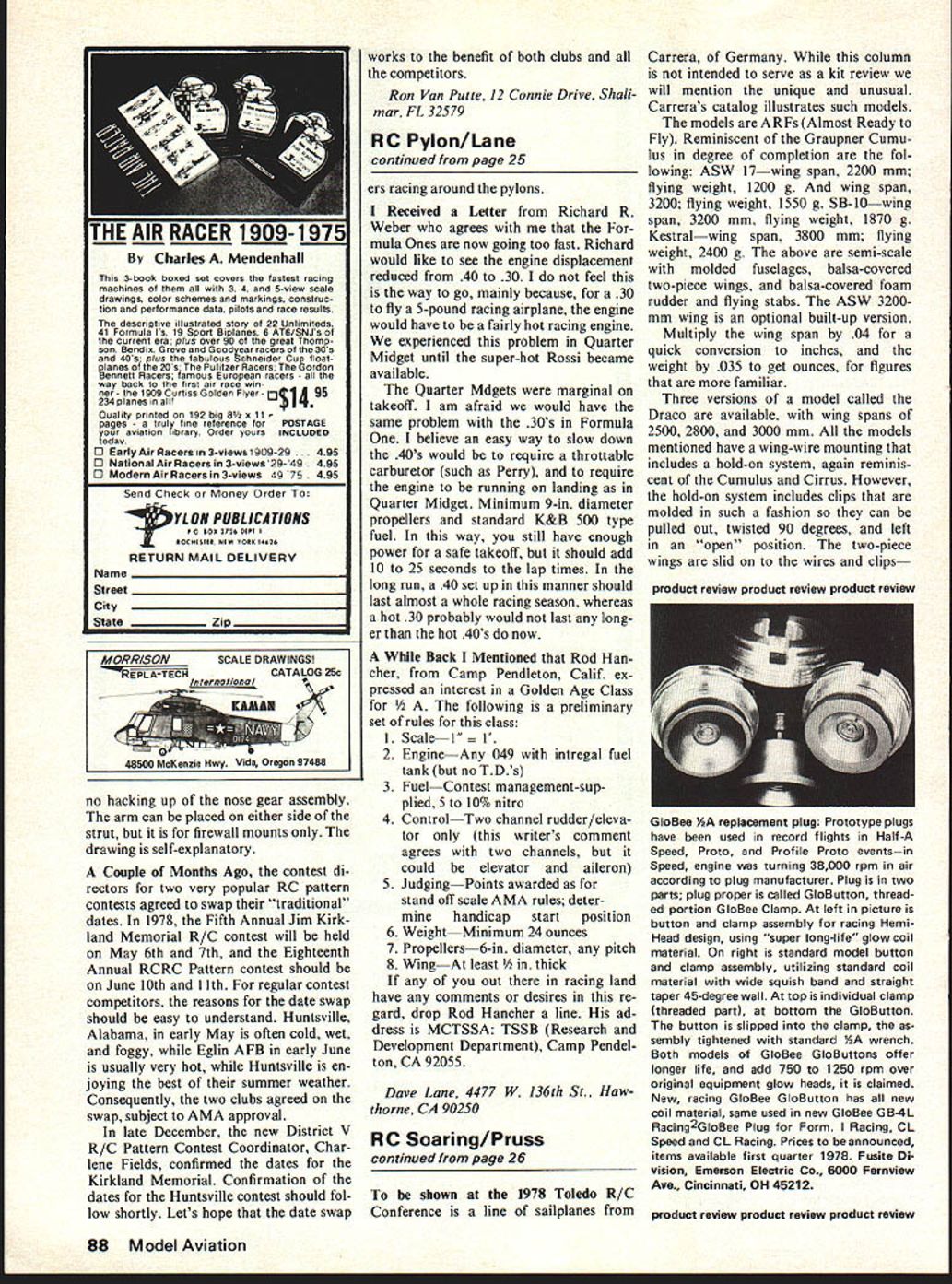
RADIO CONTROL: Pylon Racing
Dave Lane
RECEIVED a letter from a group of old-timers from the back woods of Iowa who would like to try pylon racing. Probably, there are other groups of old timers in the country that would like to try pylon racing, but who do not know where to start.
The place to start is with the AMA Rule Book. Both Quarter Midget and Formula One are spelled out in this manual. If you have never raced, I would not recommend either Quarter Midget or Formula One to start with. The outline in the handbook for the racing course is standard, regardless of the aircraft you desire to race. Probably the best type of aircraft for your first race would be the Quickie 500 class. There are several commercial kits available at many hobby shops. These aircraft have 500 sq. in. wing area, use the front-rotor .40 engine, and usually weigh out at 4 1/2 to 5 pounds. If you decide to use this class of racing for your first event, be sure to start with stock, front-rotor .40's and mufflers (no tuned pipes), and use a standard fuel such as K & B 500.
One excellent design is the 4-Bits, listed No. 123 in the Plan Service. In fact, this plan is one of the most popular of all AMA plans, regardless of type. Hundreds of this fine airplane have been built.
Now let's talk about the race course. As you will see in the rule book, you need a clear area for the course, at least 750 ft. long and 150 ft. wide. In addition, you need another 550 ft. from the nearest pylon to the spectator area, and if this is going to be your first race, allow even more room. This is primarily for safety. You will find that even the best pattern flier has trouble keeping his racing plane on the course.
You will need a minimum of eight people on the course to run the race, excluding pilots. This gives you four lap counters, one start/finish flagman, and three pylon judges. The judge at pylon one will keep track of cuts (when the airplane flies inside the pylon). One cut means a pilot gets only one point for the lap, two cuts he gets zero points for the race, so be sure you fly far enough to go around the pylon. If you have enough manpower you can have five people at a turn (assuming you run 4-plane heats). One man is the chief pylon judge, who has final say on all cuts. The other four flag each airplane as it reaches the pylon. This way, the pilot's caller knows when to tell the pilot to turn. The other two pylon judges are for pylons two and three, and they keep track of any cuts, and notify the start/finish line.
For those of you who have never run a pylon race, I would suggest you attend the next race in your area and observe the mechanics of setting up the heats and operating the race.
Anyone wishing to obtain a matrix on establishing heat races to eliminate frequency conflicts, should write to Jack Fabbri, RR 1, Box 776-35, Pina Vista Rd., W. Eau Gallie, FL 32935. He will be glad to send you a heat matrix system.
If you decide to pursue pylon racing, you should join the NMPRA (National Miniature Pylon Racing Assoc.). Contact Whit Stockwell, 4000 Havenhurst Ave., Encino, CA 91436.
Regarding Laverne Williams' Question about the Hot Canary Bipe that was observed in the July, 1977 issue of Model Aviation, that model was scratch built. To my knowledge, there are no commercially available racing biplanes at this time, the main reason being that the biplane is not competitive with the typical monoplane. If the biplane turns out, then by all means have biplane races. There is nothing more exciting than a sky full of two wing ers racing around the pylons.
I received a letter from Richard R. Weber who agrees with me that the Formula Ones are now going too fast. Richard would like to see the engine displacement reduced from .40 to .30. I do not feel this is the way to go, mainly because, for a .30 to fly a 5-pound racing airplane, the engine would have to be a fairly hot racing engine. We experienced this problem in Quarter Midget until the super-hot Rossi became available.
The Quarter Midgets were marginal on takeoff. I am afraid we would have the same problem with the .30's in Formula One. I believe an easy way to slow down the .40's would be to require a throttleable carburetor (such as Perry), and to require the engine to be running on landing as in Quarter Midget. Minimum 9-in. diameter propellers and standard K&B 500 type fuel. In this way, you still have enough power for a safe takeoff, but it should add 10 to 25 seconds to the lap times. In the long run, a .40 set up in this manner should last almost a whole racing season, whereas a hot .30 probably would not last any longer than the hot .40's do now.
A while back I mentioned that Rod Hancher, from Camp Pendleton, Calif., expressed an interest in a Golden Age Class for 1/2 A. The following is a preliminary set of rules for this class:
- Scale—1" = 1'
- Engine—Any .049 with integral fuel tank (but no T.D.'s)
- Fuel—Contest management-supplied, 5 to 10% nitro
- Control—Two channel rudder/elevator only (this writer's comment agrees with two channels, but it could be elevator and aileron)
- Judging—Points awarded as for stand-off scale AMA rules; determine handicap start position
- Weight—Minimum 24 ounces
- Propellers—6-in. diameter, any pitch
- Wing—At least 1/2 in. thick
If any of you out there in racing land have any comments or desires in this regard, drop Rod Hancher a line. His address is MCTSSA: TSSB (Research and Development Department), Camp Pendleton, CA 92055.
Dave Lane, 4477 W. 136th St., Hawthorne, CA 90250
Transcribed from original scans by AI. Minor OCR errors may remain.

