
Radio Control: Pylon Racing
Dave Lane
A COUPLE of months back I mentioned that Bob Violett said that even he was hard pressed to keep up with the Formula One aircraft. It seems that my source of information was in error. In a letter to me Bob Violett stated that he does not think Formula One aircraft are going too fast, and that he is looking forward to turning a one-minute time this year. He also stated that his engine was turning 21,500 rpm on the line, and not 24,500 as written.
Bob declared that, if the rules were changed to lower the nitro content in the fuel, he would quit racing. He is a dedicated "go-fast" flier and does not want Formula One slowed down!
Bob Wilde, of Rancho Hobbies, in West Los Angeles, is spearheading an effort to organize pylon workers. Bob's idea is to create an association for pylon workers similar to the USPJA. This association would be affiliated with NMPRA and would provide trained personnel to work on the race course. These people would be dedicated to the task of providing accurate lap counting, timing, and pylon judging, similar to the system used by the full-scale racing fraternity.
Wilde feels it is time that the people who work at the pylon races receive some recognition for their effort. It is hoped that this concept could be incorporated throughout the country. Each NMPRA district would have its own chapter of pylon workers to support the races run in its district. If you have thoughts on this subject, contact Bob Wilde, 10570 West Pico Boulevard, West Los Angeles, CA 90064.
A point of interest for you full-scale racing buffs. Paul White is rebuilding No. 16 "Shoestring" for this racing season and is building a sister ship that will be called "Snowshoe." Bill Bennett of Circus Circus Hotel and Casino in Las Vegas is providing the sponsorship money. Paul says they are shooting for 280 mph to 300 mph this season. As soon as the new planes are ready, I will present pictures for you Shoestring fans.
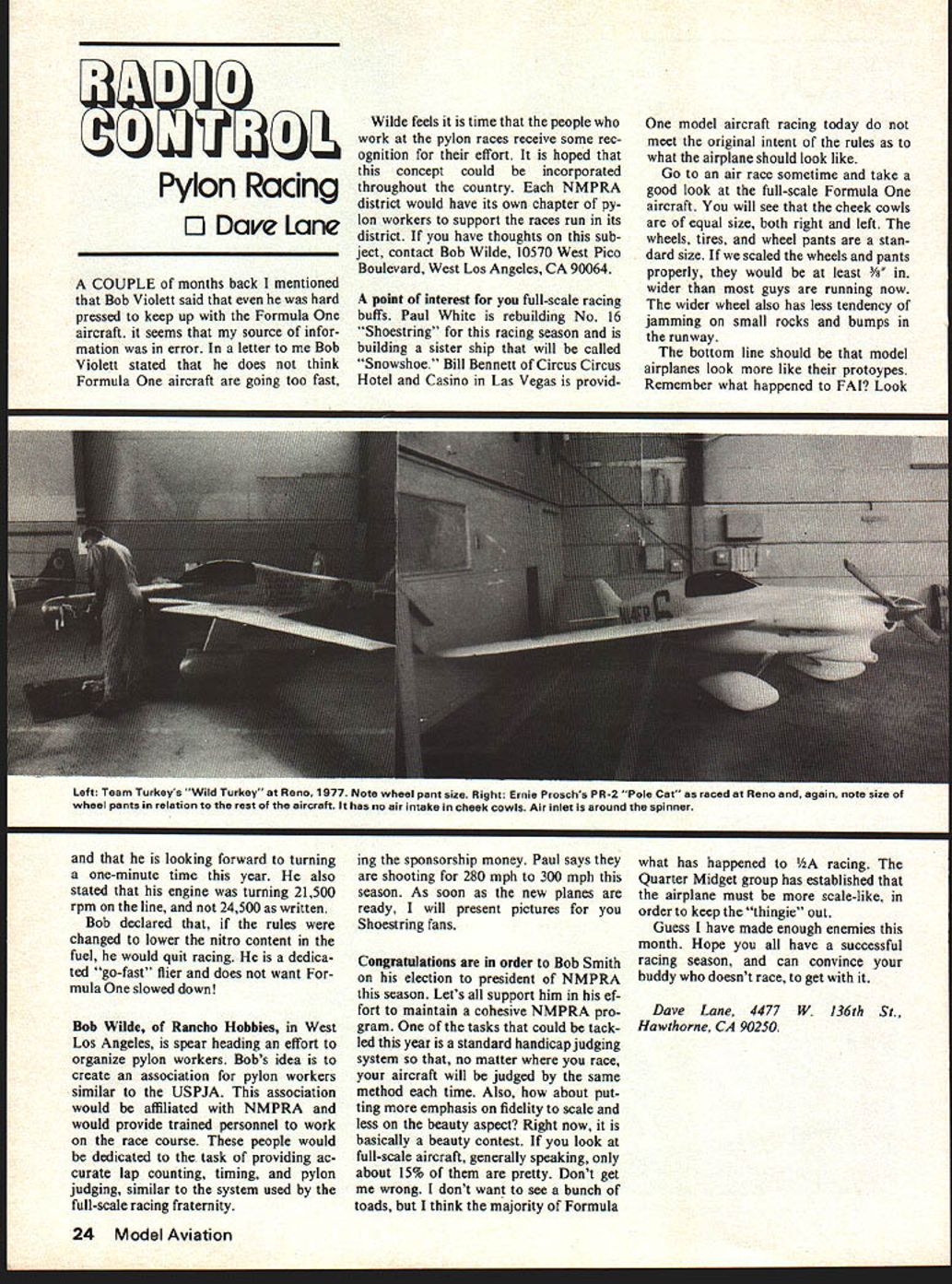
One model aircraft racing today do not meet the original intent of the rules as to what the airplane should look like. Go to an air race sometime and take a good look at the full-scale Formula One aircraft. You will see that the cheek cowls are of equal size, both right and left. The wheels, tires, and wheel pants are a standard size. If we scaled the wheels and pants properly, they would be at least 3/8 in. wider than most guys are running now. The wider wheel also has less tendency of jamming on small rocks and bumps in the runway. The bottom line should be that model airplanes look more like their prototypes. Remember what happened to FAI? Look what has happened to ½A racing. The Quarter Midget group has established that the airplane must be more scale-like, in order to keep the "thingie" out.
Congratulations are in order to Bob Smith on his election to president of NMPRA this season. Let's all support him in his effort to maintain a cohesive NMPRA program. One of the tasks that could be tackled this year is a standard handicap judging system so that, no matter where you race, your aircraft will be judged by the same method each time. Also, how about putting more emphasis on fidelity to scale and less on the beauty aspect? Right now, it is basically a beauty contest. If you look at full-scale aircraft, generally speaking, only about 15% of them are pretty. Don't get me wrong, I don't want to see a bunch of toads, but I think the majority of Formula racers should look like their prototypes.
Guess I have made enough enemies this month. Hope you all have a successful racing season, and can convince your buddy who doesn't race, to get with it.
Dave Lane, 4477 W. 136th St., Hawthorne, CA 90250.
Transcribed from original scans by AI. Minor OCR errors may remain.

