
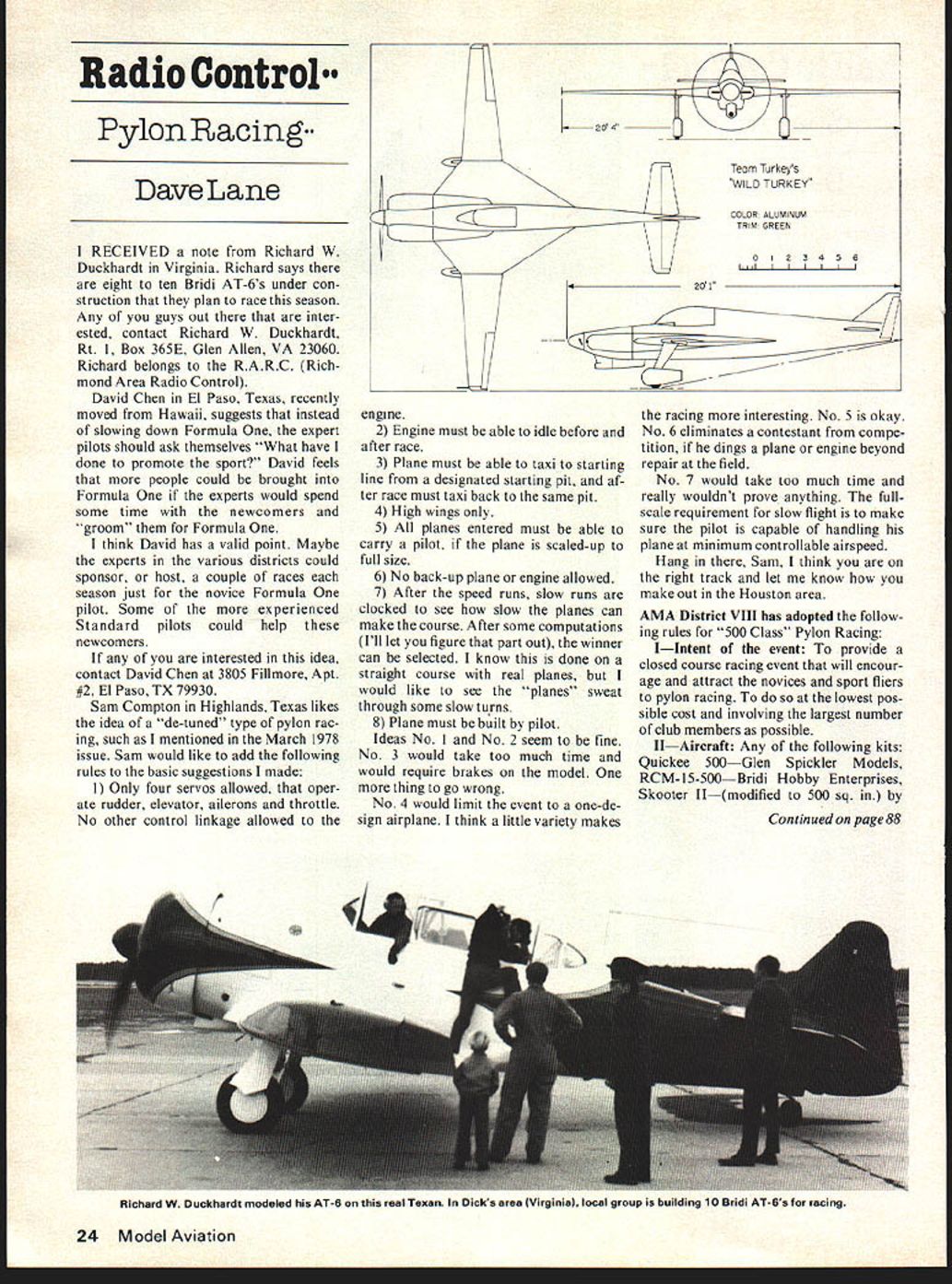
Radio Control..
Pylon Racing..
Dave Lane
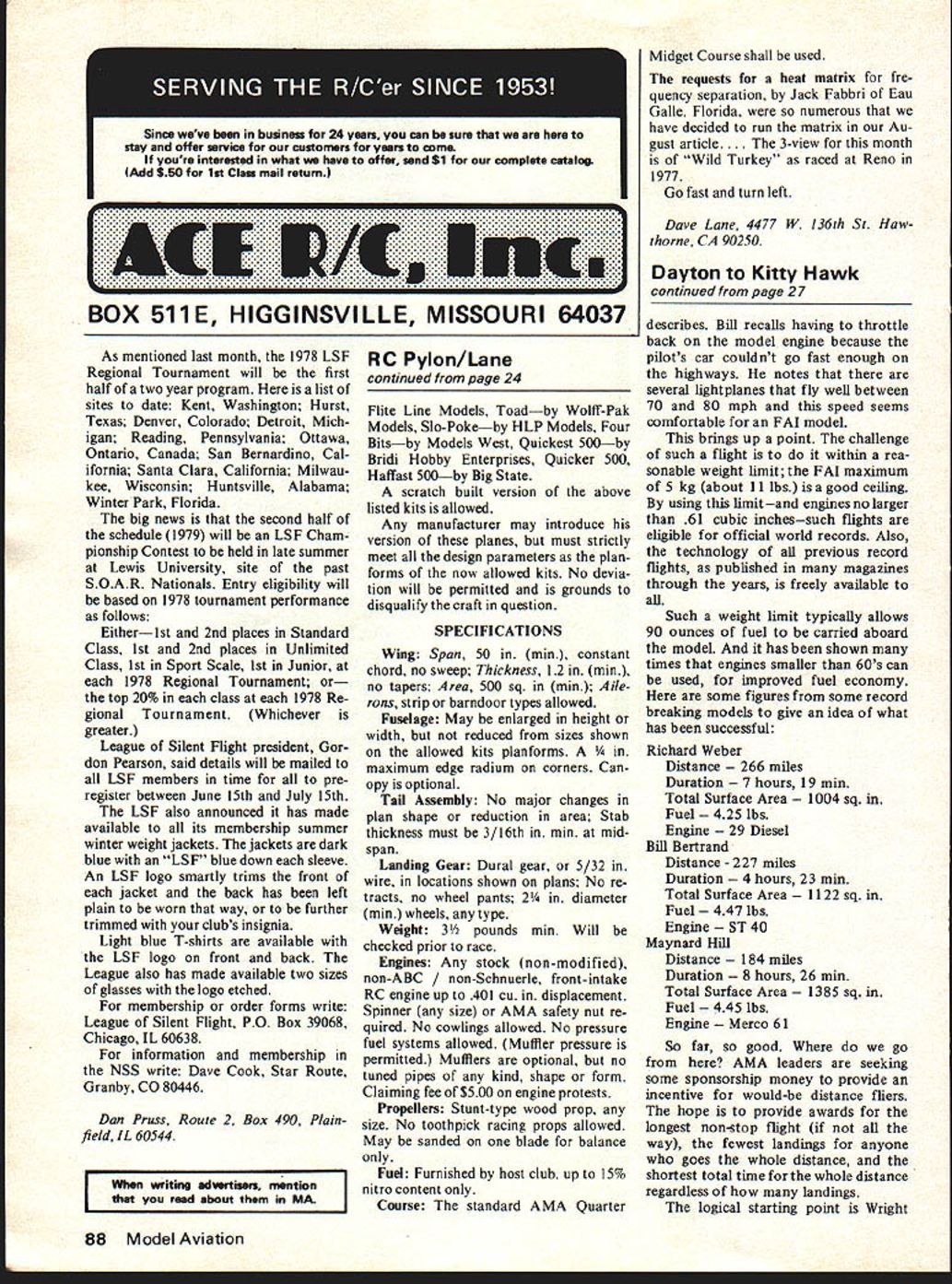
I RECEIVED a note from Richard W. Duckhardt in Virginia. Richard says there are eight to ten Bridi AT-6's under construction that they plan to race this season. Any of you guys out there that are interested, contact Richard W. Duckhardt, Rt. 1, Box 365E, Glen Allen, VA 23060. Richard belongs to the R.A.R.C. (Richmond Area Radio Control).
David Chen in El Paso, Texas, recently moved from Hawaii, suggests that instead of slowing down Formula One, the expert pilots should ask themselves "What have I done to promote the sport?" David feels that more people could be brought into Formula One if the experts would spend some time with the newcomers and "groom" them for Formula One.
I think David has a valid point. Maybe the experts in the various districts could sponsor, or host, a couple of races each season just for the novice Formula One pilot. Some of the more experienced Standard pilots could help these newcomers.
If any of you are interested in this idea, contact David Chen at 3805 Fillmore, Apt. #2, El Paso, TX 79930.
Sam Compton in Highlands, Texas likes the idea of a "de-tuned" type of pylon racing, such as I mentioned in the March 1978 issue. Sam would like to add the following rules to the basic suggestions I made:
- Only four servos allowed, that operate rudder, elevator, ailerons and throttle. No other control linkage allowed to the engine.
- Engine must be able to idle before and after race.
- Plane must be able to taxi to starting line from a designated starting pit, and after race must taxi back to the same pit.
- High wings only.
- All planes entered must be able to carry a pilot, if the plane is scaled-up to full size.
- No back-up plane or engine allowed.
- After the speed runs, slow runs are clocked to see how slow the planes can make the course. After some computations (I'll let you figure that part out), the winner can be selected. I know this is done on a straight course with real planes, but I would like to see the "planes" sweat through some slow turns.
- Plane must be built by pilot.
Ideas No. 1 and No. 2 seem to be fine. No. 3 would take too much time and would require brakes on the model. One more thing to go wrong. No. 4 would limit the event to a one-design airplane. I think a little variety makes the racing more interesting. No. 5 is okay. No. 6 eliminates a contestant from competition if he dings a plane or engine beyond repair at the field. No. 7 would take too much time and really wouldn't prove anything. The full-scale requirement for slow flight is to make sure the pilot is capable of handling his plane at minimum controllable airspeed.
Hang in there, Sam, I think you are on the right track and let me know how you make out in the Houston area.
AMA District VIII has adopted the following rules for "500 Class" Pylon Racing:
I—Intent of the event: To provide a closed course racing event that will encourage and attract the novices and sport fliers to pylon racing. To do so at the lowest possible cost and involving the largest number of club members as possible.
II—Aircraft: Any of the following kits: Quickee 500—Glen Spickler Models; RCM-15-500—Bridi Hobby Enterprises; Skooter II—(modified to 500 sq. in.)
Radio Control: Pylon Racing
Flite Line Models, Toad—by Wolff-Pak Models, Slo-Poke—by HLP Models, Four Bits—by Models West, Quickee 500—by Bridi Hobby Enterprises, Quicker 500, Halfast 500—by Big State.
A scratch built version of the above listed kits is allowed.
Any manufacturer may introduce his version of these planes, but must strictly meet all the design parameters as the planforms of the now allowed kits. No deviation will be permitted and is grounds to disqualify the craft in question.
SPECIFICATIONS
- Wing: Span, 50 in. (min.), constant chord, no sweep; Thickness, 1.2 in. (min.), no tapers; Area, 500 sq. in. (min.); Ailerons, strip or barndoor types allowed.
- Fuselage: May be enlarged in height or width, but not reduced from sizes shown on the allowed kits planforms. A 1/4 in. maximum edge radius on corners. Canopy is optional.
- Tail Assembly: No major changes in plan shape or reduction in area; Stab thickness must be 3/16th in. min. at mid-span.
- Landing Gear: Dural gear, or 5/32 in. wire, in locations shown on plans; No retracts, no wheel pants; 2 1/4 in. diameter (min.) wheels, any type.
- Weight: 3 1/2 pounds min. Will be checked prior to race.
- Engines: Any stock (non-modified), non-ABC / non-Schnuerle, front-intake RC engine up to .401 cu. in. displacement. Spinner (any size) or AMA safety nut required. No cowlings allowed. No pressure fuel systems allowed. (Muffler pressure is permitted.) Mufflers are optional, but no tuned pipes of any kind, shape or form. Claiming fee of $5.00 on engine protests.
- Propellers: Stunt-type wood prop, any size. No toothpick racing props allowed. May be sanded on one blade for balance only.
- Fuel: Furnished by host club, up to 15% nitro content only.
- Course: The standard AMA Quarter Midget Course shall be used.
Transcribed from original scans by AI. Minor OCR errors may remain.

