
Radio Control: Pylon Racing
Dave Lane
I HAVE received several inquiries on how to establish the heat matrix for a pylon race. The following information was prepared by Jack Fabbri, and should answer most of your questions. I assume that you will use 4-plane heats, but you will find that the system works for 3, 5, 6, or whatever, as long as you can spread the radio frequencies.
Without knowledge of the predominant frequency loading in your area, I'll set up a hypothetical mix based on my past experience (which says that most people fly on 72.08, 72.24, 72.40 and 72.96). I once had, from 121 entries, 27 entries on 72.24, and 22 on 72.40, at Bakersfield, California. To mess it up even more, 40 odd contestants had back-up airplanes on different frequencies than were their primary airplanes. I just put that in to give a feel of what can be handled and I promise not to confuse you with how we did it (until you call and ask, of course).
Okay, let's lay out the frequencies of your entrants.
- First, list each contestant by his frequency, not his alphabetical order or his chronological time of arrival. You pre-prepare a frequency list and write them down as they sign up (Fig. 1). Note: The guys who fly on 50-54 MHZ are the saviors; you can usually put them in a pile and use them as wild cards. Let's assume 19 entries and fill out the form.
- Well, we have two guys on 72.08, three on 72.24, two on 72.32, three on 72.40, and two on 72.96. All the rest are onesies. Let's sort them into four groups with five in #1, five in #2, five in #3, and four in #4. (See Fig. II.) Note: All like frequencies must fall into the same group. As you see, you took the three's and the two's and put them into separate groups to start; the rest is easy. Be sure to document the frequencies.
OK, now check them. Are any frequencies in the one group, repeated in another? The answer should be "no." If not, fix it. Beyond this step, you have no more frequency worries unless some klutz switches a radio during the contest. To guard against this, you impound all transmitters and use a baseball bat as punishment.
If you feel that this Fig. II bit is a pain in the writing hand, please let me assure you, it is the most valuable document you will have during the event. First, you use it at the pre-race pilots' meeting—read it out loud and be sure you get an affirmative from each pilot. Later, if the mortality rate gets to you, Fig. II is a ready reference to determine how to juggle heats (move people around to fill in on airplane races).
- Now, assign contestant numbers starting with "1" in the *NO Column. Note: All groups must have the same amount of numbers (i.e., if there are five people in the largest group, all groups get five numbers, even the blanks). Notice that #20 is blank. Try to avoid using a system with groups of six (6 lines in the Matrix). The 6's will repeat in Columns 1 and 3 in
the third round, Columns 1 and 4 in the 4th round, alternately to the 8th round where everyone is a repeat. Try it out and see. Should you be forced into this situation, you can juggle numbers in Columns 3 and 4 but keep the Column 3's in Column 3, and Column 4's in Column 4. Or, you can just use the matrix on Fig. V-A for four rounds.
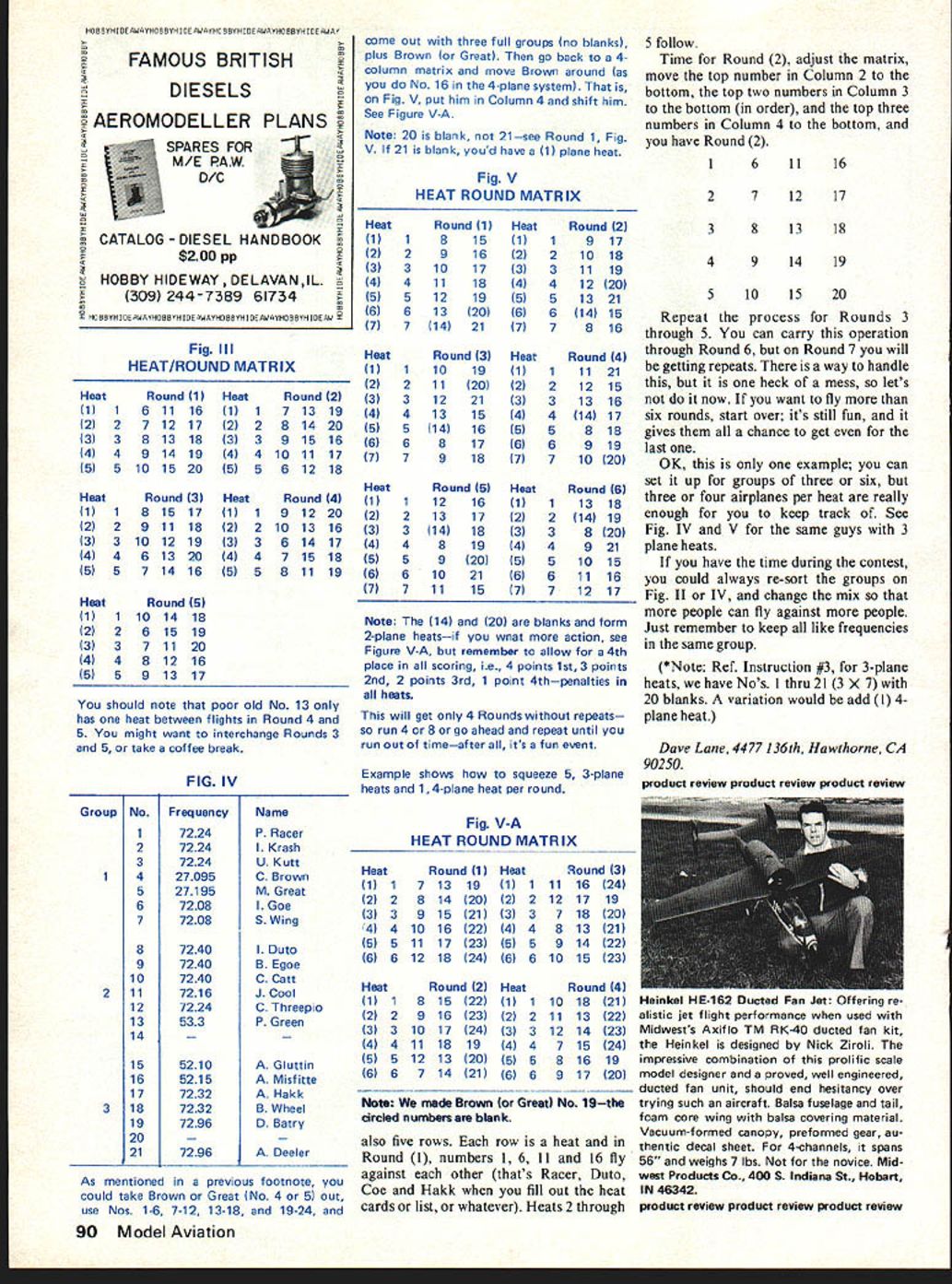
- The hard part is done, let's set up five rounds with five heats in each round. See Fig. III (we use the numbers, it's quicker and more straightforward than the names). Take note of Round 1. There are five heats (in parens) and four columns. There are four rounds.
You should note that poor old No. 13 only has one heat between flights in Round 4 and 5. You might want to interchange Rounds 3 and 5, or take a coffee break.
Fig. IV
Group No. Frequency Name 1 1 72.24 P. Racer 2 72.24 I. Krash 3 72.24 U. Kutt 4 27.095 C. Brown 5 27.195 M. Great 6 72.08 I. Goe 7 72.08 S. Wing 2 8 72.40 I. Duto 9 72.40 B. Egoe 10 72.16 C. Catt 11 72.24 J. Cool 12 53.3 C. Threepio 13 53.3 P. Green 3 14 52.10 A. Gluttin 15 52.15 A. Misfitte 16 72.32 A. Hakk 17 72.32 B. Wheel 18 72.96 D. Batry 19 72.96 A. Deeler
As mentioned in a previous footnote, you could take Brown or Great (No. 4 or 5) out, use Nos. 1-6, 7-12, 13-18, and 19-24 and come out with three full groups (no blanks), plus Brown (or Great). Then go back to a 4-column matrix and move Brown around (as you do No. 16 in the 4-plane system). That is, on Fig. V, put him in Column 4 and shift him. See Figure V-A.
Note: 20 is blank, not 21—see Round 1, Fig. V. If 21 is blank, you'd have a (1) plane heat.
Fig. V
HEAT ROUND MATRIX
Heat Round (1) Heat Round (2) (1) 1 8 15 (1) 1 9 17 (2) 2 9 16 (2) 2 10 18 (3) 3 10 17 (3) 3 11 19 (4) 4 11 18 (4) 4 12 20 (5) 5 12 19 (5) 5 13 21 (6) 6 13 20 (6) 6 14 22 (7) 7 14 21 (7) 7 15 23 (8) (14) (20) (8) (14) (20)
Note: The (14) and (20) are blanks and form 2-plane heats—if you want more action, see Figure V-A, but remember to allow for a 4th place in all scoring, i.e., 4 points 1st, 3 points 2nd, 2 points 3rd, 1 point 4th—penalties in all heats.
This will get only 4 Rounds without repeats—so run 4 or 8 or go ahead and repeat until you run out of time—after all, it's a fun event.
Example shows how to squeeze 5, 3-plane heats and 1, 4-plane heat per round.
Note: We made Brown (or Great) No. 19—the circled numbers are blank.
Also five rows. Each row is a heat and in Round (1), numbers 1, 6, 11 and 16 fly against each other (that's Racer, Duto, Catt and Hakk when you fill out the heat cards or list, or whatever). Heats 2 through 5 follow.
Time for Round (2), adjust the matrix, move the top number in Column 2 to the bottom, the top two numbers in Column 3 to the bottom (in order), and the top three numbers in Column 4 to the bottom, and you have Round (2).
1 6 11 16 2 7 12 17 3 8 13 18 4 9 14 19 5 10 15 20
Repeat the process for Rounds 3 through 5. You can carry this operation through Round 6, but on Round 7 you will be getting repeats. There is a way to handle this, but it is one heck of a mess, so let's not do it now. If you want to fly more than six rounds, start over; it's still fun, and it gives them all a chance to get even for the last one.
OK, this is only one example; you can set it up for groups of three or six, but three or four airplanes per heat are really enough for you to keep track of. See Fig. IV and V for the same guys with 3-plane heats.
If you have the time during the contest, you could always re-sort the groups on Fig. II or IV, and change the mix so that more people can fly against more people. Just remember to keep all like frequencies in the same group.
(*Note: Ref. Instruction #3, for 3-plane heats, we have Nos. 1 thru 21 (3 x 7) with 20 blanks. A variation would be add (1) 4-plane heat.)
Dave Lane, 4477 136th, Hawthorne, CA 90250.
Transcribed from original scans by AI. Minor OCR errors may remain.

