
Radio Control: Pylon Racing
Dave Lane
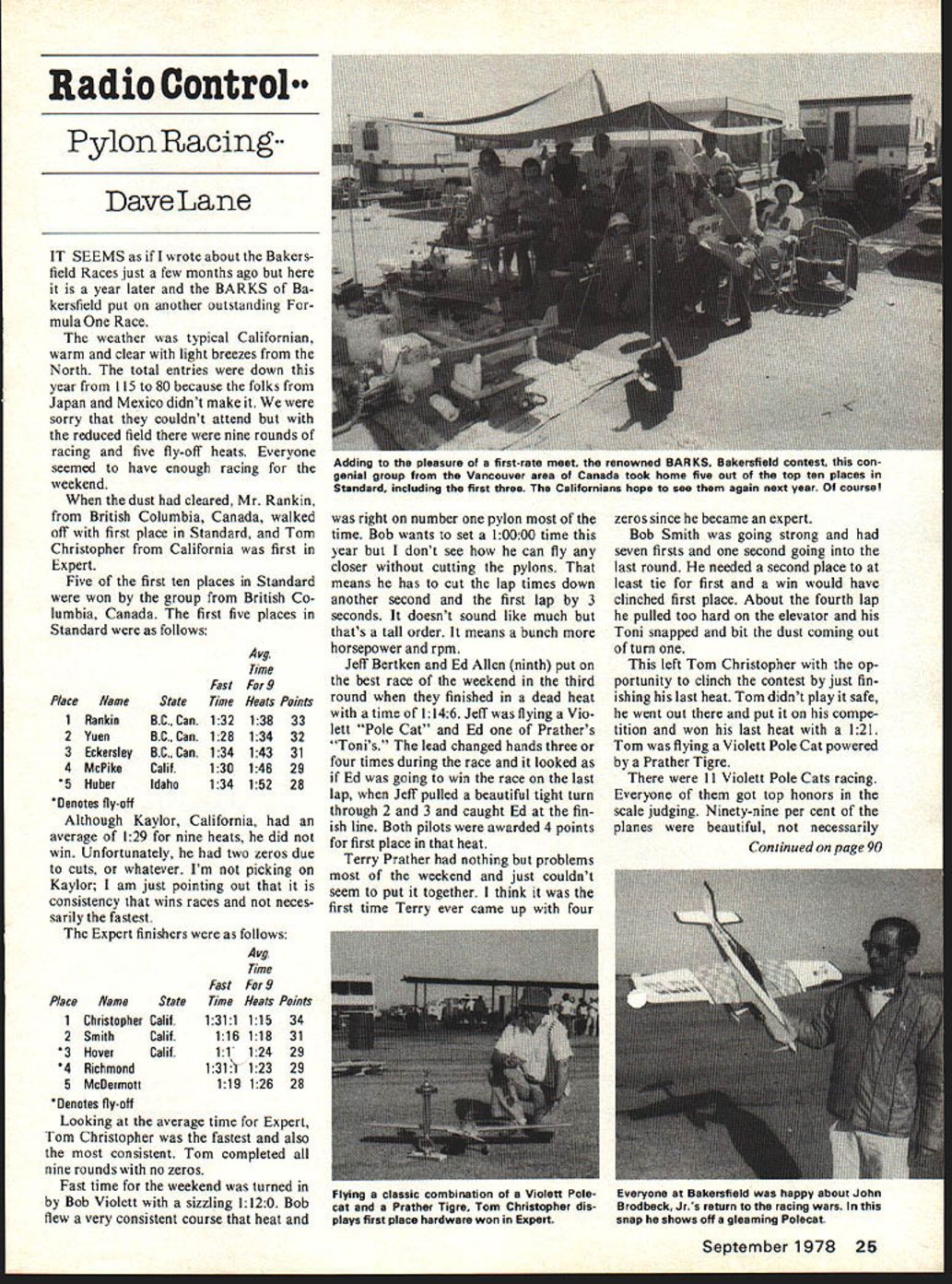
IT SEEMS as if I wrote about the Bakersfield Races just a few months ago but here it is a year later and the BARKS of Bakersfield put on another outstanding Formula One Race.
The weather was typical Californian, warm and clear with light breezes from the North. The total entries were down this year from 115 to 80 because the folks from Japan and Mexico didn't make it. We were sorry that they couldn't attend but with the reduced field there were nine rounds of racing and five fly-off heats. Everyone seemed to have enough racing for the weekend.
When the dust had cleared, Mr. Rankin, from British Columbia, Canada, walked off with first place in Standard, and Tom Christopher from California was first in Expert.
Five of the first ten places in Standard were won by the group from British Columbia, Canada. The first five places in Standard were as follows:
Place Name State Fast Time Avg. For 9 Heats Points
- 1 Rankin B.C., Can. 1:32 1:38 33
- 2 Yuen B.C., Can. 1:28 1:34 32
- 3 Eckersley B.C., Can. 1:34 1:43 31
- 4 McPike Calif. 1:30 1:46 29
- 5 Huber Idaho 1:34 1:52 28
* Denotes fly-off
Although Kaylor, California, had an average of 1:29 for nine heats, he did not win. Unfortunately, he had two zeros due to cuts, or whatever. I'm not picking on Kaylor; I am just pointing out that it is consistency that wins races and not necessarily the fastest.
The Expert finishers were as follows:
- 1 Christopher Calif. 1:31 1:15 34
- 2 Smith Calif. 1:16 1:18 31
- 3 Hover Calif. 1:17 1:24 29
- 4 Richmond 1:31 1:23 29
- 5 McDermott 1:19 1:26 28
* Denotes fly-off
Looking at the average time for Expert, Tom Christopher was the fastest and also the most consistent. Tom completed all nine rounds with no zeros.
Fast time for the weekend was turned in by Bob Violett with a sizzling 1:12.0. Bob flew a very consistent course that heat and was right on number one pylon most of the time. Bob wants to set a 1:00:00 time this year but I don't see how he can fly any closer without cutting the pylons. That means he has to cut the lap times down another second and the first lap by 3 seconds. It doesn't sound like much but that's a tall order. It means a bunch more horsepower and rpm.
Jeff Bertken and Ed Allen (ninth) put on the best race of the weekend in the third round when they finished in a dead heat with a time of 1:14.6. Jeff was flying a Violett "Pole Cat" and Ed one of Prather's "Toni's." The lead changed hands three or four times during the race and it looked as if Ed was going to win the race on the last lap, when Jeff pulled a beautiful tight turn through 2 and 3 and caught Ed at the finish line. Both pilots were awarded 4 points for first place in that heat.
Terry Prather had nothing but problems most of the weekend and just couldn't seem to put it together. I think it was the first time Terry ever came up with four zeros since he became an expert.
Bob Smith was going strong and had seven firsts and one second going into the last round. He needed a second place to at least tie for first and a win would have clinched first place. About the fourth lap he pulled too hard on the elevator and his Toni snapped and bit the dust coming out of turn one.
This left Tom Christopher with the opportunity to clinch the contest by just finishing his last heat. Tom didn't play it safe; he went out there and put it on his competition and won his last heat with a 1:21. Tom was flying a Violett Pole Cat powered by a Prather Tigre.
There were 11 Violett Pole Cats racing. Everyone of them got top honors in the scale judging. Ninety-nine per cent of the planes were beautiful, not necessarily scale, but beautiful. It still is a beauty contest when it comes to judging. The prettiest planes were given the lowest handicap. Don't get me wrong, I think workmanship should be rewarded, but I also believe the planes should look more like the prototype!
Gary McPike, Sec.-Treas. of NMPRA, has a new address and anyone wishing to contact Gary may do so at the following address: NMPRA, Gary McPike, Sec., 22247 Ybarra Road, Woodland Hills, CA 91367.
Ed Allen has some interesting comments about Formula One.
"It seems that every time I read an article on Pylon racing," Ed writes, "someone is always crying about Formula I going too fast or costing too much! The expense is high, but most contestants are willing to pay because it is a first-class racing event. For those individuals who are not willing to pay the price, or are not able to fly well enough, there certainly are many other racing events for airplanes that an individual can choose from, as indicated in your articles.
"I also wonder why I never read an article that is 100 percent in favor of Formula I and covers such items as tips for flying better, cutting costs, and just plain going fast? It also appears to me that the people doing the complaining never fly Formula I on a regular basis.
"If interest is low in Formula I, let us try to get the right information to the people that will help them gain more interest in Formula I for what it is and not in other racing events; after all, isn't that what 'Pylon' is about, pros and cons?
"You state that only the pros reap the benefits of Formula I. This is not true. The people who win are the ones with the interest and ability to do so.
"As you know," Ed continues, "in order to win in either class (Standard or Expert), you have to have it 'altogether' at one time to win; however, not always in the order of going fast, flying well, and six Prather engines. It certainly helps, but first place can be won by being consistent. An example: I won the first contest this year and came to that race not totally prepared. I had only three props, 3/4 gallon of fuel (one questionable crashed engine), and I had to borrow more glow plugs when I arrived. Not only that, I never went faster than 1:20—not too impressive for an 8-year expert! To say the least, I just lucked out and had the interest.
"What I am trying to point out is that your column should encourage Formula I. The opportunity to win is there for the interested pilot. I believe there are categories that a Formula I pilot should consider before he takes up Formula I, or before he gives it up. These points are all important and should be given considerable thought:
1) All the necessary first-class equipment is available to each and every person interested in Formula I to break the world's record.
2) A person must evaluate how well he can fly and what class, as well as his building ability.
3) After considering the above two points, he will be able to evaluate how much he is willing to, or should, spend on the necessary equipment.
4) How much interest does he really have to seek those so-called speed secrets as a competitive racer?
"I believe if a person thinks about these points, he will have found not only two classes of Formula I, but just about as many classes as an individual could possibly desire, depending on his abilities and interest.
"Formula I exists because the people who fly this event like to build model airplanes as a hobby. A model builder should choose areas of interest, then decide how advanced he wants or can be. If he can decide his abilities and interest, he will find his 'home' somewhere between the last place and first place, in either Standard or Expert.
"I would like to see more articles on building techniques, trimming/balancing tips, and cost-cutting ideas. These items would encourage Formula I. I strongly believe that stated in a positive way will be more encouraging than 'slow me down, run lower nitro, or add lead.' Another way of encouraging Formula I is to institute a program tried on the West Coast—this was the Rookie Races. The object was solely to encourage interest by guiding, directing, and teaching beginners and Standard-class pilots. The 'pros' or experts do not race but help by suggesting improvements to the aircraft, equipment, and would even test-fly the airplane to check the trim.
"I certainly hope that the points I have brought up, namely, encouragement through evaluation of interests and abilities, will make model people 'see the light' and do all we can to keep Formula I the best racing event ever."
Any comments from you racers out there? Ed has some valid points. I especially want to hear from you racers out there. I examined the supplied scanned page carefully. This page does not contain any part of the article titled "Radio Control: Pylon Racing" by Dave Lane. The visible material on the page is an advertisement and continuations of other items (RC Helicopters / Chesney and Typhoon / Schaaf), not the Pylon Racing article.
Because the page contains no text from the requested PRIMARY ARTICLE, there is nothing for me to extract or correct from this scan. If you intended to supply page 3 of 3 of that article, please provide the correct scanned image (or pages 1 and 2) that actually contain the "Radio Control: Pylon Racing" text, and I will extract and correct it. If you prefer, you can also upload a higher-resolution crop showing any portion of the Pylon Racing article on this page and I’ll re-check.
Transcribed from original scans by AI. Minor OCR errors may remain.

