
Radio Control - Pylon Racing
Dave Lane
While looking through some newsletters this month, I ran across an interesting item in the Seattle Radio Aero Club's monthly on 1/2A racing. Apparently 1/2A racing in the Seattle area has diminished in popularity and the following is the solution the SRAC came up with.
SRAC 1/2A Racing (Ace Pacer) rules and format
- The plane for 1/2A racing will be the Ace Pacer only, with either the foam wing that comes with the kit or a built-up wing for those who are already building from plans. No other changes to the plane structure will be allowed.
- A stock, commercially muffled engine of up to, and including, an .051 may be used. The original high-compression head put out by Cox is acceptable for those who want to use 10% fuel. Heads modified to accept a regular short-reach glow plug are OK.
- Throttles are OK.
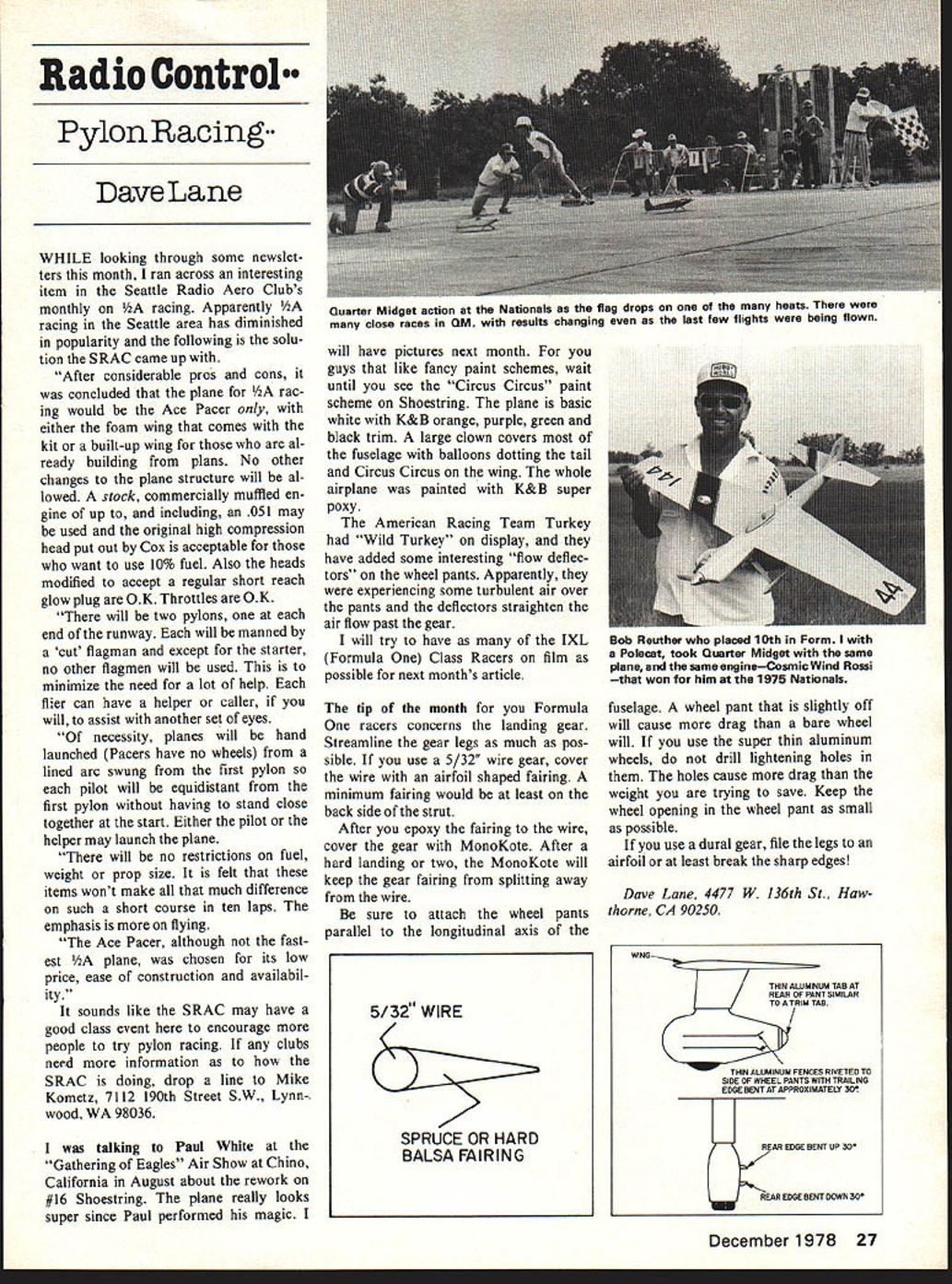
- There will be two pylons, one at each end of the runway. Each will be manned by a "cut" flagman. Except for the starter, no other flagmen will be used to minimize the need for a lot of help. Each flier may have a helper or caller to assist with another set of eyes.
- Planes will be hand launched (Pacers have no wheels) from a lined arc swung from the first pylon so each pilot will be equidistant from the first pylon without having to stand close together at the start. Either the pilot or the helper may launch the plane.
- There will be no restrictions on fuel, weight, or prop size. It is felt these items won't make much difference on such a short course in ten laps. The emphasis is more on flying.
- The Ace Pacer, although not the fastest 1/2A plane, was chosen for its low price, ease of construction, and availability.
If any clubs need more information on how the SRAC is doing, drop a line to:
- Mike Kometz
- 7112 190th Street S.W.
- Lynnwood, WA 98036
I was talking to Paul White at the "Gathering of Eagles" air show at Chino, California, in August about the rework on #16 Shoestring. The plane really looks super since Paul performed his magic. I will have pictures next month. For those who like fancy paint schemes, wait until you see the "Circus Circus" scheme on Shoestring. The plane is basic white with K&B orange, purple, green, and black trim. A large clown covers most of the fuselage with balloons dotting the tail and "Circus Circus" on the wing. The whole airplane was painted with K&B super epoxy.
The American Racing Team "Turkey" had "Wild Turkey" on display, and they have added some interesting "flow deflectors" on the wheel pants. Apparently they were experiencing turbulent air over the pants and the deflectors straighten the airflow past the gear.
I will try to have as many of the IXL (Formula One) class racers on film as possible for next month's article.
Tip of the month — Formula One landing gear
- Streamline the gear legs as much as possible.
- If you use a 5/32" wire gear, cover the wire with an airfoil-shaped fairing. A minimum fairing would be at least on the back side of the strut.
- After you epoxy the fairing to the wire, cover the gear with MonoKote. After a hard landing or two, the MonoKote will keep the gear fairing from splitting away from the wire.
- Be sure to attach the wheel pants parallel to the longitudinal axis of the fuselage. A wheel pant that is slightly off will cause more drag than a bare wheel.
- If you use super-thin aluminum wheels, do not drill lightening holes in them. The holes cause more drag than the weight you are trying to save. Keep the wheel opening in the wheel pant as small as possible.
- If you use a dural gear, file the legs to an airfoil or at least break the sharp edges.
Dave Lane 4477 W. 136th St. Hawthorne, CA 90250
Transcribed from original scans by AI. Minor OCR errors may remain.

