
Radio Control: Pylon Racing
Dave Lane
I was fortunate enough to attend the Reno Air Races this year as Pylon Captain on #3 pylon of the IXL and AT-6 race course. This is the three-mile course, using six pylons plus the home pylon at the start/finish line. It is very similar to judging an RC pylon race as far as keeping track of the cuts, the major difference being the number of people required on the pylons at a full-scale air race.
Pylon crew and duties
At a full-scale race there are several people working each pylon:
- Pylon Captain
- At least two Pylon Judges
- Pylon Spotter
The captain verifies any cuts and must submit a written description of the cut. This description includes how many feet inside the pylon, whether the pilot was forced to cut because of traffic, or whether the pilot was simply flying too close. One of the judges records on a race form each aircraft on each lap by race number, whether that aircraft was OK or cut the pylon. The other judge and the spotter confirm that the aircraft did indeed complete the lap around that pylon. Sometimes the pilots lose track of the number of laps completed and pull out of the race before they have completed the required number of laps. As you can imagine, it can get quite hectic and exciting during a race with six or seven AT-6s all coming at your pylon at the same time!
Unfortunately, this year at Reno we had a mid-air collision between two AT-6s which resulted in the deaths of two race pilots. Don DeWalt and Dimitri Prian were both from Southern California.
Highlights from the IXL class
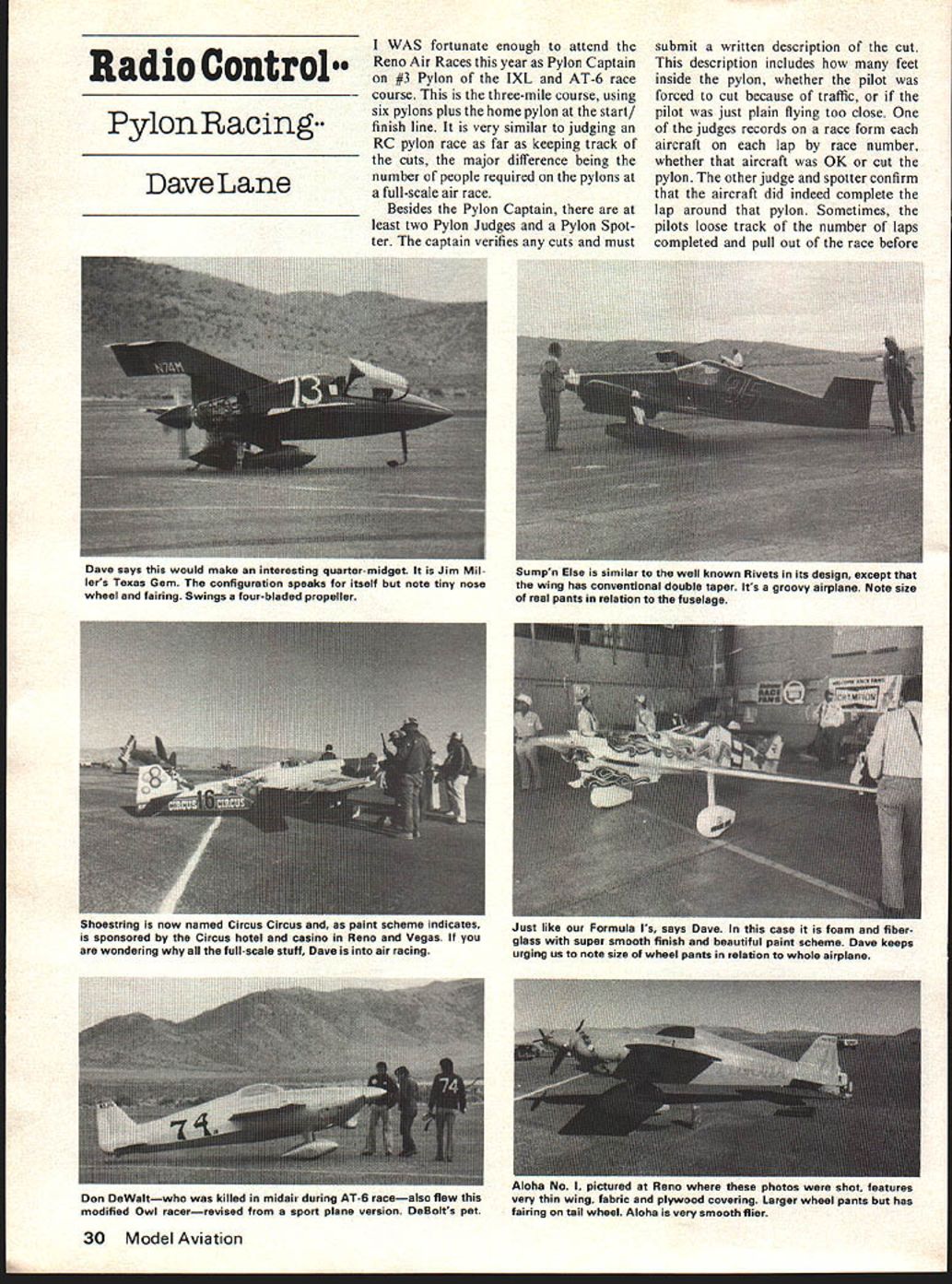
As you know, Paul White, our ex RC pylon competitor, rebuilt #16 Shoestring this past year. Circus Circus sponsored the ship and #16 looked outstanding in her new white, orange, and purple K&B colors. Paul used K&B 3/4-oz cloth, primer, and Super Poxy paint—just like we use on the models.
Ray Cote qualified Shoestring—now called Circus Circus—at 239.468 mph. This time was not a new record, but Ray was flying a very smooth but wide course. Ray commented to Paul that, since the rebuild and rerigging of #16, she flies hands-off in the straightaway.
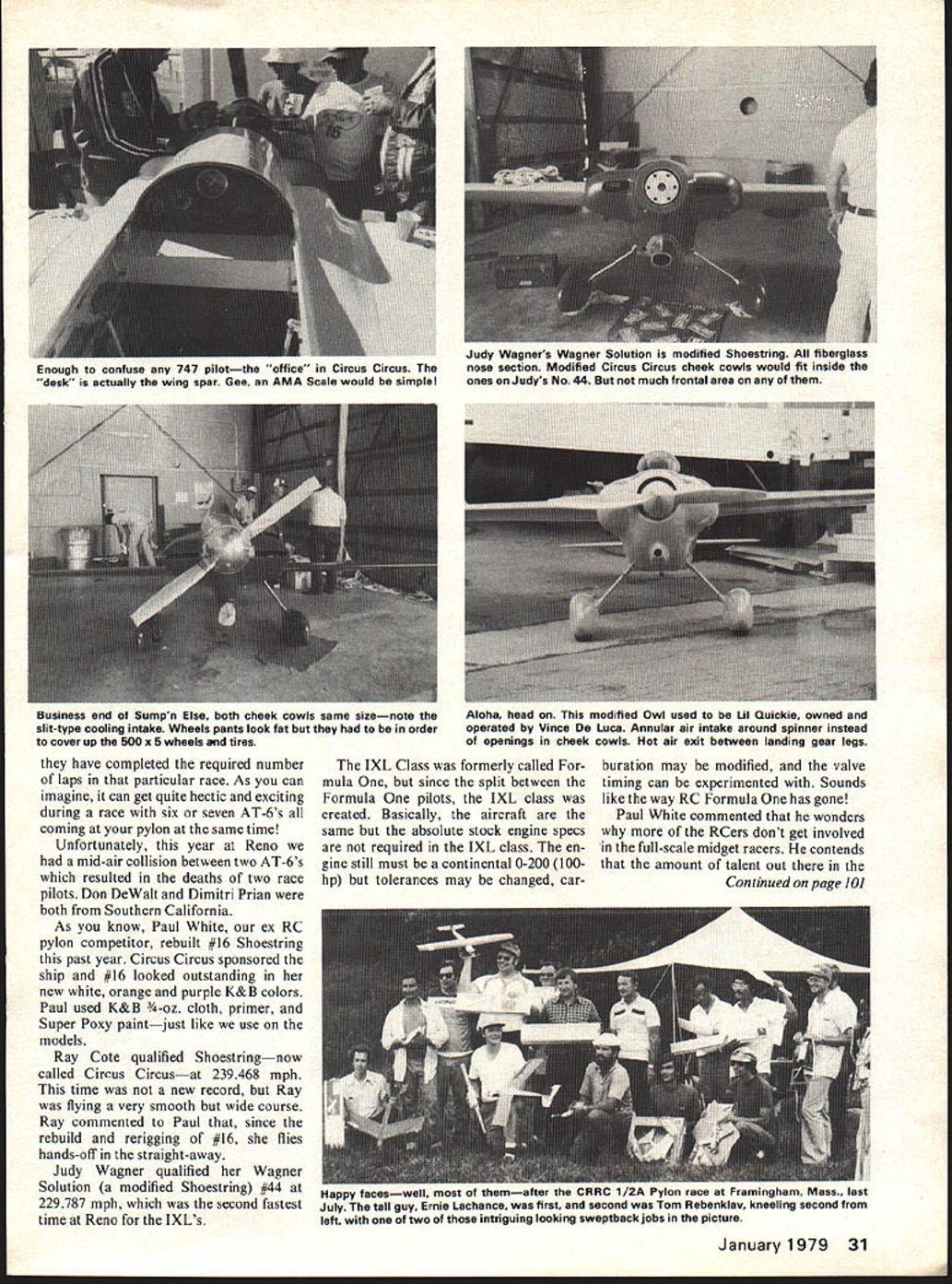
Judy Wagner qualified her Wagner Solution (a modified Shoestring) #44 at 229.787 mph, which was the second-fastest time at Reno for the IXLs.
The IXL class was formerly called Formula One, but since the split between the Formula One pilots, the IXL class was created. Basically, the aircraft are the same but the absolute stock engine specs are not required in the IXL class. The engine still must be a Continental O-200 (100 hp) but tolerances may be changed, carburation may be modified, and the valve timing can be experimented with. Sounds a lot like the way RC Formula One has gone!
Paul White commented that he wonders why more RCers don't get involved in the full-scale midget racers. He contends that the amount of talent out there in the RC world could be a boon to the IXL or Formula One class of air racing. Paul isn't advocating the desertion of RC, only the addition of involvement in full-scale racing. It might be something to think about the next time you are scratching your head about what your next project should be. Bob Johans (another RC pylon racer) was part of the pit crew on Circus Circus this year with Paul.
If you would like to get involved with full-scale air racing, look around your area for a race pilot and offer your services. Most pilots are always looking for additional pit crew help. You will be surprised at how involvement with full-scale air racing will change your perspective on RC racing. It also gives you first-hand knowledge of the aircraft.
I think if more modelers did become involved with full-scale air races, we could get more public recognition of our RC pylon racing—possibly being able to put on races during the qualifying days, and as part of the air show routine during the actual races. It could be something to consider for the future to get more people interested in RC pylon.
Unlimited class and other notes
The Red Baron Racing Team from Idaho Falls, Idaho showed the unlimited gang the way around the pylons again this year. The Griffon-powered RB-51 was flown this year by Steve Hinton, from Claremont, California. Steve qualified at 427.153 mph and never looked back during the rest of the races. He flew a very smooth course and never really had to push the Red Baron #5 at any time.
We hope to make Reno again next year and we pray for a safe week of racing.
Look over the pictures this month and note the wheel pants and spinner size in relation to the overall airframe on the IXLs, then look at your RC speedster and see if the relationship is the same.
That's all for this month. Go fast and turn left.
Dave Lane 4477 W. 136th St. Hawthorne, CA 90250
Transcribed from original scans by AI. Minor OCR errors may remain.

