
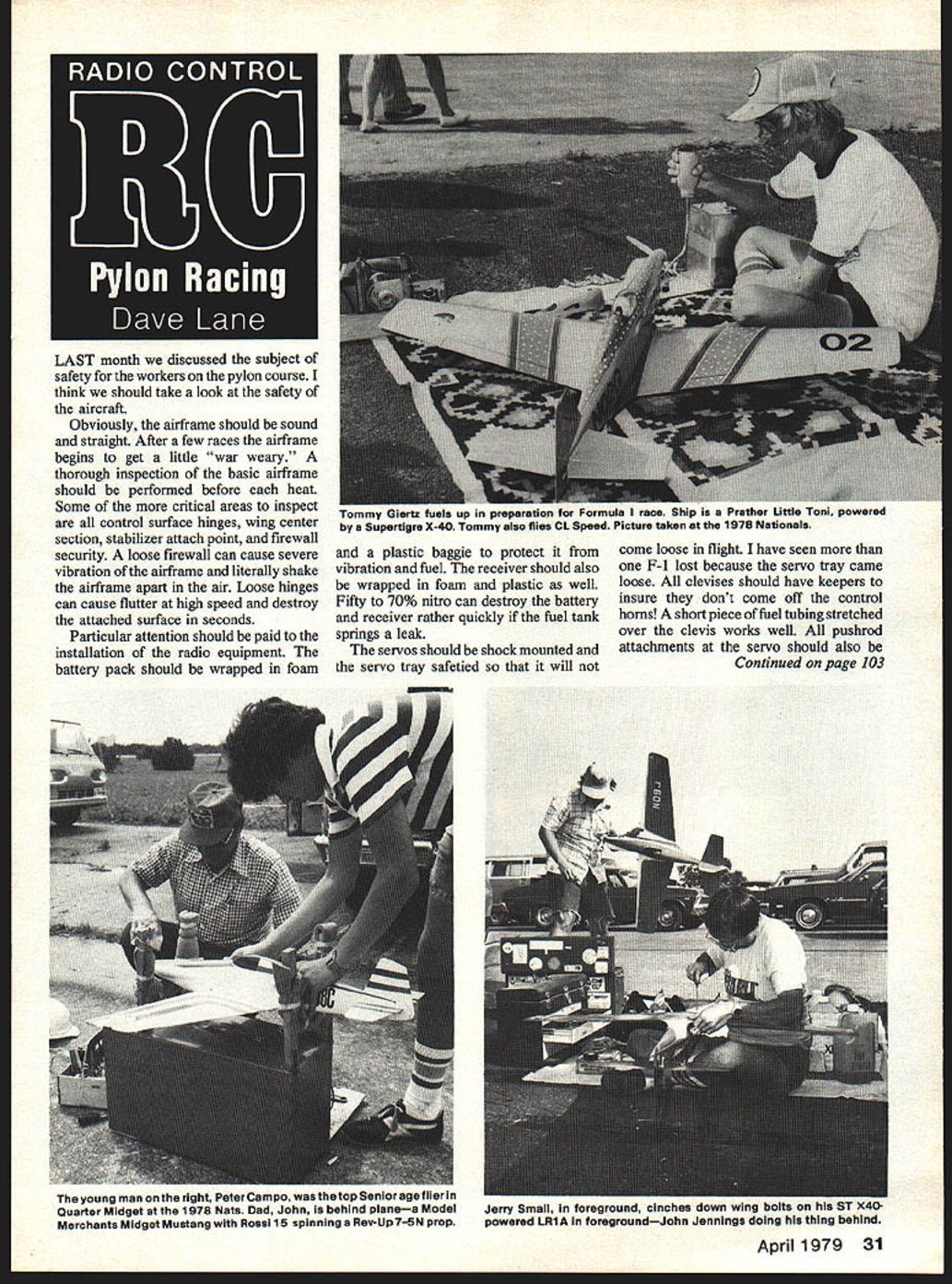
Radio Control: Pylon Racing
Dave Lane
LAST month we discussed the subject of safety for the workers on the pylon course. This month we should take a look at the safety of the aircraft.
Aircraft Airframe and Structure
Obviously, the airframe should be sound and straight. After a few races the airframe begins to get a little “war weary.” A thorough inspection of the basic airframe should be performed before each heat. Some of the more critical areas to inspect are:
- All control-surface hinges
- Wing center section
- Stabilizer attach point
- Firewall security
A loose firewall can cause severe vibration and literally shake the airframe apart in the air. Loose hinges can cause flutter at high speed and destroy the attached surface in seconds.
Radio Equipment
Particular attention should be paid to the installation of the radio equipment:
- The battery pack should be wrapped in foam and a plastic baggie to protect it from vibration and fuel.
- The receiver should also be wrapped in foam and plastic.
- Fifty to 70% nitro can destroy the battery and receiver very quickly if the fuel tank springs a leak.
Servos and Control Linkages
- Servos should be shock-mounted and the servo tray secured so it will not come loose in flight. I have seen more than one F-1 lost because the servo tray came loose.
- All clevises should have keepers to ensure they don't come off the control horns. A short piece of fuel tubing stretched over the clevis works well.
- All pushrod attachments at the servo should also be keepered.
Pushrods
Balsa pushrods are not recommended for racing aircraft. Use:
- 1/4-inch dowel or fiberglass arrow shafts as the safest options (I personally prefer 1/4-inch dowels).
- Note: arrow shafts eventually fatigue from constant vibration.
Landing Gear
Landing gear must be solidly attached. Wheels should be true and free-wheeling. Many a racer has been dumped on takeoff or has veered left or right and scattered people and/or destroyed equipment because a wheel or landing gear failed.
Propeller, Spinner and Starter Safety
Always check prop balance and crankshaft tightness before flight. Be sure the spinner is secure. Don’t use an electric starter against a loose spinner; if the spinner comes off the prop can fly in unpredictable directions and may injure the fellow beside you.
Preflight Checklist (recommended)
- Inspect firewalls, hinges, wing center, stabilizer attach points
- Secure battery and receiver with foam and plastic
- Shock-mount servos and secure servo tray
- Keepers on clevises and servo attachments
- Use solid pushrods (preferably 1/4-inch dowel or fiberglass shafts)
- Check landing gear attachment and wheel condition
- Balance prop and tighten crankshaft; secure spinner
Basically, have a safe plane and you will probably have a safe race. A safe plane eliminates problems that would otherwise keep you from concentrating on flying and winning the course.
Flight Technique (Pylon Height)
When racing, keep the airplane at least pylon height around the course. Fly below the tops of the pylons; don’t leave a margin of error. It might be a good idea for a pilot to have worked the pylons at least once to see what it is like. A racer comes 15 to 20 feet above the ground at 150 mph-plus — guaranteed to make you want to dig a hole and crawl in a hurry. Race pilots ought to give workers a fair shake: fly a couple feet above the pylons at least to cut; don’t strain the racer through the pylon.
NMPRA and 1979 Outlook
At the time of writing, NMPRA results look like Bill Hager will be the new president for 1979. I hope everyone in NMPRA will give Bill support and make 1979 a banner year. Racing can survive only if participants collectively voice their wants and needs. I hope F-1 and QM groups can work together in 1979 to benefit everyone concerned. Someone once said, “United we stand, divided we fall.”
Go fast. Turn left.
AMA Class and Scale Competition — Questions and Answers
Because of the type of scoring in the AMA class, entrants would have received full credit for their detail and superb craftsmanship.
Questions raised:
- Should there be added requirements to ensure only high-quality aircraft enter this class of competition?
- Should we follow pattern-type rules for mandatory advancement from Sport Scale after three first-place wins and force good aircraft and fliers into this class?
- Should there be better-quality trophies and higher-value prizes for the AMA class to draw more entries?
- Should aircraft be mandatory in the AMA class when exterior and cockpit detail are added?
Answer:
- Read your AMA rule book on the requirements for entering the AMA class. If your aircraft meets these necessary requirements, then change your presentation book, make a scale ruler and enter your aircraft in the AMA class. You might find you’ll come out a winner!
Bob and Dolly Wischer Rt. 1, S-221 Lapham Peak Road Delafield, WI 53018
Transcribed from original scans by AI. Minor OCR errors may remain.

